
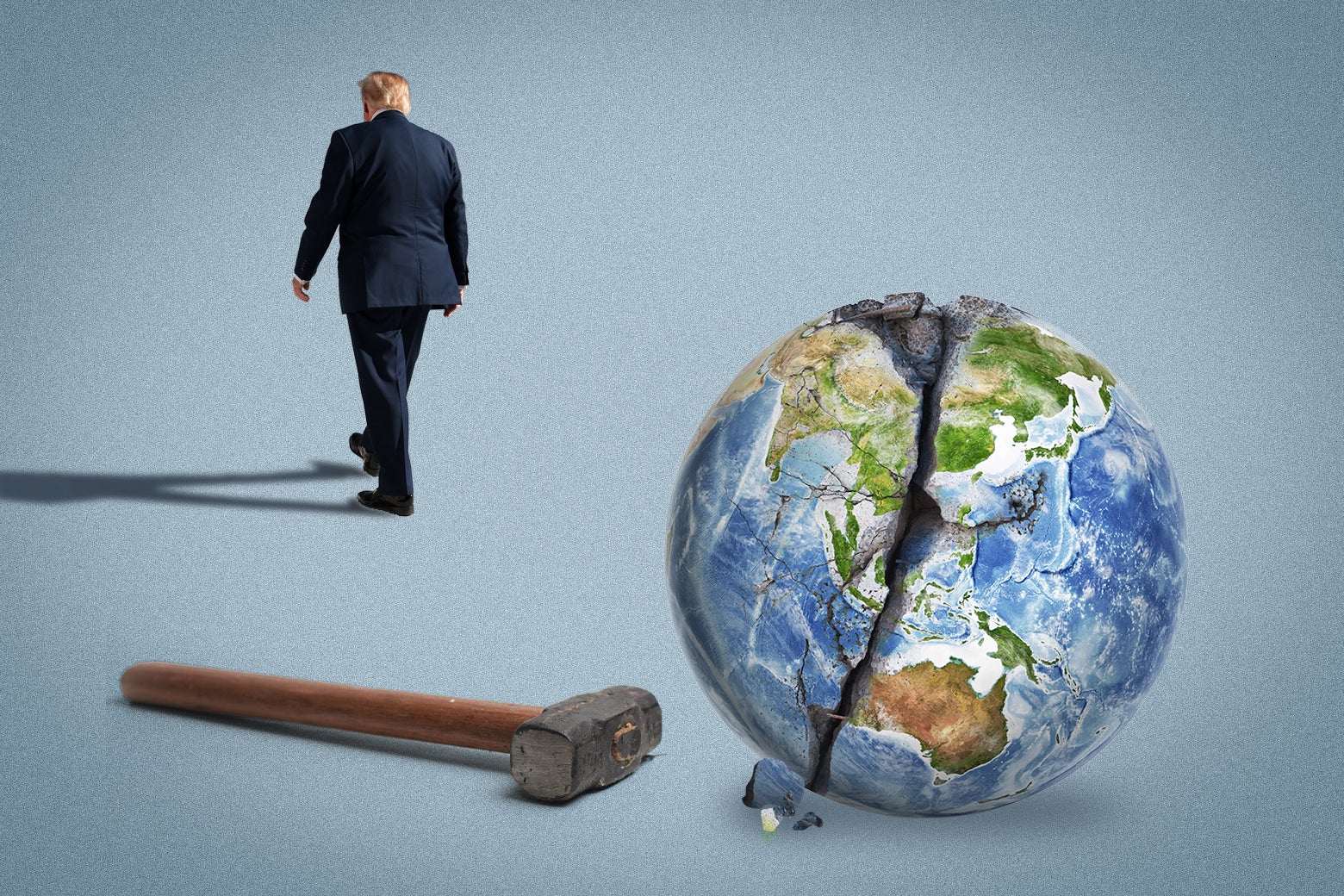
Politics Will Our Friends Still Want to Be Friends? After Donald Trump’s first term, America’s alliances snapped back in place. This time, I’m not confident we’ll be so lucky. Photo illustration by Slate. Photos by Anna Moneymaker/Getty Images and Getty Images Plus. Sign up for the Slatest to get the most insightful analysis, criticism, and advice out there, delivered to your inbox daily. America’s friends are freaking out. “Trump’s lukewarm support for NATO has led some European allies to question if the US would come to their aid if Russia were to attack them,” the Guardian reports. “In Europe, Asia, and the Middle East, governments are assessing shifting US priorities and in some cases seeking alternative sources of leadership and partnership in the belief that America has stepped back,” CNN assesses. “Why is Trump criticizing key allies to U.S. security?” a PBS News Hour segment wonders, incredulity implied. “Canadians have had enough,” the New York Times concludes after Trump berated the country’s prime minister on social media and pledged to hit it with yet more tariffs. The onslaught has veteran diplomats, foreign-policy gurus, and members of both parties bemoaning that Donald Trump is irreversibly squandering America’s long-standing partnerships and emboldening its foes. As one veteran of the George W. Bush and Obama administrations put it, “This is how the liberal international order dies.” Except all those stories are from Trump’s first term. And what happened after? Trump lost the 2020 election, and U.S. alliances rebounded. Under the Biden administration, Western nations rallied to Ukraine’s defense, and NATO expanded. South Korea and Japan shelved decades of historical enmity to present China with a united front. The U.S., U.K., and Australia signed a maritime security pact known as AUKUS. The so-called Quad alliance of Australia, India, the U.S., and Japan knitted closer together. Trump is now back in the White House, his presence once again conjuring nearly identical fears of imminent alliance collapse. “The American Age Is Over,” an Atlantic headline put it last month, and not without some justification. The story appeared as Canadian Prime Minister Mark Carney was traveling to Strasbourg, France, to explain why he wants to make Canada an “associate member” of the European Union, a clear effort to seek new partnerships as the U.S. goes rogue. “We are pursuing resilience so that no one can control our open markets, impair our sovereignty, threaten our territorial integrity, or undermine our freedoms, our democracies, our rule of law,” Carney said—not-so-subtle references to Trump’s efforts to swamp Canada with tariffs and bully it into becoming the 51st U.S. state. Other global leaders have similarly looked to forge more reliable friendships elsewhere, and the reason for their concerns was on display at the United Nations General Assembly in New York last month. “To the victor belong the spoils,” Trump told the delegates regarding the U.S. intervention in Venezuela that ousted the South American nation’s leader this year and effectively seized much of its oil reserves, a stark summation of America’s rapacious new global identity. So is this time any different? Will Trump’s bellicose and chaotic second term turn the U.S. into a global pariah, rearranging global alliances in a lasting way? Or will the inevitable end of his presidency (only 835 days to go!) once again uncork a surge of goodwill among American friends? Some think the experience of Trump’s first term makes the pessimistic case for the future of American alliances look shortsighted. And amid the doomsaying, streaks of contrarian optimism are starting to emerge. The most well-thought-out example is a Foreign Affairs essay published in August by Kurt M. Campbell and Rush Doshi, who served on the National Security Council during the Biden administration. The way Campbell and Doshi see things, America’s alliances have already survived far worse than Trump. Since World War II, the challenges have included diplomatic crises, financial crises, energy shocks, and the catastrophes of Vietnam, Afghanistan, and Iraq. “The lesson of history is that alliance systems often prove more resilient in retrospect than contemporary observers expect at the time,” they write. “Crises repeatedly generate predictions of collapse, but alliances adapt precisely because the underlying incentives remain compelling.” What are those incentives? One of them is aligned interests. We often shorthand alliances as friendships, but they’re usually built less on comity and more on mutual necessity. And as Campell and Doshi argue, the interests of America and its long-standing allies are more conjoined today than they have been in decades. Russian aggression and Chinese aspirations for economic dominance have ripped off the mask, presenting a shared challenge that only unity can meet. The other factor, Campell and Doshi say, is interdependence in the form of growing economic, technological, and military ties to counterbalance China’s industrial might. Rays of hope are always welcome in this dark era, but there are at least three reasons to think the authors’ case—and the optimistic read on the future of American alliances writ large—has some holes. Many of Trump’s changes to American politics seem likely to outlast him. Campbell and Doshi may be right that some of the ways Trump is subverting American alliances “owe more to presidential personality than to durable new politics.” But this president has repeatedly transmuted other quirks of his personality (his refusal to concede the 2020 election, his obsession with building a ballroom at the White House, and more) into Republican Party orthodoxy. It’s true that many GOP members of Congress remain supportive of NATO, critical of Russia, and leery of China. But most of the voters who elect those lawmakers are thoroughly Trumpified. The president has also purged Republican officials who object to his “America First” approach and co-opted some of the party’s older foreign-policy hands. As a Bloomberg Businessweek cover story about Secretary of State Marco Rubio recently put it, Rubio “is executing the president’s wishes around the world, even when they contradict his past beliefs.” As a senator, Rubio successfully helped pass a bill that prevents American presidents from unilaterally pulling out of NATO. But after accusing several allies of impeding the war in Iran by blocking access to military bases on their soil last month, Rubio seemed to question why NATO exists at all. “If we can’t use our base when we have a contingency, what’s the point of having the base and, frankly, the point of the alliance?” he said on Fox News. For U.S. allies watching from the outside, one Trump term may have been an aberration, but two looks like a trend. Yes, Trump is unpopular with Americans right now. But he was almost as disliked at the end of his first term before going on to win a second, and there’s little reason to think he’ll voluntarily cede his kingmaker status within the GOP even after leaving office. Given those conditions, it seems more likely than not that the next Republican presidential nominee will take after Trump’s pro-tariff, anti-NATO policies more than he or she will resemble the pro-alliance, anti-Russia GOP of yore. And because our politics tends to oscillate between the two dominant parties, the rest of the globe should expect someone of Trump’s worldview to hold power roughly half the time, at least for the foreseeable future. That’s some shaky ground on which to repair bruised friendships. Trump’s presidencies have also changed Democrats. His return undermined Joe Biden’s efforts to rehabilitate and stabilize U.S. alliances. (“America is back,” Biden frequently told world leaders, to which some of them—at least in his telling—presciently responded “But for how long?”) The damage Trump has done to American institutions, meanwhile, has some of the ambitious Democrats who hope to succeed him in the White House thinking closer to home—about economic investment, Supreme Court reform, and other domestic policies rather than about America’s place in the world. Many progressives are skeptical of flexing American military power abroad and have sometimes cast U.S. efforts to confront Russia and China as jingoistic spasms or sops to the defense industry. That’s a recipe for continuing to let alliances stagnate regardless of which party wins in 2028. America’s allies don’t wholly despise Trump’s new order. A second reason to doubt Campbell and Doshi’s case is that some of America’s allies are already benefiting from the president’s shake-up of the status quo. Nondemocracies, like Saudi Arabia and Qatar, have turned the president’s more transactional approach to geopolitics—not to mention his and his family’s susceptibility to corruption—to their advantage. Inside other allied countries, rising political factions share Trump’s right-wing, xenophobic, and isolationist orientation. His first election helped uncork a boomlet of right-wing populism, and his second has boosted it further. Last month, the far-right Alliance for Germany party won a closely watched state election in a landslide. Reform UK, led by Trump ally Nigel Farage, has topped surveys of the next national election for much of the past year. Marine Le Pen, an EU skeptic who leads France’s far-right National Rally party, is ahead in polls of next year’s presidential race. Flávio Bolsonaro, a right-wing Trump ally and the son of a jailed former president who attempted a coup in the mold of Jan. 6 back in 2023, topped the first round of Brazil’s presidential election this week and is favored to win the runoff later this month. That means Trump doesn’t have to turn the U.S. into a pariah for its historical alliances to lose ground to Russia and China; he could instead transform those alliances into something closer to the countries they purport to oppose. Campbell and Doshi aren’t Pollyannas. They appreciate that some of Trump’s second-term spasms, like threatening to annex Greenland by force, have been more extreme than anything he did in his first. Still, they may be underrating just how badly another Trump presidency—especially one defined by tariffs and a war that are raising prices worldwide—is poisoning America’s international reputation. Campbell and Doshi take comfort in the fact that many European citizens tell pollsters that they expect their countries’ relations with the U.S. to improve once Trump leaves office. But the authors don’t reckon with polls showing that people in dozens of countries now view China more positively than they view the U.S., a sharp reversal even from Trump’s first term. According to a Pew Research Center survey this year, nations that now feel warmer about China include Australia, Canada, France, Germany, Greece, Italy, the Netherlands, Pakistan, Spain, and Sweden—all of which are nominally U.S. allies. Growing pessimism with the U.S. may also be helping collapse the underpinnings of American dominance to a degree that Trump’s first term never did. As the New York Times reported last month, even friendly countries are reducing their holdings of U.S. Treasury bonds amid soaring yields. The dollar’s share of currency reserves held by foreign governments, already on the decline, dropped further after Trump retook office. And the president’s efforts to fire Federal Reserve officials, jawbone companies, and turn the law against his political opponents have made some question whether the U.S. is still a safe investment. Those jitters are undermining the dollar’s 82-year run as the world’s reserve currency, threatening a sea change that would be hard for even the most internationalist of Trump successors to reverse. Logic and rationality don’t always prevail. In Campbell and Doshi’s telling, alliances are like gravity: Other Western leaders may complain about Trump now, but they’ll ultimately get over it because doing so is in their countries’ best interest. Once Trump passes from the scene, the need to put the past aside and confront a militarily strong, technologically advanced, and territorially ambitious China will become “increasingly clear to policymakers in allied capitals, just as it should become clear to post-Trump American leaders,” Campbell and Doshi write. But just because what’s in one’s own self-interest should become clear doesn’t mean it will—or that policymakers in the U.S. and elsewhere will heed it. After all, if the benefits of strong alliances were self-evident to American voters or to Trump, we wouldn’t be in this position in the first place. Rather than clarity, the legacy of Trump’s second term could instead be a sort of global muddle. In that scenario, Canada, Europe, and parts of Asia would meaningfully distance themselves from the U.S. while also seeking workable relationships with China or Russia. In fact, some of America’s long-standing allies have already started straddling. Earlier this year, Carney traveled to Beijing to inaugurate a “new strategic partnership” that saw Canada cut tariffs on Chinese electric cars in exchange for lower tariffs on Canadian agricultural goods. If allied countries can’t rely on the U.S. to serve as a predictable counterweight to China, detente with Beijing might be preferable to confrontation—even as they surely understand that it poses more of a threat to free markets and democracy than even Trump does. Trump still has two years left in office, which means things could get worse for America’s transatlantic allies before they get better. Last month, he called Carney’s pivot to Europe a potential “hostile act” that could invite “very heavy tariffs on Europe.” It’s true that some transatlantic leaders share Campbell and Doshi’s sunny outlook. Finnish President Alexander Stubb, whose country joined NATO during the Biden administration, “is betting that the alliance will adapt and survive” in the years to come, the Washington Post reported this week. But that kind of optimism can quickly start to sound more like whistling past the graveyard. Stubb, whose friendship with Trump grew out of a shared affinity for golf, is banking in part on his “good relationship” with Jared Kushner to help negotiate an end to Russia’s war in Ukraine. But as the Times reported last week, Kushner’s involvement may not be totally above board. U.S. talks with Russia now include a multibillion-dollar oil deal that could enrich Middle Eastern fat cats who have previously invested in Trump family projects, including the president’s cryptocurrency company. And despite his upbeat perspective, even Stubb acknowledges that Europe needs to forge new partnerships in “a world of disorder.” The ship of state is seeking safety in a storm. That kind of hedging is the danger of making friends mad. It’s also the hidden lesson of the history Campbell and Doshi relate in their essay. They’re correct that America’s alliances have weathered struggles before. But that’s because the bonds of friendship are hard enough to maintain when the president representing us on the world stage is rational. When he isn’t, all bets are off. Canada China Donald Trump Europe International
American Alliances Can Outlast Trump. But They Might Not Survive What Comes After Him.
Full Article
Original Source
Read the full article at Slate →KhanList aggregates and links to publicly available news content. We do not host full articles from third-party sources. Always verify important information with original sources.