
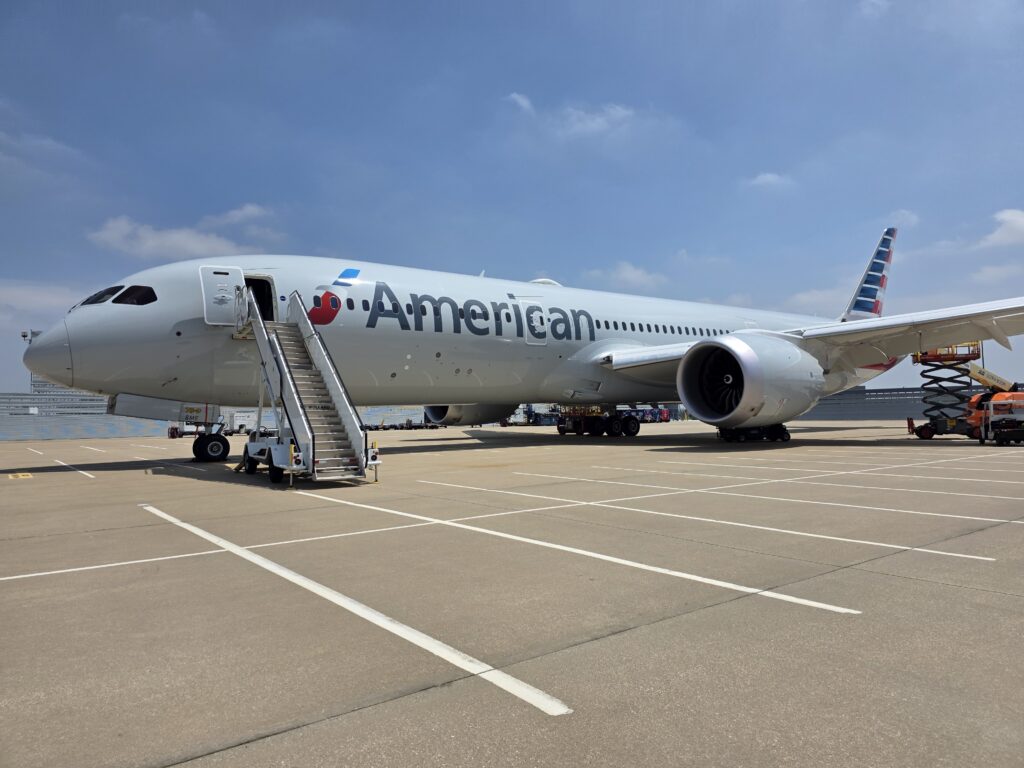
American Airlines is in the “seventh or eighth inning” of a widebody campaign that may be larger than previously understood. The airline is seeking up to 65 planes for delivery in the 2030s as it plans to replace 47 Boeing 777-200ERs. For an airline that retired about 40% of its long-haul-capable fleet during the pandemic, then spent years without enough aircraft to take advantage of the international recovery (or to build back service simultaneously in Dallas and Charlotte as well as Chicago), this matters far more than new route announcements today. However, “Up to 65” is not the same thing as 65 firm orders. We don’t know yet how many will be firm orders versus options. And planes arriving in the 2030s doesn’t help for quite some time. As American put off an order that it clearly needed, CEO Robert Isom said in 2023 that they’re such an important customer that an order book backlog at Boeing or Airbus wouldn’t matter. It clearly does. Airbus Is A Real Part Of The Competition American has an all-Boeing widebody fleet today: 47 Boeing 777-200ERs, 20 777-300ERs, 37 787-8s and 33 787-9s. That gives Boeing a meaningful advantage in training, maintenance, spare parts and scheduling. The mantra at the airline for several years was ‘simplification’ and it reduced the type and number of subfleets of aircraft. That comes at a cost – simpler fleets may mean less pilot training and fewer spare parts, but different aircraft are more appropriate to the economics of different missions. American retired all of its Airbus A330s during the pandemic, but those might also be easier to gain delivery slots for than more 787s. Chief Commercial Officer Nat Pieper says the competition “could go either way” between Boeing and Airbus. He acknowledges Boeing gets points for fleet commonality, but says Airbus can make those points up elsewhere economically (selling planes cheap). There is “no stigma” inside American about returning to Airbus widebodies. Airbus could just be a stalking horse in negotiations with Boeing, but Pieper also has a real history of ordering Airbus. He was Delta’s vice president of fleet strategy and transactions when Delta chose 25 Airbus A350-900s and 25 A330-900neos in 2014, and he fronted that decision. American’s bio for him says he orchestrated nine multibillion-dollar aircraft campaigns at Delta (during a period when Delta didn’t order Boeing). The irony is that American already had an order for 22 Airbus A350s inherited from US Airways. In 2018 it cancelled those planes and ordered 47 more Boeing 787s, arguing that fleet simplification made the A350 uneconomic. American had an A350 simulator which they later sold off. Now they’re presumably considering: Boeing 787-9 or 787-10: the lowest-risk choice. American already operates both 787-8s and 787-9s, has 19 more 787-9s on order and holds 28 options. The 787-10 would add seats and excellent economics on routes within its range, but Robert Isom has previously said the larger plane isn’t a good fit for their network. Airbus A350-900: the clearest Airbus alternative for replacing the 777-200ER. It brings long range and modern economics, but also the cost of adding another fleet type. Airbus A330-900: another possible part of an Airbus proposal, especially for missions that do not require A350 range. It’s likely available sooner, and they previously operated the -200 and -300 variant. Boeing 777X: better suited to an eventual 777-300ER replacement than as a one-for-one answer to the smaller 777-200ER. Pieper also volunteered that he is wary of large aircraft and prefers to let other airlines work through the early problems of a new type. Pieper referred to choosing the right “airplane or airplanes.” A split order is possible. American Retired Too Many Planes—And Then Missed The Market At the start of the pandemic, American permanently retired 24 Airbus A330s, 17 Boeing 767s and 34 Boeing 757s. That meant 75 long haul capable aircraft. Some of those planes were old and expensive. The 767s may have been nearing the end of their useful life, but they were also cheap lift that allows experimenting with routes. They made so many permanent decisions at once, before anyone knew what the recovery would look like. They should have deferred that choice, especially for their 15 relatively young Airbus A330-200s. United made the better uncertainty decision. It parked planes but resisted retiring entire fleets until it had more visibility. That preserved the ability to respond when demand returned. American optimized for one forecast and gave away its options. American then compounded the problem by deferring 10 Boeing 787-9s that had been scheduled for 2024 and 2025 into 2028 and beyond. It blamed Boeing for having too few widebodies, but American chose permanent retirements and later deliveries. The Airbus A321XLR is useful for thin routes, but it is not a widebody and it doesn’t have the originally hoped-for range. American even reduced its XLR commitment from 50 aircraft to 40, as I was first to reveal last December. It’s Unclear How Much Growth A New Order Would Provide It is tempting to subtract 47 retiring 777-200ERs from 65 new aircraft and declare 18 airplanes of net international growth – if those are all firm orders. However, American is also refurbishing its Boeing 777-200s with new interiors. So it’s possible that, though a new order might be framed as replacement aircraft, it could provide greater growth. Topics on this page
American Airlines Says Order Will Be For Up To 65 Widebody Jets—And After Retiring Too Many Planes, Airbus Is Back In The Running
Full Article
Original Source
Read the full article at Viewfromthewing →KhanList aggregates and links to publicly available news content. We do not host full articles from third-party sources. Always verify important information with original sources.