
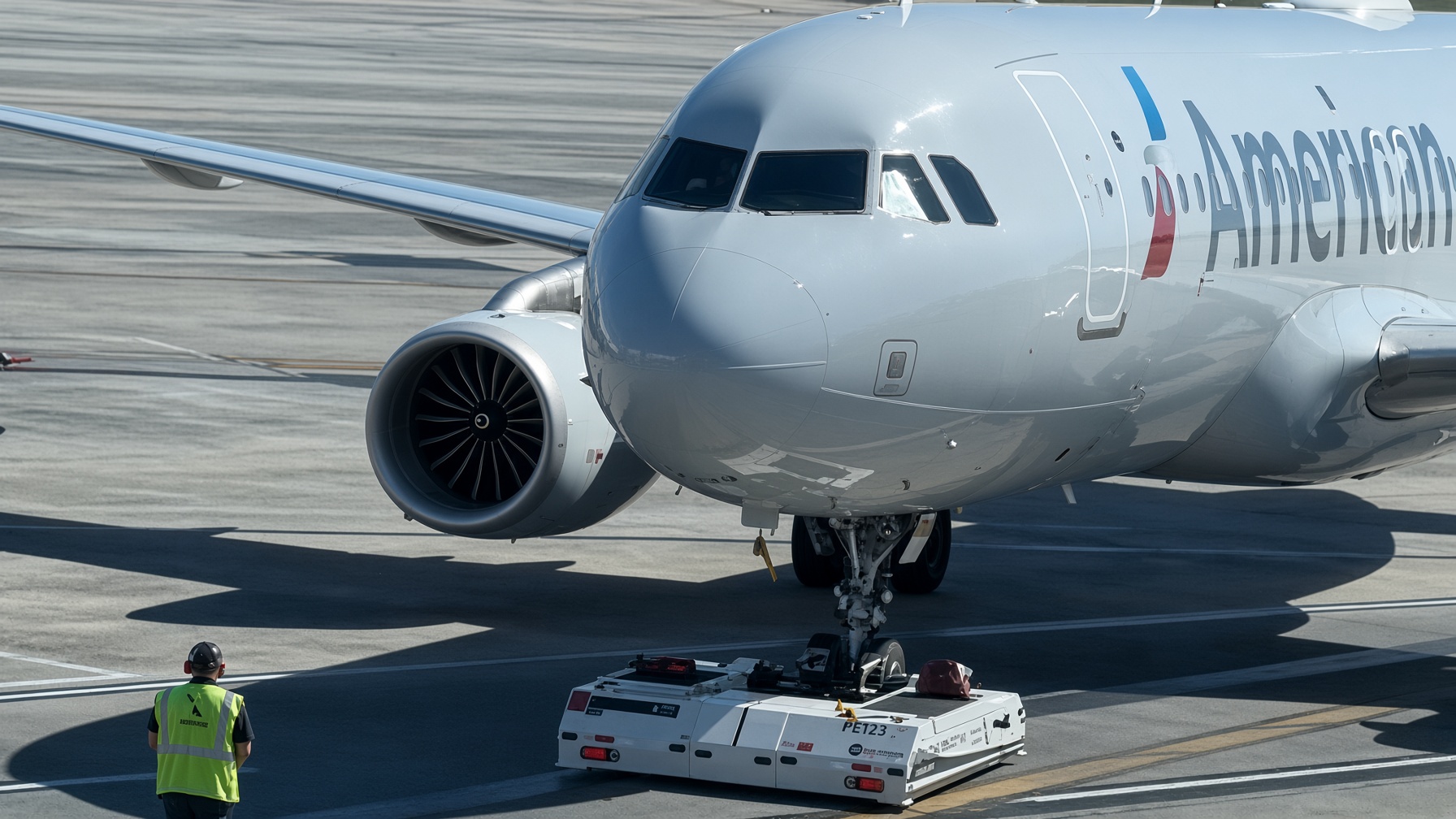
This video shows an American Airlines plane being moved around Charlotte by some sort of oversized Roomba, while a ramp worker walks alongside holding a remote control. The machine underneath the nose gear is the work you’d normally associate with a tug. And it helps with one of the more frustrating reasons your flight gets delayed leaving the gate. The equipment is a Mototok Spacer 8600 NG – an electric aircraft tug operated by the employee walking nearby. Commenters think they’re watching artificial intelligence replace a worker, even though the worker is right there controlling it. Normally you have a tractor that connects to the aircraft’s nose gear using a long metal bar (towbar). This machine captures the nose wheels in a hydraulic cradle and lifts them off the ground. The main landing gear stays on the ground. It moves the nose wheels and rolls the rest of the airplane along with them. The operator uses an industrial radio remote and can choose a position with a better view of the aircraft and nearby obstacles. The device has a capacity of 105 metric tons (~231,000 pounds) so it can move an aircraft. It takes up less room. There’s no driver’s cab or long towbar to maneuver around the nose. That’s great at tight gates and when aircraft are being parked close together. The operator can move to see better. Their view isn’t fixed by their location in the driver’s seat. It eliminates the tug’s diesel exhaust. They’re electric, quieter, and aren’t spewing particles at groundworkers. Less coordination for departure An aircraft that’s ready to leave doesn’t have to wait for a tug to arrive from somewhere else another gate. British Airways started using these in 2017. By August 2019, they’d completed 100,000 pushbacks and had 25 units at Heathrow, with equipment ready at each of their short haul stands at Terminal 5. So this isn’t brand new technology. It just hasn’t been used much in the United States. All Nippon Airways introduced it in 2019. By spring 2024, they reported eight units across four airports, including four at Osaka Itami. Mototok now reports more than 3 million pushbacks worldwide, including 1.2 million by 28 units at Heathrow Terminal 5A. It’s deployed in Charlotte, New York, Madrid, Barcelona, Hong Kong, Singapore and Kuala Lumpur. The video also reminded me of the American Airlines tug that got caught underneath a Boeing 737 at LaGuardia. The aircraft was being moved from a hangar to a gate before a Charlotte flight. The driver was taken to the hospital as a precaution, and passengers wound up on another plane. I’d previously covered a JetBlue Airbus A320 overrunning the tug pulling it at LAX. A remote control tug removes the risk to a driver. Reaction to the video includes people who use these and like how maneuverable they are, and a lengthy argument over whether jobs are disappearing. In fact, operating the tug and talking to the cockpit are still jobs (but that can be done by one person) and these don’t eliminate the requirement for wing walkers at some airports. Claims that the operator is “training his replacement” don’t make sense, except in a future world where these are truly autonomous. “Show this to all the moms who said playing video games would get you nowhere” “It’s the airport Roomba….” “What? You never seen someone taking their plane for a walk” Topics on this page
American Airlines Moves A Jet By Remote Control—The “Airport Roomba” That Reduces Gate Delays
Full Article
Original Source
Read the full article at Viewfromthewing →KhanList aggregates and links to publicly available news content. We do not host full articles from third-party sources. Always verify important information with original sources.