
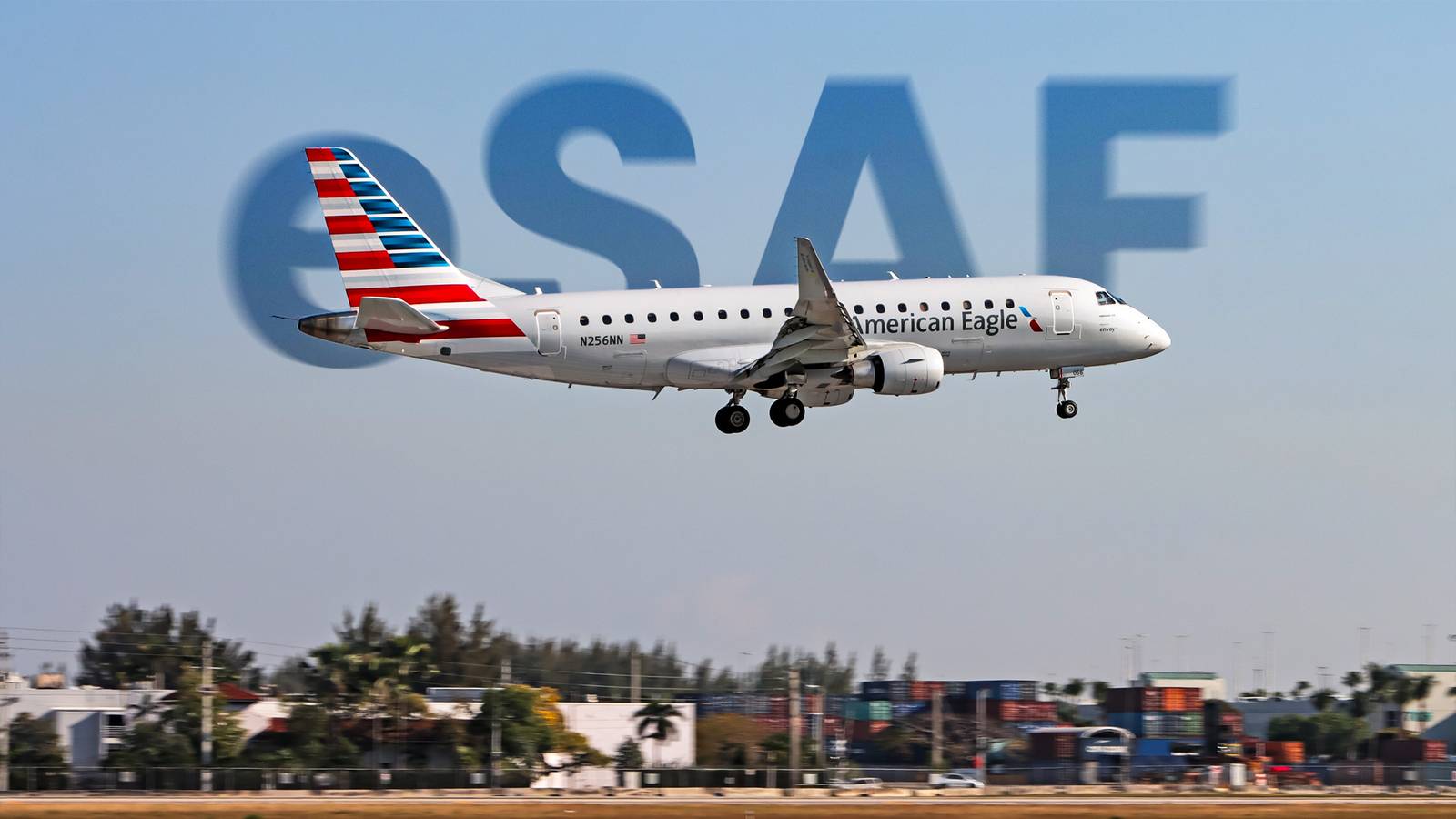
Published Aug 17, 2026, 4:00 PM EDT Prachi is a London-based journalist with extensive experience in the aviation industry. She has worked for several leading industry publications, covering a broad range of topics. Her expertise lies in aircraft maintenance, emerging technologies, and advanced air mobility. She is currently pursuing a PhD in Journalism, focusing on data journalism and its potential to transform conventional aviation reporting. Back in 2021, the International Air Transport Association (IATA) adopted a resolution calling on the global air transport industry to achieve net-zero carbon emissions by 2050. Airlines, airports and aircraft manufacturers have since been working on different ways to reduce aviation’s emissions. Sustainable Aviation Fuel (SAF) has emerged as one of the most important parts of that plan. IATA estimates that it could provide up to 65% of the emissions reductions needed for aviation to reach net-zero by 2050. American Airlines is among the carriers working towards that goal. The airline aims to replace 10% of its jet fuel consumption with SAF by 2030. It has pursued partnerships with fuel producers and invested in newer, more fuel-efficient aircraft. On August 6, the oneworld alliance member took another step in that direction. It operated a commercial passenger flight from Corpus Christi International Airport (CRP) to Dallas/Fort Worth International Airport (DFW) using a fuel blend that included Infinium’s electro-sustainable aviation fuel (eSAF). Infinium is a California-based low-carbon synthetic fuels company founded in 2020. It produces synthetic fuels, or eFuels, using renewable power and waste carbon dioxide (CO2) instead of traditional fossil-based feedstocks. American’s Embraer E175 Used Infinium’s Waste CO2 Fuel Credit: Shutterstock The recent American flight was operated under its regional brand, American Eagle, using an Embraer E175 regional jet. It also marked Infinium's first delivery of eSAF to a US commercial airport for use on a passenger flight. The fuel was produced and blended at Infinium's Project Pathfinder facility in Corpus Christi, Texas, which the company describes as the world's first commercial-scale power-to-liquids (PtL) facility. The plant has been operating since 2023. For the flight, Infinium blended its eSAF with conventional jet fuel at Pathfinder and then tested it against the American Society for Testing and Materials (ASTM) aviation fuel standard for Jet A. ASTM standards set the specifications that aviation fuels must meet before they can be used in commercial aircraft. For synthetic aviation fuel, one of these standards is ASTM D7566. It sets out which types of synthetic fuel can be approved for aviation use and how they can be blended with conventional jet fuel. Under the D7566 framework, approved synthetic fuel components can account for up to 50% of a final fuel blend, depending on the specific production pathway. Once the synthetic component has been blended with conventional jet fuel and the resulting fuel meets the applicable Jet A specification, it can be treated as conventional Jet A for use in aircraft. This means it does not require aircraft modifications, specialized fueling equipment, or segregated handling. How eSAF Differs From Today’s Dominant SAF Credit: Shutterstock Most sustainable aviation fuel currently comes from biological feedstocks. The most widely used pathway is Hydroprocessed Esters and Fatty Acids (HEFA), which uses materials such as used cooking oil, animal fats, and other waste oils and fats to produce jet fuel. HEFA has become the dominant SAF pathway, but the amount of available feedstock is limited. They are also already in demand from other industries such as road transport. This creates a problem as airlines are looking to increase their use of SAF. The aviation industry’s demand for fuel far exceeds the amount of waste oils and fats that can be sustainably supplied, meaning HEFA cannot continue expanding indefinitely at the scale the industry needs. Analysts expect that feedstock availability will become an increasingly important constraint as SAF demand grows, particularly beyond 2030. eSAF, on the other hand, takes a different approach because it does not depend on biological feedstocks. Instead, PtL production uses renewable electricity, water, and CO2 to produce a synthetic hydrocarbon fuel. Renewable electricity produces hydrogen through electrolysis; the hydrogen and captured CO2 are then converted into hydrocarbons that can be processed into eSAF. The CO2 can come from industrial sources or other waste streams, meaning the process does not require agricultural land, used cooking oil or animal fats. That difference gives eSAF a potentially much larger feedstock base than HEFA. Additionally, unlike hydrogen-powered aircraft, which would require significant changes to aircraft design and fuel storage because of hydrogen’s low volumetric energy density, eSAF is a liquid hydrocarbon fuel that can be used in existing aircraft when produced and blended to meet the required fuel specifications. The potential is therefore significant: eSAF could provide aviation with a way to increase SAF production without relying on the same waste-based feedstocks that constrain the industry’s current dominant pathway. Scaling eSAF Is So Expensive Credit: Shutterstock Moving from that theoretical potential to large-scale production, however, is a much bigger challenge. This is where the economics of eSAF become difficult. Producing eSAF is currently much more expensive than producing conventional jet fuel or bio-SAF. Some industry estimates put the cost at about 13 times that of conventional jet fuel and around three to four times that of bio-SAF. There are multiple reasons behind that. The biggest is the amount of renewable electricity needed to produce the green hydrogen used in the process. The electrolyzers, fuel synthesis equipment, and other infrastructure required to convert hydrogen and CO2 into a finished fuel also add substantial capital costs. Additionally, the source of the CO2 matters. Projects with access to low-cost renewable electricity and a nearby CO2 source can avoid some of the additional costs of transporting and processing feedstocks. According to Openexo, small-scale production costs are around $5.00 per liter, compared with about $0.80 to $1.00 per liter for fossil jet fuel. At mega-scale facilities, costs could fall by 42% to around $2.90 per liter, with projections suggesting they could reach as low as $2.50 per liter by 2050 as electrolyzer technology improves, and electricity prices stabilize at around $20 per MWh. But even if the technology improves and production costs fall, eSAF producers still need to find enough money to build these facilities in the first place. US eSAF Projects Are Further Ahead Than Europe Credit: Shutterstock In Europe, the gap between eSAF ambition and the projects actually being built is becoming clear. The ReFuelEU Aviation regulation includes a separate target for synthetic aviation fuels, with around 600,000 tonnes of annual eSAF production needed by 2030, according to Strategy&. EASA’s latest assessment, however, shows that no European PtL facility had reached a final investment decision (FID). Project SkyPower, which is a coalition of companies working to accelerate eSAF production in Europe, warned that large-scale projects needed to reach FID by the end of 2025 to have a realistic chance of producing fuel by 2030. Its analysis estimated that between $17.35 billion and $29 billion (€15 billion and €25 billion) of investment would be needed between now and 2030, with around 90% of that going towards the EU market. That deadline has passed, yet Europe still has no large-scale eSAF plant under construction. The US, meanwhile, has moved further ahead on this front. Last year, in May, Infinium’s Project Roadrunner in Reeves County, Texas, reached its final investment decision, and construction is now underway. The facility is expected to begin commercial production in 2027 and is designed to produce around 23,000 tonnes, or 7.6 million gallons, of eSAF and other eFuel products each year. American Airlines has already secured a long-term offtake agreement for eSAF from Roadrunner. In addition, International Airlines Group (IAG), the parent company of British Airways, Aer Lingus, Iberia, LEVEL and Vueling, has signed a 10-year agreement with Infinium for the supply of eSAF for its UK operations. Several Airlines Are Backing The Next Generation Of SAF Credit: Shutterstock Several other companies in North America and Europe are also developing their own approaches to eSAF production. One of them is Twelve, whose AirPlant One facility provides an early commercial demonstration of directly electrified fuel production. The company has attracted participation from airlines and investors, including IAG, Alaska Airlines, Microsoft and United Airlines Ventures. IAG has signed a 14-year agreement for approximately 785,000 tonnes, or around 260 million US gallons, of eSAF. Other than this, Norwegian Air Shuttle and Cargolux have signed long-term offtake agreements with Norwegian producer Norsk e-Fuel covering more than 140,000 tonnes of eSAF. In fact, Norwegian has taken an equity stake in the company. easyJet has also signed a memorandum of understanding with Braathens Renavia, in partnership with Mana Group and World Fuel Services, for future SAF supplies. The agreement includes up to 75,000 tonnes of eSAF as part of a potential 150,000-tonne SAF supply from 2030. There has also been movement from airlines that are already putting synthetic fuel into passenger operations. In June, KLM Cityhopper operated passenger flights using blends containing synthetic kerosene produced by INERATEC, one of Europe’s early commercial-scale PtL producers. These flights, like American’s service from Corpus Christi to Dallas/Fort Worth, show that eSAF is beginning to move beyond production facilities and into normal airline operations. Aviation Is Off Track For Net Zero By 2050 Credit: Shutterstock Overall, the aviation industry accounts for around 10% of emissions from the transportation sector. About five years ago, IATA members committed to achieving net-zero carbon emissions by 2050, and since then, airlines, manufacturers, airports, fuel producers and other parts of the industry have been working on different ways to reduce emissions. That includes more use of SAF, more efficient aircraft and engines, and improvements in flight operations and airport infrastructure. But the industry is not where it needs to be. Speaking at IATA’s 82nd Annual General Meeting in Rio de Janeiro in June, IATA Director General Willie Walsh said the 2050 target was still possible to achieve, but acknowledged that the industry was “clearly off track.” Aircraft delivery delays are one problem, as airlines have been waiting longer for newer, more efficient aircraft. SAF is another major issue; it is considerably more expensive than conventional jet fuel. Producers are struggling to secure feedstocks, financing, and the infrastructure needed to increase production. That makes the economics particularly difficult for newer fuels such as eSAF, which currently cost even more to produce. This puts American Airlines’ latest flight into perspective. The E175 flew using a fuel blend that had already passed the required specifications and could be handled through the airport’s existing fuel system. The technology worked. But the bigger question is whether companies such as Infinium can produce that fuel in large enough quantities and bring the cost down enough for airlines to use it on a much larger scale.
American Airlines Just Flew A Jet On Fuel Made From Waste CO2 & The Economics Are Brutal
Full Article
Original Source
Read the full article at Simpleflying →KhanList aggregates and links to publicly available news content. We do not host full articles from third-party sources. Always verify important information with original sources.