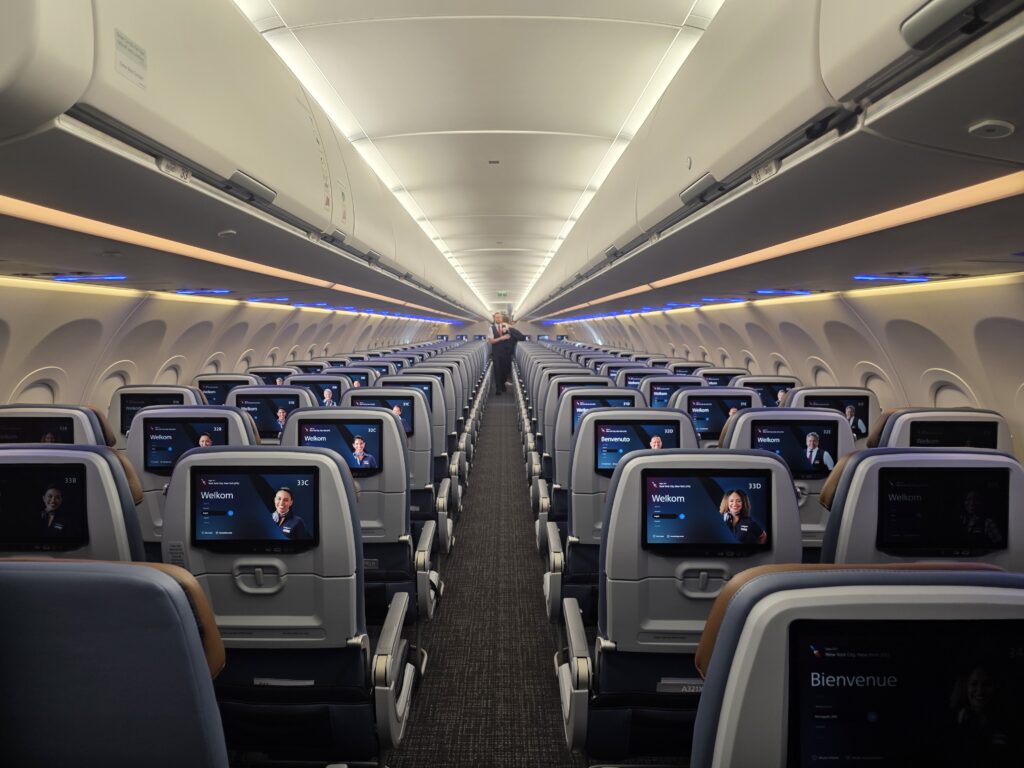
American Airlines is adding seat back tv screens to their domestic fleet. They’re adding more first class seats. And they’re adding more extra legroom coach seats, too. I’ve been telling you that TV screens at seats on domestic planes were coming. According to Chief Customer Officer Heather Garboden, “We’re making one of the most significant investments in the onboard experience in our history. From next-generation seatback entertainment at every seat to substantially more premium seating options, these enhancements will give our customers more ways to relax, stay connected and enjoy their journey. Putting TVs Back At Seats American Airlines will be retrofitting much of its fleet. They’ve announced “More storage, redesigned seats and enhanced lighting will have customers flying in comfort and style.” And they’re putting in TVs “as quickly as possible” though “full fleet installation” isn’t “expected to be complete [until] early next decade.” Seatback screens will go on all new Airbus and Boeing deliveries starting in 2028 They’ll be retrofitting aircraft as well, starting in 2028 And of course their long haul aircraft already have screens The set will offer “stunning picture quality, seamless connectivity and will enable new personalized content for a premium customer experience.” I’d expect personalization to also enable ad targeting for better monetization, which is something that Delta and United are working towards. Screens will be 4K and “among the largest displays offered on narrowbody aircraft in North America” and they’re promising expanded content, personalized recommendations, fast USB-C charging, bluetooth audio, and better flight maps. American isn’t commenting yet on what more storage means, or details of redesigned seats. This is a huge reversal for the airline. In 2017, American began removing TVs from domestic narrowbody aircraft. They said at the time that nearly everyone had their own devices (phones) though of course kids didn’t, not every family had one per child, and watching shows on a phone isn’t the same experience. People also like to multitask! While American called their cabin without screens, but with satellite wifi, the “living room experience” passengers saw the seats as antiquated. New aircraft look old, while five years ago American’s then-Chief Customer Officer derided United’s commitment to add seatback screens as ‘prettying up old planes’. It turns out that works. When American made the decision to eliminate seat back entertainment from their planes a decade ago, those systems were much more expensive. They had to be wired at every seat. Now content can be streamed wirelessly inside the cabin, and costs have dropped by at least two-thirds. Delta, United, and JetBlue are all committed to screens. American looked like an outlier, alongside Southwest. In 2019 there was a move at American to bring back screens because even then the decision to remove them was seen as a mistake. That got squashed. The airline hadn’t fully realized it had a revenue problem more than a cost problem yet. This decision brings them full circle, returning to the kind of customer experience that passengers get excited about, and giving something not just to the front of the plane. Most of their customers fly coach and will get not just screens but also about half their fleet will get Starlink wifi as well. Not every plane will get screens, and this will take quite some time. An airline spokesperson tells me, We have 100 A319s and the A320 fleet along with additional narrowbody aircraft that will be retired in the coming years that will not be retrofitted with screens. We expect new aircraft to deliver starting in the second half of 2028 while retrofit installation will begin in late 2028. I assume that ‘additional narrowbody aircraft’ includes, for instance, their ‘block one’ 737s that were delivered around the start of the millenium. It’s two years before we’ll see the beginning of this effort, but it’s something good to look forward to for many passengers. I’ll still mostly ignore the inflight entertainment and work, just setting the seatback screen to the moving map! American Hasn’t Had Enough Premium Seats. They’re Fixing That. American says that “premium seating” which includes extra legroom coach, premium economy, and business class represents 25% of seats on narrowbody flights today and they’re growing that to 40%. Their new Airbus A321XLRs are premium-heavy. They’re adding a row of first class to their Airbus A319s and A320s. Their widebodies are getting more premium seats, too. Now, though, they’ve announced: The Boeing 737 MAX 10s they have on order will get 24 first class seats. That’s what Delta is doing with theirs (Delta just shared it last week, but JonNYC leaked it last September). They’ll reconfigure Airbus A321neos to add more first class. I assume it will be one additional row, so that those also have 24. A spokesperson tells me, We are still working through details on the A321neo retrofits. The retrofit installation will begin in late 2028 and are expected to be completed in the early 2030s. The majority of narrowbody aircraft will be retrofit with more extra legroom Main Cabin Extra. Main Cabin Extra may be the biggest part of this announcement, and it’s been the biggest gap with competitors. It’s something American had been removing for years. Often American Airlines just hasn’t been an option for my family to purchase. Exit rows are out with young children, and on many planes that left just two rows of seats. American Airlines has had a ‘LOPA problem.’ US Airways management started pulling premium seats out of planes, starting in 2015. Ironically, that’s when Delta says customer behavior started to change with a willingness to spend more money for a better experience. The airline was focused on competing with low cost carriers, on costs rather than revenue. They removed business class seats from 777s and their Boeing 787-8s have just 20 seats up front. When American rolled out its ‘Oasis’ domestic product, where they removed seat back entertainment screens, and squeezed seats closer together to cram in more seats, they had planned even less legroom in coach. 29-inch pitch generated such an uproar among employees even that they backed off that plan – but they didn’t pull seats out, they spaced them differently. They gave up extra legroom coach. The problem with that was that while the airline had fares in place to try to get customers to ‘buy up’ they didn’t really have a product to buy up into. They didn’t offer something better between coach and first class, and even first class was getting less legroom and the elimination of TVs (and, at the time, poorly thought-through underseat storage). Adding Main Cabin Extra extra legroom seats, like United has, gives them a better product to: give customers something to spend more money for reward their most profitable customers who spend on Citibank credit card products and earn status One of the challenges is that status is a strong motivator of purchase behavior, but without enough first class seats and without much between standard coach and first class there’s been limited benefit to that status. That hurts repeat purchase behavor, credit card acquisition and spend volume – and that’s all high margin. The airline isn’t commenting yet on how many additional Main Cabin Extra seats will be added to each aircraft type, or what that will mean to legroom or seat count on those aircraft. American Airlines Group employs 130,000 people. Planes are purchased years in advance. Virtually everything they do involves working with and getting approval from government at various levels. That means they’re in a slow-moving industry. Still, they’ve done a tremendous amount in 18 months. I’m genuinely surprised by the progress along a number of different fronts. Ever since US Airways management from Tempe moved into Dallas, American missed the direction the industry was moving. They focused on competing with Spirit and Frontier after those carriers had peaked. They missed that credit card spend on the East and West Coasts (and Chicago) would be key drivers of profit. They missed that long haul would matter, retiring the planes capable of doing it. They didn’t have premium seats or a premium product right as customers were willing to spend for those things. In other words, American was putting out a different product than what customers wanted to buy, they alienated their best customers and failed to earn a revenue premium for their product which doesn’t work at an airline that has high costs. But they finally realized that, and first talked to employees about it in January 2025. Now, they’re investing in lounges with more business class lounges, more Admirals Clubs, and better food. They’re investing in airports like Charlotte, Dallas and LAX. They’re improving the onboard amenities. American’s new cabins are attractive. Their new business class seats are good, though the A321XLR has kinks. They’re improving their app (but they aren’t close to competitors here), their policies (though there’s a way to go) and their disruption handling, even holding planes for passengers which was a red line under previous management they’d never cross. They’ve actually done three quarters of what I dared hope for three years ago and many things I assumed would be beyond the pale for them. Not everything is great. The lowest fares no longer earn miles or recognize status. Checked bag fees have gone up. They still need more widebody aircraft to allow them to serve the destinations their customres want to fly to. But it’s really exciting to see the way they have fight in them still. Now they need to communicate the exciting message of what they’re trying to accomplish, not just to their customers but also to their employees, and motivate employees to deliver the experience they’re investing in to make possible. Topics on this page
American Airlines Is Bringing Back Seatback TVs, Adding First Class And Extra Legroom Seats — Reversing A Decade Of Cabin Mistakes
Full Article
Original Source
Read the full article at Viewfromthewing →KhanList aggregates and links to publicly available news content. We do not host full articles from third-party sources. Always verify important information with original sources.