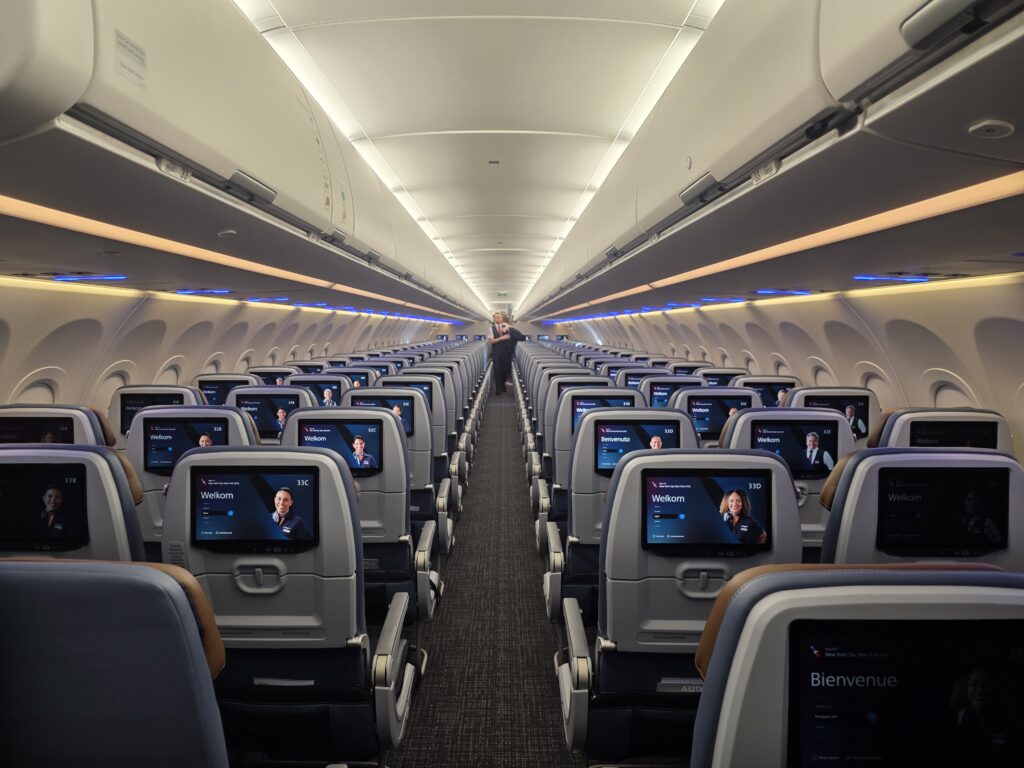
American Airlines plans to bring back TVs at seats on most narrowbody aircraft after beginning to remove them for cost saving back in 2017. They’re finally repudiating the Doug Parker era – Parker famously hoped he could get away with not even adding seat power to planes. These investments, along with adding Starlink wifi to around half their fleet, is great news for customers. Flight attendants – who complained about screens being removed in the first place – are already grousing about the change: They see it as one more problem they will be expected to manage. The screens will break. Passengers will complain. Crews will have to troubleshoot them. And flights will take delays over televisions that nobody really needs because everyone carries a phone. Screens might break, and that passenger at that seat on a five-hour flight may be unhappy. But the overall conclusion is backwards. Seatback entertainment should make the cabin easier for flight attendants to manage, not harder. And the reflexive pessimism some crewmembers show says more about American’s culture problem than it does about the merits of screens. The Complaints Have Already Started One crewmember complained in this discussion of American’s announcement: “The maintenance, how damaged they’ll get… How many will complain when they don’t work.” Another commenter argued that American should put the money into working power outlets and figuring out how to operate on time. Under a local Facebook page’s story, a self-identified 12-year American flight attendant, wrote: “This is news to me and I’ve been a flight attendant with AA for 12 years. We got rid of them.” American does tell employees what they’re doing! Many flight attendants don’t find out what’s happening from the airline. They learn what they’re supposed to be doing from peers. Norms develop amongst flight attendants, who play by their own rules, rather than even listening to the company (and sometimes even tuning them out). A Broken TV Is Not Going To Ground The Airplane American is not going to hold a loaded Boeing 737 at the gate until the screen in 27A can play Ted Lasso. The FAA’s minimum equipment guidance gives entertainment systems as an example of equipment installed for passenger convenience. Since it doesn’t affect airworthiness, it can be handled under the airline’s approved deferral procedures rather than being addressed before departure. That can mean rebooting a screen, deactivating it, placarding it, documenting the defect and fixing it later. A passenger might receive miles or a travel credit if they’re lucky. If the entertainment system is also used for the passenger safety briefing, the safety function has to be addressed under the aircraft’s minimum equipment list. Flight attendants currently perform the demonstration manually. This @americanair flight attendant knows how to get passengers' attention. Brilliant! pic.twitter.com/k8UYVCGzx7 — nycphotog (@nycphotog) August 18, 2026 Delta, United and JetBlue already manage large fleets with seatback screens. Only JetBlue’s on-tie performance is consistently worse than American’s, and screens aren’t the reason. Screens Should Mean Fewer Demanding Passengers An occupied passenger is usually an easier passenger. Children have something to watch. Nervous flyers have a distraction. The moving map answers “where are we?” and “how much longer?” without a trip to the galley. A customer can watch a movie while using a phone or laptop for something else. Boredom and stress can make a cabin harder to manage, and entertainment reduces both. Plus they can advertise the credit card on the screen, and that helps flight attendants get passengers to take and complete applications earning them more moey. When American was removing screens in 2018, employees argued internally that older passengers and children did not always bring devices, crews ran out of headsets, and a screenless product could not compete with Delta. Flight attendants told me that screens kept passengers occupied and made them less likely to come to the back for additional drinks and snacks. And just six months ago, during flight attendants’ protest against CEO Robert Isom, an American flight attendant complained that the airline had removed screens and fallen behind Delta and United. “They’re relying on us, the flight attendants, to be the product and we can only do so much.” Now American is giving them more product! Flight Attendants Can Stop Doing Most Mainline Domestic Safety Demonstrations Screens let American use safety videos again across most of its mainline domestic operation. On a normal departure they no longer have to repeat the synchronized seat belt, oxygen mask and life vest pantomime in the aisle. Is it weird that I actually miss the 2012 video, “there are so many places to go in this world, and so many airlines that can take you there.” It was professional. It wasn’t ambitious in scope or cinematography. I knew several of the crewmembers featured. The Next Turnaround Has To Be Cultural American’s new plan is bigger than televisions. They’re increasing premium seating, investing in airports and lounges, and improving food – and policies. They’re installing Starlink. These are great investments, but to get the value out of them the turnaround has to be cultural. For years, employees watched the airline remove screens, squeeze seats, and shrink lavatories. Front line employees became increasingly cynical. And that didn’t begin with current management. Management needs employee buy-in to deliver a premium product. The first step is eliminating the confusion over what product they’re trying to deliver. The airline has spent years saying the focus is on the operation, not the customer. Now they’re giving employees the tools to deliver a quality product. They need to show frontline employees have a strong future, and that they’re in a fight where crew make the difference and whether the investments matter. Employees have a direct economic stake in making the strategy work. The current flight attendant contract improved profit sharing from the old 5% formula to a pool equal to 10% of American Airlines Group pre-tax earnings up to $2.5 billion and 20% above that. When American earns more, flight attendants share in it. When American barely earns anything, there is little to share. Seatback screens aren’t a threat to flight attendants. They are a tool that should occupy passengers, reduce cabin friction and eliminate most live safety demonstrations on mainline domestic flights. The airline needs to make sure that flight attendants see this as a positive, as an investment, and as a tool – along with all the others they’re finally giving to crew – and that if employees get onboard with the new vision they’ll generate the revenue premium they need and employees benefit too. Topics on this page
American Airlines Flight Attendants Are Already Complaining About Seatback TVs — But The Screens Will Make Their Jobs Easier
Full Article
Original Source
Read the full article at Viewfromthewing →KhanList aggregates and links to publicly available news content. We do not host full articles from third-party sources. Always verify important information with original sources.