
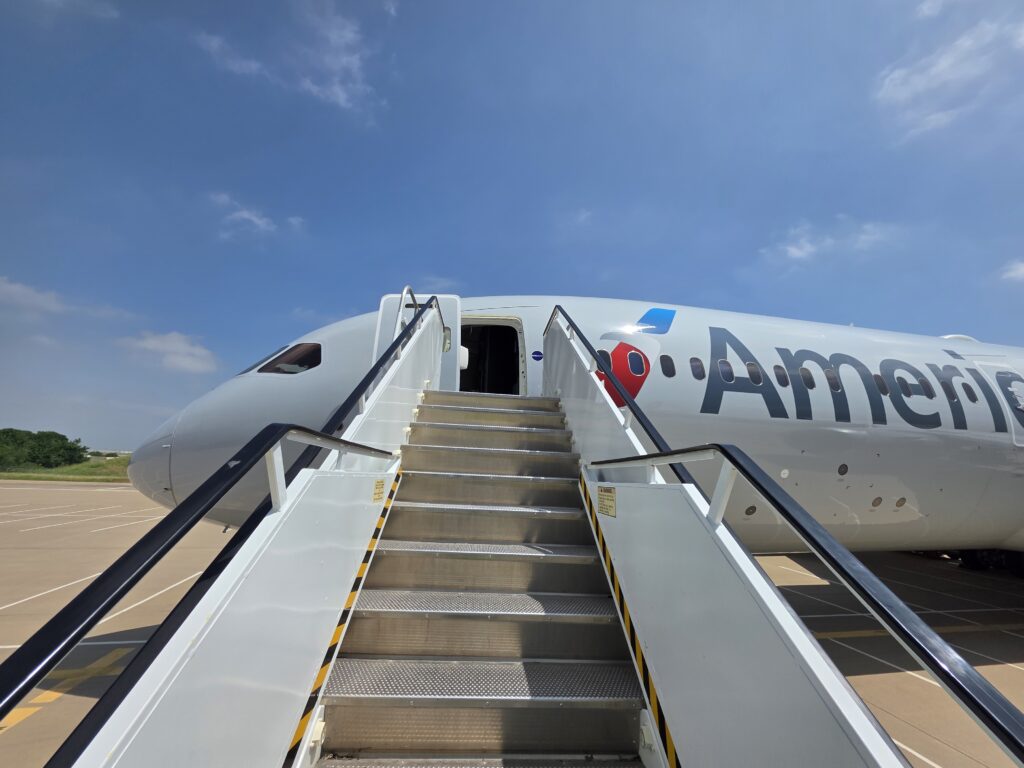
An American Airlines Boeing 787-9 flying Rome to Philadelphia diverted to Dublin on Saturday after most of its cabin crew became dizzy and ill. About six of the nine flight attendants were affected. Flight AA719, operated by 2019 delivery Boeing 787-9 (registration N840AN) left Rome Fiumicino shortly before 1 p.m.. Four hours into the trip, while cruising at 39,000 feet, the aircraft turned toward Ireland. It landed on runway 28L about six hours after leaving Rome and medical responders met the plane. According to aviation watchdog JonNYC, AA 719. Flight divert after 6 of 9 FA’s felt dizzy / ill. He subsequently described it as “approx 6 FA’s affected.” So the uncertainty here is whether six is the confirmed number of sick crew. on this, I'm told– 100% UNCONFIRMED– "AA 719. Flight divert after 6 of 9 FA’s felt dizzy / ill." 100% unconfirmed. https://t.co/2uBxohJ0Bn — JonNYC (@xJonNYC) July 25, 2026 approx 6 FA's affected. — JonNYC (@xJonNYC) July 25, 2026 Some coverage has described this as six of eight flight attendants. American staffs its legacy Boeing 787-9s `with nine cabin crew, one above the FAA minimum. The aircraft remained in Dublin, and an additional flight, AA9601, appears in the schedule for Monday. What Could Make Most Of The Flight Attendants Ill At Once? JonNYC says he “wonder[s] if this was an oxygen-mask event for passengers too” so while the exact cause of flight attendants falling ill isn’t clear, I take the “too” here as intentional. So it doesn’t seem to be a food issue or infectious disease. It could be pressurization, cabin air, or fumes. And it seems like it would have been localized to certain parts of the cabin since there’s no report of pilots becoming ill, smoke, or rapid descent. Paddle Your Own Kanoo suggests, The more likely cause for this diversion is a fault with the air conditioning packs that supply the air into the cabin. If even one of these packs stops working, the levels of oxygen in the cabin can drop to the point that passengers and crew could start feeling the early symptoms of hypoxia. The 787 does not use engine bleed air to supply the cabin. Electrically powered cabin air compressors draw fresh outside air, which is used for ventilation and pressurization. That eliminates the conventional pathway where engine oil can contaminate air, but it doesn’t rule out fumes or contaminants originating elsewhere on the aircraft. The FAA actually does contemplate operating a 787 with one of the two packs inoperative though requires remaining close to a suitable airport. In 2019, American flight 729 from London Heathrow to Philadelphia also diverted to Dublin after a cleaning product spilled in a galley and seeped into carpeting. Two flight attendants temporarily lost consciousness, and three people were taken to the hospital. Passengers May Be Owed $682 Each Or Nearly $200,000 Total Because AA719 departed Rome, EU261 rules apply even though American is a U.S. airline. American owes affected passengers meals, lodging where necessary and rerouting to Philadelphia regardless of why the diversion occurred. Passengers arriving at least four hours late may also be entitled to €600 in cash compensation unless American can establish extraordinary circumstances. With 285 seats, on a full aircraft and at US$682 per passenger, American’s exposure here is $194,370. However, most passengers likely would not know to claim compensation, and those who do might have to fight a first-level objection. I’ve often seen unjustified denials of claims initially as a matter of course, with customers having to escalate before getting sufficient attention to acknowledge anything is legally due. The European Court of Justice has held that unexpected illness of a required crewmember is part of normal airline operations and is not automatically an extraordinary circumstance. It seems like American would have to demonstrate an external contamination event (that didn’t result from their own management of the aircraft) in order to avoid liability. Topics on this page
American Airlines 787 Diverts To Dublin After Most Cabin Crew Fall Ill — Passengers May Be Owed $200,000
Full Article
Original Source
Read the full article at Viewfromthewing →KhanList aggregates and links to publicly available news content. We do not host full articles from third-party sources. Always verify important information with original sources.