
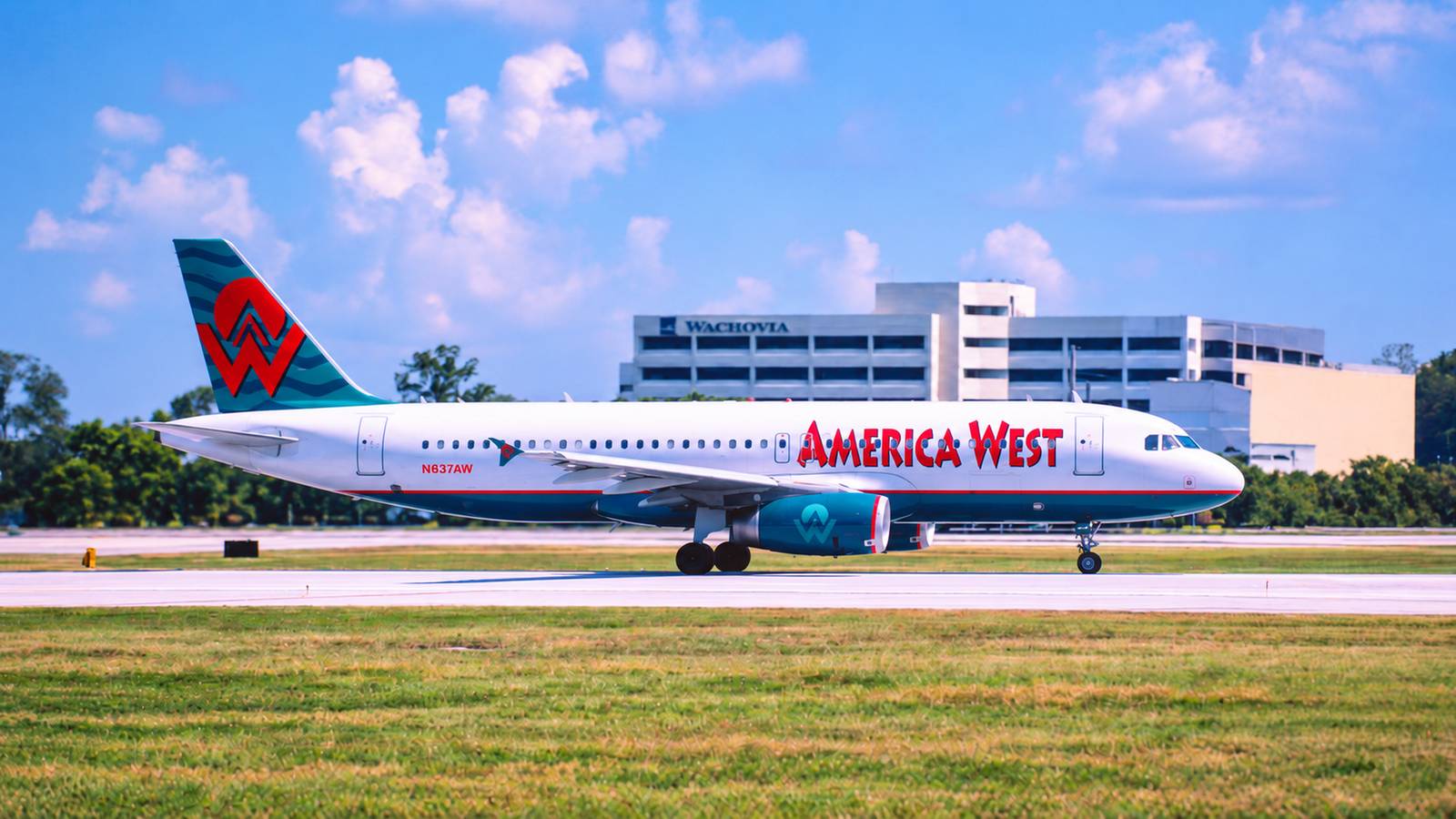
In February 2003, America West Airlines announced a dramatic restructuring of its hub at Port Columbus International Airport (CMH), reducing operations from 49 daily departures serving 15 destinations to just four daily flights. The decision, made under CEO Doug Parker, eliminated more than 90% of the airline's Columbus flying, ended its regional-jet operation, and according to the Midland Report-Telegram, reduced its local workforce from 400 to just 65 employees. A hub that had helped connect the eastern and western United States was effectively dismantled in a matter of months. However, Columbus, now known as John Glenn Columbus International Airport, was far from an isolated failure. Over the following decade, major airlines would substantially reduce or eliminate connecting hubs in cities like St. Louis, Cincinnati, Memphis, and Cleveland. Mergers, changing aircraft economics, and expanding nonstop networks transformed American aviation. More than two decades later, airlines are experimenting with new growth markets such as Austin Bergstrom International Airport (AUS), while the executives behind America West's Columbus decision went on to help shape the modern US airline industry. Why America West Chose Columbus For Its Third Hub Founded in 1981 and launching operations in 1983, America West established itself as a growing national carrier built around Phoenix Sky Harbor International Airport (PHX) and Las Vegas' Harry Reid International Airport (LAS), then known as McCarran. However, competing with established airlines across the eastern United States presented a geographical challenge. A third hub farther east could gather passengers from smaller cities and connect them to America West's expanding western network without requiring nonstop flights between every market. Columbus offered a relatively central location for reaching the Midwest and East Coast, with less congestion than many larger metropolitan airports. America West's Hubs Strategic Role Principal Markets Daily Departures Phoenix Primary connecting hub Western US, transcontinental and international services 305 Las Vegas Secondary western hub Leisure traffic and domestic connections 154 Columbus Eastern connecting hub Midwest, East Coast and connections to western hubs 49 America West began flying there in December 1991 with five daily departures, subsequently developing a connecting operation throughout the 1990s, including after emerging from bankruptcy in 1994. The airport eventually became the airline's third hub alongside Phoenix and Las Vegas, extending its reach well beyond its southwestern origins. The strategy increasingly depended on smaller aircraft operated by regional partner Chautauqua Airlines under the America West Express brand. Its 50-seat Embraer ERJ-145s helped feed passengers from smaller markets into Columbus, where they could connect to other destinations. By 2002, America West and its affiliates carried more than 700,000 departing passengers from CMH, making them the airport's largest airline group. However, those passenger numbers concealed an operation struggling to generate sufficient profits. Why Doug Parker Cut Columbus From 49 Daily Flights To Four By the early 2000s, America West's network had changed substantially. The addition of greater numbers of longer-range aircraft such as the Boeing 757-200led to more nonstop flights from Phoenix and Las Vegas to major eastern cities, reducing the need to transfer passengers through Ohio. Meanwhile, competing carriers had also expanded regional-jet operations throughout the East and Midwest, creating excess capacity in many markets. In February 2003, Executive Vice President Scott Kirby to MRT explained the situation. "As flights from our primary hubs of Phoenix and Las Vegas have grown to major East Coast markets, the value of Columbus as a connecting hub has diminished." The financial consequences of these network changes were substantial. America West reported that Columbus was losing approximately $25 million annually, an increasingly unsustainable burden following the September 11 attacks and the subsequent aviation downturn. On February 10, 2003, Parker announced the hub's elimination, with reductions implemented between April and June. The decision involved withdrawing 12 Chautauqua-operated regional jets, discontinuing 13 destinations, and reducing employment from approximately 400 to 65. Only two daily departures each to Phoenix and Las Vegas would survive. Metric Before Restructuring After Restructuring Daily departures 49 4 Destinations 15 2 Departures eliminated — 45 (92%) Chautauqua regional jets supporting the hub 12 Approximate local workforce 400 65 Annual hub losses before closure $25 million Hub discontinued Network role Connecting hub Spoke serving PHX and LAS The consequences extended beyond Columbus. America West also abandoned LaGuardia Airport (LGA) because the airport's then-applicable 1,500-mile (2,414 km) perimeter restriction prevented nonstop flights from either Phoenix or Las Vegas. Nevertheless, the collapse of the connecting hub did not destroy the wider Columbus market. A subsequent Government Accountability Office study found that total airport traffic increased slightly as competing carriers, particularly Southwest Airlines, expanded, although local origin-and-destination traffic declined by 4.2% over the period examined. Columbus Wasn't Alone: The Rise & Fall Of America's Smaller Hubs During the 1980s and 1990s, hub-and-spoke networks were fundamental to the expansion strategies of US airlines. By concentrating passengers through intermediate airports, carriers could offer connections between numerous cities without operating every route nonstop. Smaller hubs often benefited from regional jets that made low-demand routes commercially possible, although their success depended on attracting sufficient connecting passengers. Columbus's collapse came as several larger connecting hubs were encountering similar financial and competitive pressures. Lambert St Louis International Airport (STL) provides a particularly striking comparison. Once the principal hub for TWA, it passed to American Airlines following TWA's acquisition in 2001. American subsequently reduced operations substantially because the network overlapped with its existing Chicago O'Hare International Airport (ORD) and Dallas/Fort Worth International Airport (DFW) hubs. Cincinnati Northern Kentucky International Airport (CVG) experienced an even more dramatic decline. Airport Former Hub Airline Major Reduction / Closure Principal Factors John Glenn Columbus International Airport (CMH) America West 2003 $25 million annual losses, declining connecting value St. Louis Lambert International Airport (STL) Trans World Airlines (TWA) / American Airlines Major reductions from 2003; hub ended by 2010 Network overlap following TWA acquisition Cincinnati/Northern Kentucky International Airport (CVG) Delta Air Lines / Comair Substantial reductions from 2005; hub downgraded Bankruptcy, regional-jet economics, network consolidation Frederick W. Smith International Airport (MEM) Northwest Airlines / Delta Air Lines 2013 Atlanta overlap, fuel costs, weak connecting economics Cleveland Hopkins International Airport (CLE) Continental Airlines / United Airlines 2014 Network overlap and sustained unprofitability At its 2005 peak, Delta Air Lines operated more than 600 daily departures to nearly 150 destinations, but bankruptcy, high regional-jet costs, and its subsequent merger with Northwest Airlines contributed to the hub's contraction to fewer than 180 daily departures by 2013. Northwest's Memphis hub suffered after its 2008 merger with Delta, whose enormous Atlanta operation served many of the same connecting markets. Delta eliminated Memphis's hub status in 2013, citing high fuel costs, limited local demand, and the inefficiency of 50-seat regional jets. United Airlines made a comparable decision at Cleveland Hopkins International Airport (CLE) in 2014 after inheriting the operation from Continental Airlines. These hub closures were not identical, but they shared a fundamental weakness: connecting networks that became harder to justify when larger hubs offered competing alternatives. How Southwest & LCCs Changed America's Hub-And-Spoke Model America West's Columbus hub was increasingly undermined by the airline's own expanding nonstop network. Its Boeing 757s and new Airbus A320-family aircraft enabled direct services between Phoenix and Las Vegas and major eastern cities, reducing the need to transfer passengers through Ohio. The airline subsequently took the strategy further, with the Las Vegas Sun reporting that it introduced nonstop transcontinental services between California and New York and Boston later that year, demonstrating its growing willingness to bypass traditional connecting hubs altogether. Meanwhile, the rapid expansion of Southwest Airlines and other low-cost carriers was fundamentally changing the competitive landscape. In the time that America West served Columbus, Southwest more than tripled in size to nearly 400 Boeing 737s, becoming the largest US carrier by originating domestic passengers. Other carriers, like JetBlue and Frontier Airlines, were also rapidly expanding low-cost nonstop alternatives. America West CMH Market Southwest's Market Entry Nature Of Competition Chicago Chicago Midway (MDW) 1992 Alternative Chicago airport St. Louis 1992 Direct route overlap Baltimore 1993 Direct route overlap Boston Providence (PVD) 1996; Manchester (MHT) 1998 Alternative New England airports Orlando 1996 Direct route overlap New York LaGuardia 1999 Direct route overlap Hartford 1999 Direct route overlap Washington National Baltimore (BWI) 1993 Alternative Washington-area gateway For passengers who previously relied on traditional hubs, particularly those traveling between smaller Midwestern and eastern markets, these carriers offered a growing range of lower-fare alternatives. Southwest's competitive threat was particularly relevant at Columbus itself. The airline launched flights there in June 1992, just months after America West established its hub, initially operating seven daily departures to Chicago Midway International Airport (MDW) and St. Louis. Southwest's network subsequently expanded throughout the Midwest and East, increasingly overlapping with America West, or feeding the same metro areas via alternative airports. By 2002, Southwest carried more than 300,000 departing passengers at Columbus, about half the volume carried by America West, but enough to exert severe downward pressure on fares from the airport. That, combined with the unprofitable hub economics and the fact that America West was cannibalizing its own original hub strategy, led to the airline abandoning the hub just a year later. Delta's Austin Expansion Shows How Airlines Build Networks Today Credit: Markus Mainka | Shutterstock Hub-building has changed significantly in the years since, and Delta Air Lines' growing presence at Austin-Bergstrom International Airport (AUS) provides a modern comparison with America West's Columbus experiment. Rather than immediately establishing a conventional connecting hub, Delta has gradually expanded its focus-city operation with additional domestic, leisure, and international routes. The airline now plans more than 70 daily departures by Summer 2027, including a new route to Paris Charles De Gaulle Airport (CDG), with its investment including a flight attendant base, additional terminal gates, and plans for another Sky Club. American Airlines previously attempted an ambitious expansion at Austin, increasing its network from eight destinations before the pandemic to 37 by December 2021. However, the rapid buildup encountered operational difficulties and aircraft deployment constraints, and the airline substantially reversed the expansion during 2024. Delta has taken a more incremental approach, adding routes cautiously while withdrawing underperforming services, including Austin–Memphis and Austin–New Orleans in November 2026. Factor America West At Columbus Delta At Austin Period 1991–2003 Expanding in 2026 Market strategy Eastern connecting hub Growing focus city Network emphasis Connecting passengers Local demand with increasing connectivity Regional aircraft ERJ-145 feeder operation Mix of mainline and larger regional jets Peak/planned departures 49 daily 70+ peak-day departures planned for 2027 International strategy Feed western hubs Local nonstop demand and partner-hub connections Principal challenge Connecting network losses Sustaining profitable growth against competitors Outcome Hub eliminated Expansion continuing The contrasting strategies demonstrate that developing a successful focus city requires more than simply introducing a large number of routes. Modern airlines increasingly evaluate growth markets using detailed assessments of local demand, corporate traffic, fares, competitive capacity, airport access, and connecting potential. Delta's planned Austin–Paris nonstop, scheduled to begin in March 2027 using an Airbus A330-900, illustrates the different opportunities available today. Rather than relying principally on connections through Austin, the route will serve the Texas market while offering onward connectivity through Air France-KLM's Paris hub. In an appropriate historical coincidence, Delta also introduced nonstop flights between Austin and Columbus in June 2026. These services link two airports that represent different generations of airline network development. From Columbus To American Airlines: What Became Of America West, Parker And Kirby? America West's withdrawal from Columbus did not end its ambitions to compete nationally. In 2005, the carrier merged with US Airways, gaining an extensive eastern network without having to build another connecting hub from scratch. The combined airline retained the US Airways name, with Doug Parker continuing as CEO. Eight years later, US Airways merged with American Airlines in a transaction that created one of the world's largest carriers, and Parker became its chief executive. America West's identity disappeared, but its management and corporate legacy became deeply embedded in American aviation. Scott Kirby followed a similarly influential career path. Having served as an America West executive during the Columbus restructuring, he became President of US Airways in 2006 and American Airlines following the 2013 merger. Kirby subsequently joined United Airlines as President in 2016 and became its CEO in 2020, a position he continues to hold. Parker, meanwhile, stepped down as American's CEO in 2022 and departed its board in 2023. Two executives involved in eliminating a relatively small Ohio hub ultimately helped lead two of the three largest US legacy airline groups. The Columbus decision also anticipated a fundamental principle of modern airline network planning. An airport's geographical position and the ability to generate connections are valuable, but neither guarantees that a hub can support itself financially. As airlines consolidated, aircraft became more efficient, and nonstop networks expanded, the strongest connecting hubs grew more important while many smaller operations became expendable. America West's Columbus hub disappeared because the airline found more effective ways to serve its customers — a calculation that continues to shape airline expansion decisions more than two decades later.
America West's Columbus Hub Fell From 46-49 Daily Departures To Just 4 After Doug Parker Cut 90% Of Flying
Full Article
Original Source
Read the full article at Simpleflying →KhanList aggregates and links to publicly available news content. We do not host full articles from third-party sources. Always verify important information with original sources.