
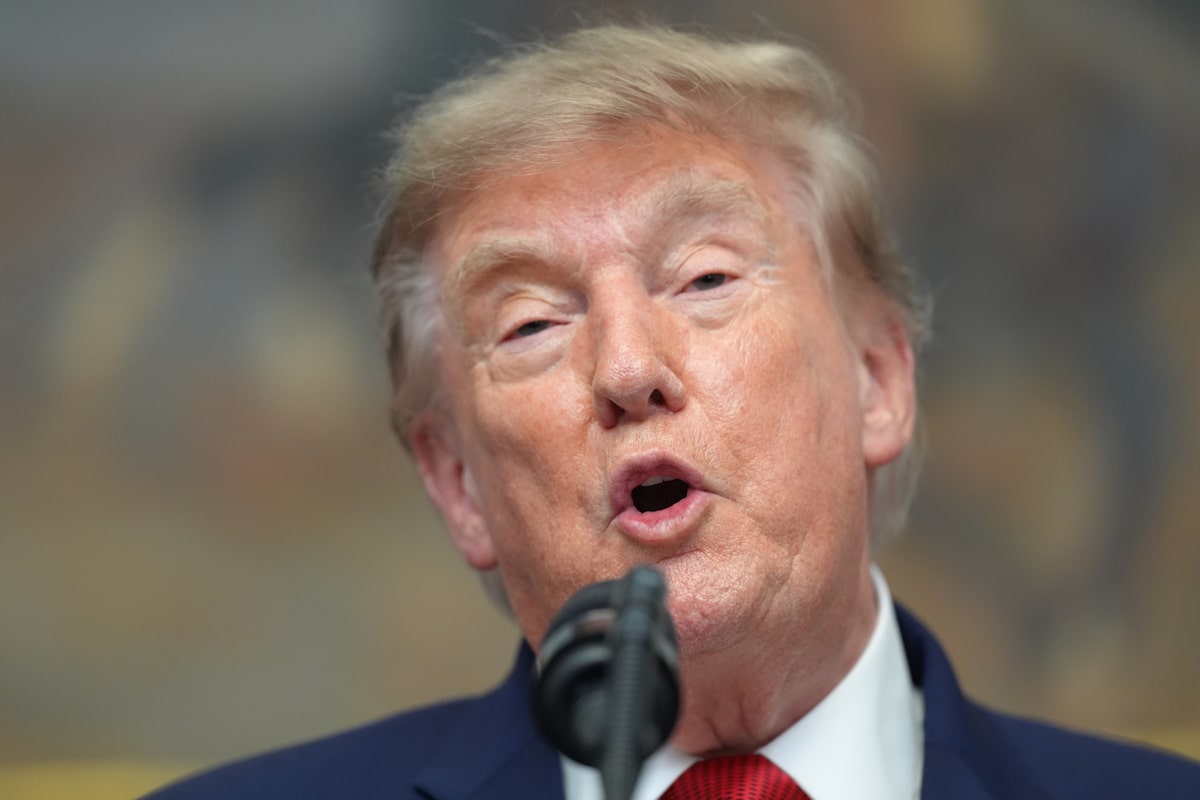
Open this photo in gallery:Alone among U.S. leaders, President Donald Trump hasn’t issued the sort of panegyric that had become common in the presidential repertoire, David Shribman writes.Jacquelyn Martin/The Associated PressA quarter-century ago, in the wake of the assistance that Newfoundlanders provided to stranded American travellers after the 9/11 terrorist attacks, Canadian officials distributed a book titled A Diary Between Friends (“a visual and written expression of a friendship of unusual depth,” Prime Minister Jean Chrétien wrote in the foreword). A half-century ago, the National Film Board marked the U.S. Bicentennial with Between Friends/Entre Amis (a “joyful recognition of that striking triumph of the human spirit reflected in the atmosphere of peace and friendship which pervades the many relationships between two proud and free nations,” Prime Minister Pierre Trudeau wrote in his foreword).Now, with talks for a landmark trade pact broken down – creating another sad stage in an entirely different political environment among the two North American giants – nobody would contemplate producing high-spirited, high-toned encomiums to what once was a special relationship among special relationships. No prominent literary or photographic tributes will be issuing forth from above the 49th parallel to commemorate the American Semiquincentennial being celebrated this year.Ottawa fires back after rejecting U.S. trade dealInstead, the talks marking the relationship between Canada and the United States today – negotiations that involved such items as Brantford hockey sticks and Kentucky bourbon – added a summertime frost to a relationship that now is special only in the enmity it represents.In the long view – going back to Franklin Delano Roosevelt and his meetings with William Lyon Mackenzie King – the current break between the two countries can only be regarded with bewilderment that the negotiations were so fraught, so packed with bitter suspicion and the heartbreak and resentment that comes from being jilted and dishonoured. The talks went down to the wire, then dragged into a fevered overtime – all while, according to a Léger poll released Monday, 56 per cent of Canadians wanted the government to “take a hard line and make no more concessions.” In the end, Prime Minister Mark Carney took the hint from the Canadian public rather than the bait from the American president.These sorts of negotiations in ordinary times with conventional political figures in the White House were never a day at the beach, to be sure. But now there is a sea change in the political environment to match the climate change in the physical environment. It has been a long time coming. No matter how tough the negotiations in earlier matters – energy, water resources, lumber, automobiles – there were always so many Canadian visitors to Ogunquit Beach in Maine that for 26 years, until 2004, it was possible to walk the beach on a summery Saturday afternoon and hear, without interruption, the complete play-by-play of a Montreal Expos game, in both French and English. One day this month there was but a single Canadian licence plate in the beach parking lot. What Trump’s new tariffs mean for Canada’s economyNow, with the negotiations over, there are no more meditations about how geography made us neighbours but history made us friends (John F. Kennedy, 1961) This new agreement represents a grudging reminder of the often-forgotten sentence that follows that famous encomium in Parliament 65 years ago: “Economics has made us partners.”Now that last sentence comes with an asterisk. The leader on one side of the border has been conducting a verbal range war while the leader on the other side has traipsed gingerly in his conversations with his counterpart, applying a negotiation technique pioneered by Mary Poppins: “firm but gentle.” The film came out in 1964, the year Lyndon Johnson, speaking in Vancouver, said, “No nation in the world has had greater fortune than mine in sharing a continent with the people and the nation of Canada.”Alone among U.S. leaders, Donald Trump – who in recent days has upended America’s long-standing friendships with Oman and South Korea in much the same way he has done with Canada – hasn’t issued the sort of panegyric that had become common in the presidential repertoire. Canadians might be forgiven for, as General Douglas MacArthur said in his farewell speech at West Point in 1962, listening “vainly, but with thirsty ears, for the witching melody” of the sort of rhetoric in FDR’s 1936 speech in Quebec when he spoke of “the desire of the people of both countries to practise what they preach when they speak of the good neighbour.”As a result, Mr. Carney has looked beyond North America, explaining at Davos earlier this year that the world is “in the midst of a rupture, not a transition.” No one missed the import of the message, that “Canadians know that our old, comfortable assumptions that our geography and alliance memberships automatically conferred prosperity and security [are] no longer valid.”But the Prime Minister also knows that in the year before Mr. Trump returned to the White House, three-quarters of Canadian goods were exported to the United States and that Canada imported nearly half its goods from across the U.S. border. That’s what motivated the Canadian negotiators in the talks.But hardly anybody expected the negotiations – said for days to be nearing a happy conclusion – to break down the way they did. The overarching sentiment was encapsulated by Beth Burke, the CEO of the Canadian American Business Council. In releasing a major report this month on the status of the trade relationship, she warned, “This is not a moment for uncertainty to define our future. … It is a moment to reaffirm the principles that have made North America one of the world’s strongest economic regions and to build a more resilient partnership for the decades ahead.”That moment apparently has passed.
America is really being a bad friend
Full Article
Original Source
Read the full article at Theglobeandmail →KhanList aggregates and links to publicly available news content. We do not host full articles from third-party sources. Always verify important information with original sources.