
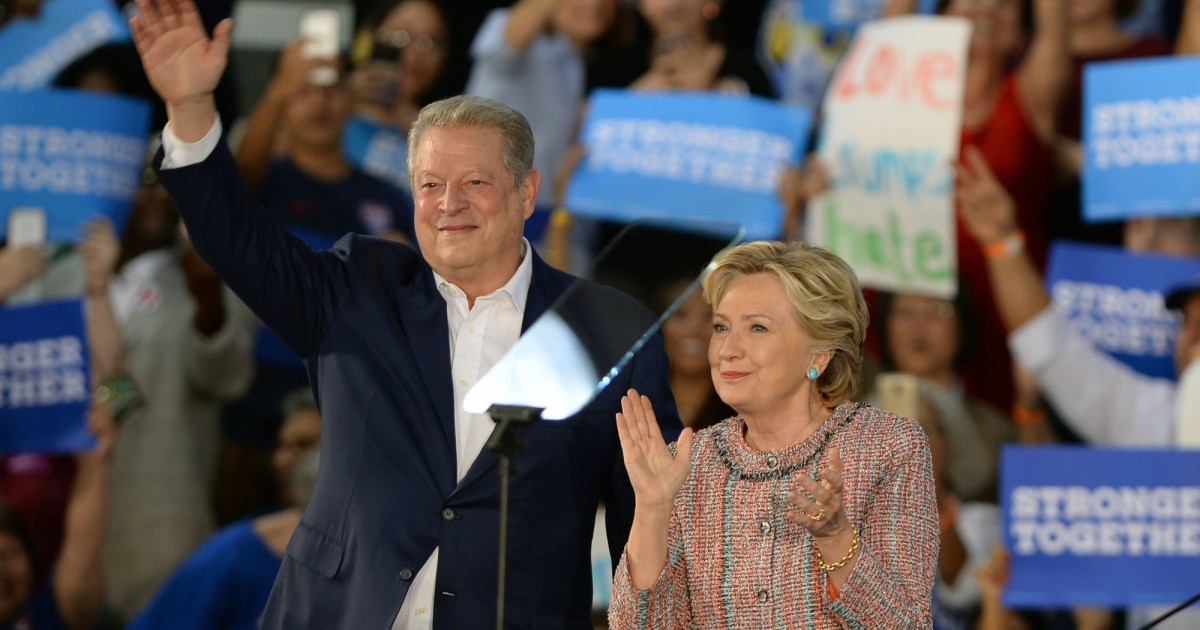
Al Gore and Hillary Clinton at a 2016 Florida rally.Solar/Ace Pictures/Zuma Get your news from a source that’s not owned and controlled by oligarchs. Sign up for the free Mother Jones Daily. Tuesday’s wave election swept Democrats into power in Congress. But the most seismic result for American politics and democracy may come out of the battleground states where Democrats just won trifecta control by taking both state houses and the governor’s mansion: Come January, Democratic legislators will have the votes to elect the next president by the popular vote. State lawmakers could circumvent the Electoral College by enacting what’s known as the National Popular Vote Interstate Compact. Under the current system, each state gets a set number of electors, and the candidate who wins enough states to accumulate at least 270 electoral votes becomes president. This system allows the winner of the popular vote to lose, as Al Gore did in 2000 and Hillary Clinton again in 2016. But the NPVIC would bypass the Electoral College, with each state that enacts the compact awarding its electors to the winner of the national popular vote. The compact would only take effect once states representing a majority of electoral votes sign on, ensuring that the winner of the national popular vote becomes president. “Every voter should be politically relevant. Under the current system, they are not.” In April, Virginia became the 18th state to join the compact, bringing the total number of electoral votes pledged under the proposal to 222. On Tuesday, Democrats took trifecta control of state governments in Michigan, Wisconsin, Pennsylvania, Arizona, and Nevada. That’s 61 electoral votes. Add in Alaska, where late-arriving votes are still being counted, and that’s 64. With Virginia on board, only 48 more votes are needed for the compact to reach 270 votes and take effect. The emerging math means there is a real chance that the next president is selected based on the national popular vote. That would represent a sea change in American politics. The current Electoral College system violates the basic principle of one person, one vote. Instead of candidates being forced to campaign for every vote, millions of presidential votes in uncompetitive states are effectively wasted in a winner-take-all system. Politicians and donors pour billions of dollars into a handful of battlegrounds, while the votes—and concerns—of most of the country are ignored. “Under the current system, four out of five American voters are on the sidelines,” says Patrick Rosenstiel, a Republican strategist who is advocating for the compact. “Every voter should be politically relevant. Under the current system, they are not.” The Electoral College was part of the Framers’ power-sharing concession with small states and slave states at the nation’s founding. Throughout our history, it has been a bulwark of white supremacy. Because a state’s Electoral College votes are based on their congressional representation, slave states benefited from the three-fifths compromise with outsized clout. After Reconstruction, Southern whites disenfranchised Black people, while using the electoral votes allotted to their states’ Black residents to become even more politically powerful. This warped our politics and enshrined white supremacist policies for decades. The Supreme Court’s gutting of the 1965 Voting Rights Act this year threatens to return the country to a similar situation: a white majority running up their influence on the backs of Black people they have gerrymandered out of power. The Electoral College system is not just a racist institution, it is also a glaring achilles heal for our democracy. In 2000, the Supreme Court’s decision to halt a recount in a single state—Florida—meant the winner of the popular vote lost. That history shows how the current process can be manipulated in just one state by interference, disenfranchisement, or legal tampering to upend the will of the people. In 2016, Russia targeted voters in key states, demonstrating that even foreign adversaries understand our current system’s vulnerabilities. In 2020, Joe Biden won the popular vote by 7 million votes, but Donald Trump lost the three closest states in the Electoral College by just 44,000 total votes, opening the door his election-stealing scheme. Moreover, Trump’s attempt to hold onto power on January 6, 2021 by sending a violent mob to stop the certification of the electoral votes could never have happened if the president were chosen by a simple majority. While Democrats have been the chief drivers of the national vote compact, Republicans might conclude they would also benefit from a change. On Tuesday, Democrats swept statewide races in Texas, shattering the political epicenter of the Republican Party. The win showed that in a wave, Texas can go blue, and with it, the second-largest state’s 40 electoral votes. Georgia, North Carolina, Ohio, and Iowa also saw Democratic sweeps. These results may induce some Republicans to support the compact, reasoning that they might have more luck by actually counting millions of Republican votes in California and New York, for example, than by hoping swing states go their way in tough years. As Rosenstiel said the day after the midterms, “the environment is right for the 2028 presidential election to be run by national popular vote.” This month’s elections are a mandate for change, and much of the change demanded is to our political system itself. Electing the president by a national popular vote could reshape American politics, empower voters, and protect our elections from interference. And for the first time in decades, it is actually possible.
America Finally Has the Votes to End the Electoral College
Full Article
Original Source
Read the full article at Motherjones →KhanList aggregates and links to publicly available news content. We do not host full articles from third-party sources. Always verify important information with original sources.