
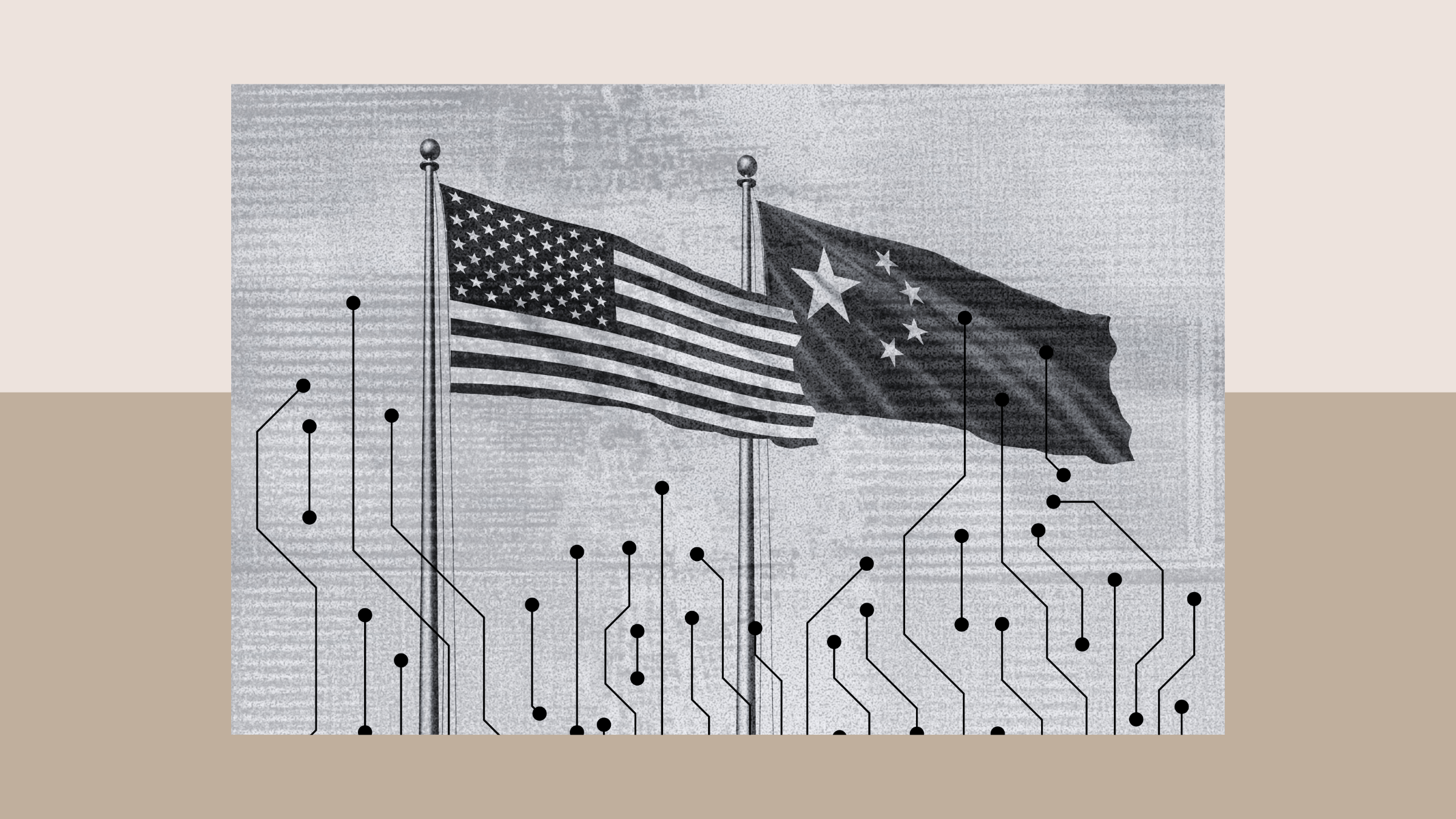
We are in the age of artificial intelligence. Many are comparing the technology to electricity and describing it as the industrial revolution of this century. The United States has long dominated the field, but China’s meteoric rise has made it the strongest challenger to American dominance. The AI race is increasingly bipolar, and much of the power to shape this critical technology is concentrated in these two countries.With the American and Chinese dominance of this emerging technology comes a widening geographic divide that begins with who builds AI technologies and where. As the great power rivalry between Washington and Beijing intensifies, most other countries increasingly rely on AI technologies but have little say in how those systems are built, tested, and governed.These technologies are entering schools, hospitals, and government offices around the world, but decisions about what makes these systems safe and how much control people retain are made largely elsewhere. So are the decisions about whose values frontier models reflect and which languages they support.The bipolar concentration of AI power has heightened the sense of vulnerability outside the U.S. and China and given a new urgency to the efforts of various countries to build sovereign models of their own.AI by the few, AI of the few, AI for the fewFor now, the future of AI in the rest of the world depends on the U.S. and China. Take the computing infrastructure needed to build the most advanced AI models, also known as frontier models. Between 2022 and June 2026, the U.S. received roughly 72% of the world’s new AI computing capacity, according to estimates by Epoch AI, a research organization. China received 10%. That left a mere 18% for all other countries combined.This concentration extends beyond AI chips. The International Energy Agency estimates that the U.S. and China accounted for about 70% of the electricity consumed by data centers worldwide in 2024, while data centers in the rest of the world consumed a meager 30%. Research and development infrastructure for AI is similarly concentrated in the U.S. and China. A Carnegie Endowment study of more than 10,000 researchers who published at NeurIPS, a leading AI conference, in 2025 found that three-quarters were affiliated with employers in the U.S. or China.Even if we set aside the energy and physical infrastructure needed to build frontier models, significant gaps in training data and language coverage remain. Consider the question of languages and representation. Most of the world’s roughly 7,000 languages remain poorly supported by AI, even though about 3.4 billion people speak them. The data used to train frontier models and the benchmarks used to evaluate them largely leave these languages out.A recent snapshot of Common Crawl, a web archive widely used to train language models, revealed that roughly 43% of the pages were in English. A mere 0.2% were in Hindi, a language spoken by more than half a billion people. In a 2025 study, my colleagues and I found that training data for Quechua, a language spoken today by about 8 million people, primarily across South America, included texts from the era of Spanish colonization.Developers of most frontier models rely heavily on publicly available data on the internet, which contains biases and harmful content my colleague Claire Wardle described as the “armpit of the internet.” In fact, my research has shown that frontier models can act as a powerful force for cultural and linguistic homogenization while reproducing gender, disability, caste, and religious biases.I have been studying and evaluating how AI affects the way people in different cultures express themselves in writing. I have consistently found that when users in India write with AI assistants, their writing styles shift to mimic those of Americans, and their language loses some of its cultural nuance. The suggestions of AI assistants also influence and change how these users describe their cultural norms and express their views on a range of social issues.Even the cost of using AI can depend on the language you speak. AI companies often charge by the token, a unit of text. The same message can require more tokens in Hindi and Odia than in English. Newer systems have narrowed this gap but have not eliminated it. Thus, developers building AI-driven apps in Hindi or Odia can face a language tax, paying more to process the same content than they would in better-supported languages such as English, Mandarin, or Spanish.Sovereign AI models of their ownThe rest of the world has little control over American and Chinese frontier models, and even access to them can depend on decisions made in Washington or Beijing. In June, citing national security concerns, the U.S. government ordered Anthropic to block foreign nationals—including those on its own staff—from accessing Fable 5 and Mythos 5 models. Anthropic responded by taking both models offline for all users. The restrictions were lifted later that month, but the episode exposed how quickly a single government’s decision can cut off access to technologies used around the world.The incident invigorated the efforts of several middle powers to build sovereign models of their own. A handful of middle powers have charged ahead and developed their own models: Sarvam in India, Cohere in Canada, Mistral in France, and Jais in the United Arab Emirates. Their developers have sought to make these models more responsive to local needs, contexts, and languages.To gain more control over the technology and protect their national interests, the governments of India and Canada are moving quickly to invest in domestic AI firms, including through equity stakes. In the UAE, Jais was developed by a partnership involving Inception, a subsidiary of G42, which is chaired by Sheikh Tahnoun bin Zayed Al Nahyan, the country’s national security adviser and a member of Abu Dhabi’s ruling family. Here, the term “sovereign” can take on a literal meaning. Yet it remains unclear how powerful these sovereign models are or how well they reflect local cultures and contexts. Many sovereign models are built by adapting open-weight models developed in the U.S. or China and can inherit biases from those models. As our study shows, some regional models can write fluently in local languages while misreading the social norms and contexts of their speakers. Knowing how to speak a language is not the same as understanding the social norms of its speakers or how their schools, hospitals, and government offices work.Training data contribute to these failures. But developers also train models to favor some responses over others—a process called “alignment.” One common approach asks people to compare AI-generated responses and choose which they find more helpful or less harmful. Those judgments are then used to train models, shaping how they respond to millions of users.Yet the people and languages represented in this feedback do not adequately reflect the world’s diversity. For instance, in a 2022 Anthropic study, feedback was collected in English, and roughly 20 paid online workers accounted for about 80% of the data. Even Meta’s more recent Community Alignment project, designed to help models respond to different cultural preferences, draws on participants from only two countries in the Global South and includes English and Hindi, but none of the hundreds of other languages spoken in India.It is also difficult to reliably and systematically measure how safe these models are in local contexts. Existing safety tests cover too few languages and cultural contexts in the Global South and often assess isolated responses rather than conversations that unfold over multiple exchanges.Can these sovereign AI models compete with the frontier models? This challenge is especially daunting since frontier models have ushered in a new era of scientific discovery and uncovered cybersecurity vulnerabilities in digital and physical environments, including critical national infrastructure. AI already plays a prominent role in advancing mathematics, chemistry, medicine, life sciences, robotics, and autonomous systems. If sovereign models cannot keep pace, the countries relying on these models could fall behind in these critical areas.Competing coalitionsThe U.S. and China are consolidating their power in artificial intelligence and building competing coalitions. In July, Beijing established the World Artificial Intelligence Cooperation Organization. Washington, which leads the Pax Silica initiative, reportedly plans to press its allies and partners to choose sides in the AI race and to warn them against joining competing coalitions.Other countries seeking a greater say in their AI future should start by forming a coalition of their own. Together, they could agree on shared priorities and work to shape global AI rules that pay equal attention to safety, productivity, and national sovereignty. As Douglas Rediker of the Brookings Institution has argued, middle powers gain bargaining power when they negotiate together. That leverage can help preserve each country’s ability and freedom to build its own AI systems, adapt existing ones, or switch from one to another.Such a coalition would not have to start from scratch. The Global Partnership on Artificial Intelligence (GPAI), which brings together 46 countries and the European Union, offers one place to start. In February, the India AI Impact Summit in New Delhi was the first in a series of major government-hosted AI summits to take place in the Global South, bringing together world leaders, executives of AI firms, and civil society organizations to discuss the future of AI for humanity. In September, at the 81st session of the United Nations General Assembly in New York, Finland proposed measures to manage the pace of AI development and establish transparent safety protocols.Yet the pressure to raise productivity can make it hard for governments to agree on safeguards. Twenty-two countries signed Finland’s proposal to keep AI “under human control,” but others, including Nigeria and India, did not. When asked whether AI needed more regulation, Bosun Tijani, Nigeria’s minister of digital economy, reportedly responded, “We are desperate for productivity gains. People talk about risks, but we don’t have time to wait.”Countries that lack the computing power and infrastructure required to build frontier models on their own should pool their resources to build shared regional infrastructure. The United Nations Development Programme’s work to expand AI computing infrastructure in Kenya, Malawi, Rwanda, South Africa, Togo, and Zambia is an important beginning. But computing power alone is not enough. Countries should also share data, coordinate skill-building and training initiatives, and invest together in research and innovation, which would help people use the new infrastructure to build technologies their communities need.And researchers in different countries should collaborate and test AI models together. This includes building robust benchmarks and evaluation infrastructure that account for local languages, cultural and social norms, and institutional realities. They should also work together on mandatory pre-deployment testing of models and develop common standards and efforts to improve transparency. The current system of evaluating AI models is fragmented and serves most developing countries poorly. We need to consolidate these segregated efforts to test and evaluate these models and their evolving capabilities.Given the geopolitics of AI and the scarcity of essential resources required to do this work, funders need to support long-term international partnerships. Yet funding for sustained research across borders remains difficult to secure—even for researchers based in the U.S., as I have experienced firsthand. These partnerships would help researchers pool resources, build shared infrastructure for testing and evaluating AI, and develop governance frameworks and safeguards that address shared risks while responding to local needs.Finally, frontier models dominate the conversation about AI. But there are different types of AI technologies that are often equal to the task: decision support systems, predictive models, and small generative models. Using an all-powerful model for an everyday task is like taking your kids to school in a spaceship or blowing out birthday candles with a fire extinguisher. Smaller models built or adapted for particular languages and uses deserve investment too.These steps could give more countries the capacity to make informed choices and protect their interests. The billions who live outside the U.S. and China deserve a say in what AI is built for, whose needs it serves, and how it is governed. Their role must not be limited to adopting what the two great powers decide for the rest of the world. The AI technologies we build in the future need to be responsive to the diversity of human experiences. Without that, we risk leaving our science, culture, politics, and defense dependent on decisions made elsewhere.
America, China, and the Costs of the Bipolar AI Race
Full Article
Original Source
Read the full article at Time →KhanList aggregates and links to publicly available news content. We do not host full articles from third-party sources. Always verify important information with original sources.