
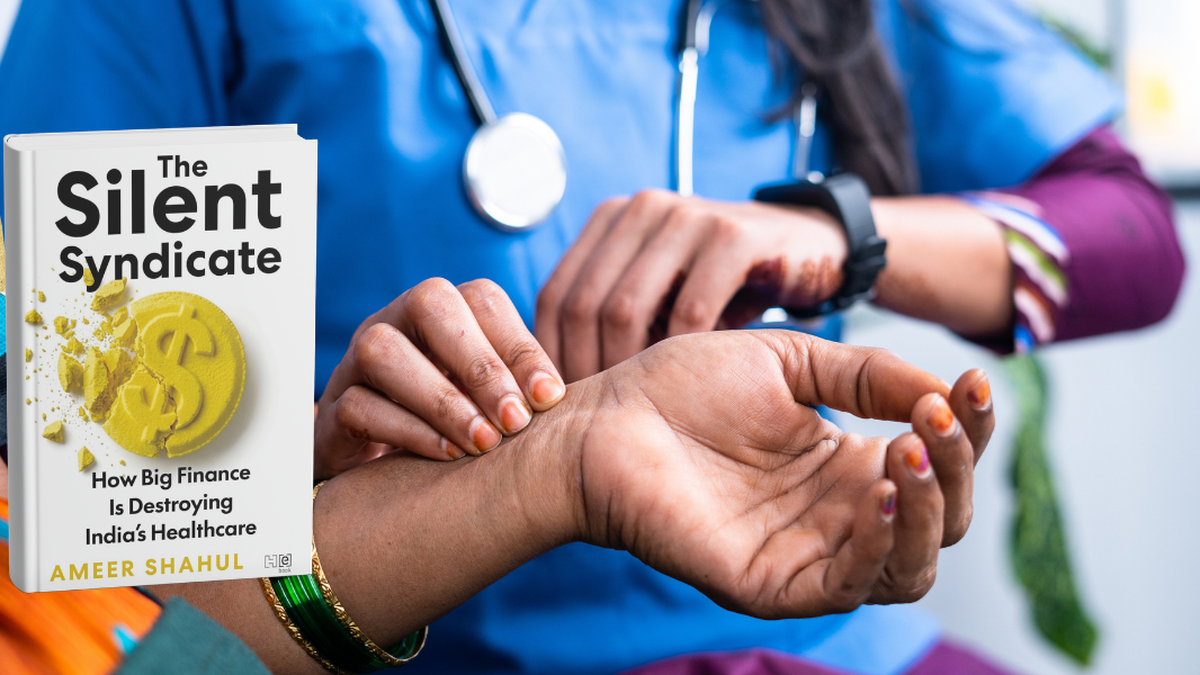
Home Books Authors InterviewThe public policy expert says financial interests and claim rejections are driving up the cost of treatment Published - October 30, 2026 06:18 pm IST Getty Images/iStock In a country where for most people the bulk of medical expenses are out of pocket, high healthcare costs are no less dangerous than any deadly disease. In his new book, The Silent Syndicate: How Big Finance is Destroying India’s Healthcare’ (Hachette India) public policy expert Ameer Shahul documents the infiltration of global financial interests into India’s healthcare sector and how it is making medical care even more unaffordable and inaccessible for the average citizen. Excerpts from an interview: What does ‘silent syndicate’ mean? While working on the book, I came across quite a few healthcare players, ranging from actors in the pharma industry to finance, diagnostics, insurance, and a plethora of lobbyists. Together, they have been very active in the Indian space for almost a quarter century. These players, with the lobbying groups acting on their behalf, have become stronger since 2016. There have been conversations between these groups to frame positions more suited to them on a collective basis. I could trace those links — some direct, some indirect, some opportunistic. I found that these active conversations between the lobbies and the industries were contributing to the deterioration of our healthcare system. I wanted to give them a name and connect the dots between the various players to show how they act in complete coordination. So I coined the term ‘Silent Syndicate’ to describe them. Author Ameer Shahul The fuel on which this ‘syndicate’ runs is global financial capital. How does the entry of private equity alter the nature of a hospital? Once a private equity firm picks up a stake in a hospital, they put a member on the hospital’s board, or sometimes take over the board, depending on the percentage of stake they have. Then they start introducing their metrics. For instance, we used to talk about the average number of days before a patient can get out of the hospital, the rehospitalisation that happens after the preliminary recuperation, and the number of OPD visits by a patient. Those were the metrics used by doctors and hospitals for a long period. But once private equity players came into the fold, they changed the metrics to occupancy rate, average revenue per bed, EBITDA (Earnings Before Interest, Taxes, Depreciation, and Amortization), quarterly revenue, and return on capital employed and started expecting hospitals to perform to the tune of those metrics. But weren’t these metrics already in place, given that hospitals in the private sector had to function as profitable businesses? If you go back 30-40 years, hospitals were not considered an industry. Their primary role was that a care centre, but over a period of time, their role morphed into that of a profitable business. That’s when these other metrics started to come in. They started looking at how much revenue each doctor is bringing to the hospital and fixing internal targets for doctors, which was never the case earlier. Doctors always used to be assessed in terms of the number of patients handled at the OPD, the number of room visits, the number of ICU visits, etc. Under the new paradigm, what mattered was average revenue per doctor, and conversion rates — OPD patients to inpatient cases, inpatient to surgeries, inpatients to ICU patients. So if you’re a doctor who is not performing to the satisfaction of the management — say, you were supposed to bring in ₹20 lakh a month and you are only able to bring in ₹10 lakh — you will be shown the door. Somebody who brings in ₹50 lakh against a target of ₹15 lakh will be rewarded. That’s how the hospital works today, in alignment with any other industry. The other outcome of this is that doctors are under pressure, and the hospital management is under pressure to bring in more revenue, so they obviously have to pass this on to the patients. The consultation fee charged by each doctor is looked at by the management and revised every quarter. So are the procedure charges, from a normal surgery to ICU charges. Even something as simple as a drip line, a saline administered to a patient in an emergency, is a unit from which revenue needs to be generated. Sometimes this goes up 10 or 20 times its actual cost. The business of care has changed into a business of profit. The scariest section in the book for me was the one on health insurance. Your book suggests that it’s when you need health cover the most that there is a good chance you won’t get it. Why is that? If you look at the IRDAI (Insurance Regulatory and Development Authority) numbers, it’s very clear that in 2024–25 there were about ₹30,000 crore worth of claim rejections and claim repudiations. Given such a huge claims rejection figure, how come health insurance firms boast settlement ratios of 96% to 98%? This percentage has nothing to do with the total value of the rejections. When they say they have a 98% claim settlement ratio, that only means that out of 100 claims received, they have honoured 98 and rejected only two. But you’re not looking at what those 2% of rejected claims are. That is precisely why I said when you need the money most, that’s when it gets rejected. Suppose you have a small injury — say, a broken finger — and you go to a hospital and the bill is ₹5,000. You submit it, and the insurer will be happy to settle the claim. But suppose you or one of your relatives faces a serious situation — say, a cardiac issue or a rare disease — where you need ₹50 lakh. Imagine you have a coverage of ₹1 crore and are eligible for ₹50 lakh. You won’t get it. This is where the rejections come — in the large-claim category, which the insurance companies don’t want to honour, because those are the kinds of claims that will hurt them the most. So why does this not get addressed? Once you have bought the policy and there is a dispute, you are left high and dry. Say, you’re buying a policy with a ₹5 lakh coverage. If you’re 50 years old, you’re paying a premium of approximately ₹20,000, and the insurer will be very happy to pay any claim below ₹20,000. But the moment it crosses that threshold of ₹20,000, it’s cutting into his pocket; he’s not making any money on your policy. And if you have been a policyholder for, say, five or 10 years, you have only contributed, say, ₹2 lakh on average in premiums. He’s not looking collectively at the money he’s making; he wants to make money from every policy. That is how the business works. He thinks that every year, he’s going to make ₹20,000 out of this person. And the moment it cuts into his pocket, he will try to see how he can reject the claim. In fact, there are rejection experts within health insurance companies, at escalating levels — level one, level two, and so on. Some of them are qualified doctors. They read the policies and the discharge summary or the hospital reports to find loopholes, either in the policy or in the discharge summary, or by reading between the two, and come up with an explanation for how the claim can be rejected. People who have mastered this are in high demand among health insurance companies. Can you talk a little about how the reinsurer fits into the scheme of things? When you buy a policy, you sign on some dotted lines. But you don’t read the policy documents in detail. There are a very large number of pages — some 10 or 20 pages of documents — that you don’t have time to read through. Even assuming I read through every single line of those 35 pages and I have a problem with, say, two paragraphs, what can I do about it? Nothing. These terms and conditions are a one-way document. Though it is considered to be a contract, it’s not a negotiable contract. You either sign it or you don’t buy it. That’s it. It is the reinsurers who have fixed these conditions because they have a lot of data at their fingertips. Say, for instance, muscular atrophy is a disease that involves a huge expense for the patient; to treat it, a person needs ₹1 crore. If the reinsurer gets an insight from the data that there is a possibility of large-scale muscular atrophy in Indonesia, Malaysia, or India, they would categorise it as a red category, and it will be put under barred entry. Sometimes they will put it under pre-existing disease conditions, which means you will have to wait for three years if you have the disease or any indication of it. In some cases, they bluntly refuse to give insurance cover for it. They say: to include muscular atrophy, you need to buy a different policy — like the cancer policies being sold separately by some health insurers. So, these high-risk, expensive diseases are categories dealt with separately by the reinsurers, based on data on the prevalence of these diseases in the countries they look at. They frame the policies clause by clause. Part of the insurance premiums collected from you goes directly to the reinsurers. To mitigate their risk, insurers reinsure a large group of policies with reinsurance companies. If your total claims go beyond X amount, the reinsurer will have to pay the insurer some amount of money. These are called treaty documents or treaty arrangements, wherein they enter into an annual contract. And to enter into such treaty arrangements, the reinsurers define the policy conditions and then pass them on to the insurance or health insurance organisations. Can you elaborate what you mean by the ‘MedTech trap’? MedTech is a complex area. It’s not just about a technology used for a surgery, a robotic surgery, or a technology used for producing new molecules. It’s the whole gamut of technology in healthcare. It starts from the molecule-invention laboratories, to robotic surgeries, to the stents and other devices we use for surgeries. It’s also the diagnostic technology — a whole lot of equipment out there, from scanners to MRIs to blood tests. These technologies have become very pricey over a period of time, and the cost is being passed on to the patient without us knowing it. Let me illustrate with a simple example. You get into a hospital, and the doctor explains to you that you have two options: there is a normal surgery, which is keyhole surgery, and there is robotic surgery. They would obviously elaborate on the advantages and disadvantages, and you would end up picking robotic surgery, thinking it is better than the keyhole laser surgery that would otherwise cure your problem. But you are probably not aware of what more you are getting from robotic surgery than from keyhole surgery. You sign up for robotic surgery thinking it is superior, not realising that, beyond solving your gallbladder problem, it’s not going to give you anything extra. But the charges are phenomenal. For instance, if you’re charged about ₹1.5 lakh for a keyhole gallbladder surgery, robotic surgery will cost you some ₹4–5 lakh. And most often, if you are supported by an insurance company that is willing to pay, you would say robotic surgery is best. But in effect, you are not getting anything extra from the surgery. You are becoming part of a paying chain: you make a payment, it goes to the hospital, it gets passed on to the insurance company, and it becomes a kind of economic ecosystem in which some benefit, and you don’t benefit any more than what you really need. In other domains, we keep hearing that automation and robotics will reduce the costs of production. Here, with robotic surgery, you don’t need to pay for a surgeon — the robot is doing it. Shouldn’t the cost actually come down? Absolutely. When you introduce a robot in an automobile factory, the production volume increases and the production cost therefore comes down. We expect the same thing in a hospital scenario. But unfortunately, the cost of surgery doesn’t come down with robotic surgery. That should have been the ideal system. One explanation for the difference that I have heard from hospitals is that you have better precision with robotic surgery than with a surgeon’s bare hands. That’s the kind of explanation I get. But I don’t think that holds true. One recurring theme in your book is that the prices of whatever we pay for in our medical treatment are not set in India any more; they are set in the boardrooms of London, New York and Geneva, where the major financial behemoths are headquartered. What does this really mean for India’s healthcare sovereignty? That’s the most concerning part of the story. We are slowly losing control of a very strategic asset — the healthcare of all of us. The moment a private equity firm holds a large part of the ownership, its nominees start sitting on the board. They report to the headquarters in New York or Singapore or wherever they are based, and they look at turning the hospital around in the shortest period of time. We generally talk about return on investment over a seven-year period: for any investment you make in an industry in India, if you are able to recover the entire investment in about seven years, it’s a good return. But the hospitals talk about an 18-month return on any investment they make in the hospital sector. That is where the pressure comes from. Somebody sitting in Basel or New York talks about an 18-month return on whatever money they put in. And that whole pressure starts getting passed on from the global headquarters to the board nominees, to the management of the hospital, and from there to the doctors who are treating patients, and also to the accountants and revenue collectors at the hospital. Eventually, what gets reflected is in the consultation charges of the doctor, the procedure charges, the materials including the room charges, and even the canteen bills. In the major metros, many hospitals are getting transformed into hotels. You walk into a hospital, it has a huge lobby, and on the side, you have a Starbucks. If you talk to any hospital management person, they start talking about “giving an experience” — a term generally used in the hospitality sector. The only experience a patient expects from a hospital is getting cured of his disease. You are not going into a hospital to get the experience of an amphitheatre or the entertainment industry. You offer patients a lot of other benefits they are not expecting, but you make money from every aspect of it. This the transformation. How big a problem is lobbying by Big Pharma? The lobbies associated with the healthcare industry are extremely powerful, probably the most powerful in our country today. Every segment of the industry we talked about has a particular lobby group — in some cases, multiple lobby groups — working in our country. Most of them are already working from their bases in the U.S. or Europe, and they have their extensions in India, either in Bombay or Delhi. And they have built up a whole system around this. They have research groups working on various research aspects; data-mining groups helping them; lawyer groups working with them on briefs on the legal aspects; and political groups. There are also local lobby groups — what we call foundations and grant-making organisations. Then there are academicians who work for them on a payment basis, and NGOs who are on their payrolls, who take money from them and do the work they want done. So they’ve created a whole network of organisations around them, and they spend quite a lot of money on these activities. Many of these lobby groups have unfettered access to ministries, many of the chairmen and members of parliamentary standing committees, and such entities. In the book I also talk about the modus operandi of these lobby groups — how they start working, from creating an initial document, to getting a survey done, and then eventually getting a decision made in their favour. One of the key examples I can quote is the prices of medicines — the trade margin rationalisation we talk about. Cancer drugs and many other drugs are non-scheduled drugs, as we call them, whose prices are not controlled by the price control orders. In 2018, the National Pharmaceutical Pricing Authority (NPPA) started a novel exercise, wherein it put a trade margin cap on cancer drugs — 42 cancer drugs, as a pilot. The ministry was so enthused because the people working on it found that it had reduced the prices of these 42 cancer drugs many times over. They were getting ready to roll it out to multiple other categories of non-scheduled drugs. Then the lobby groups started getting worried, and from 2018 till 2026 — for almost eight years — it has been put in cold storage. It’s still not rolled out. We have started hearing rumours that it is coming back, because there is a case going on in the Supreme Court on pricing. But this is how it works — eight years of lives lost, eight years of money lost for patients who were paying multiple times the price for these cancer drugs. Most often, we find that these lobbies also work very closely with the missions of their native countries, which help these lobbies as and when they want. So it’s a very powerful lobby, and difficult for many of the senior government officials working in these spaces to break out of their influence. sampath.g@thehindu.co.in Published - October 30, 2026 06:18 pm ISTSign in to unlock member-only benefits!Access 10 free stories every monthSave stories to read laterAccess to comment on every storySign-up/manage your newsletter subscriptions with a single clickGet notified by email for early access to discounts & offers on our products
Ameer Shahul on The Silent Syndicate and how care centres have now turned into profit centres
Full Article
Original Source
Read the full article at Thehindu →KhanList aggregates and links to publicly available news content. We do not host full articles from third-party sources. Always verify important information with original sources.