
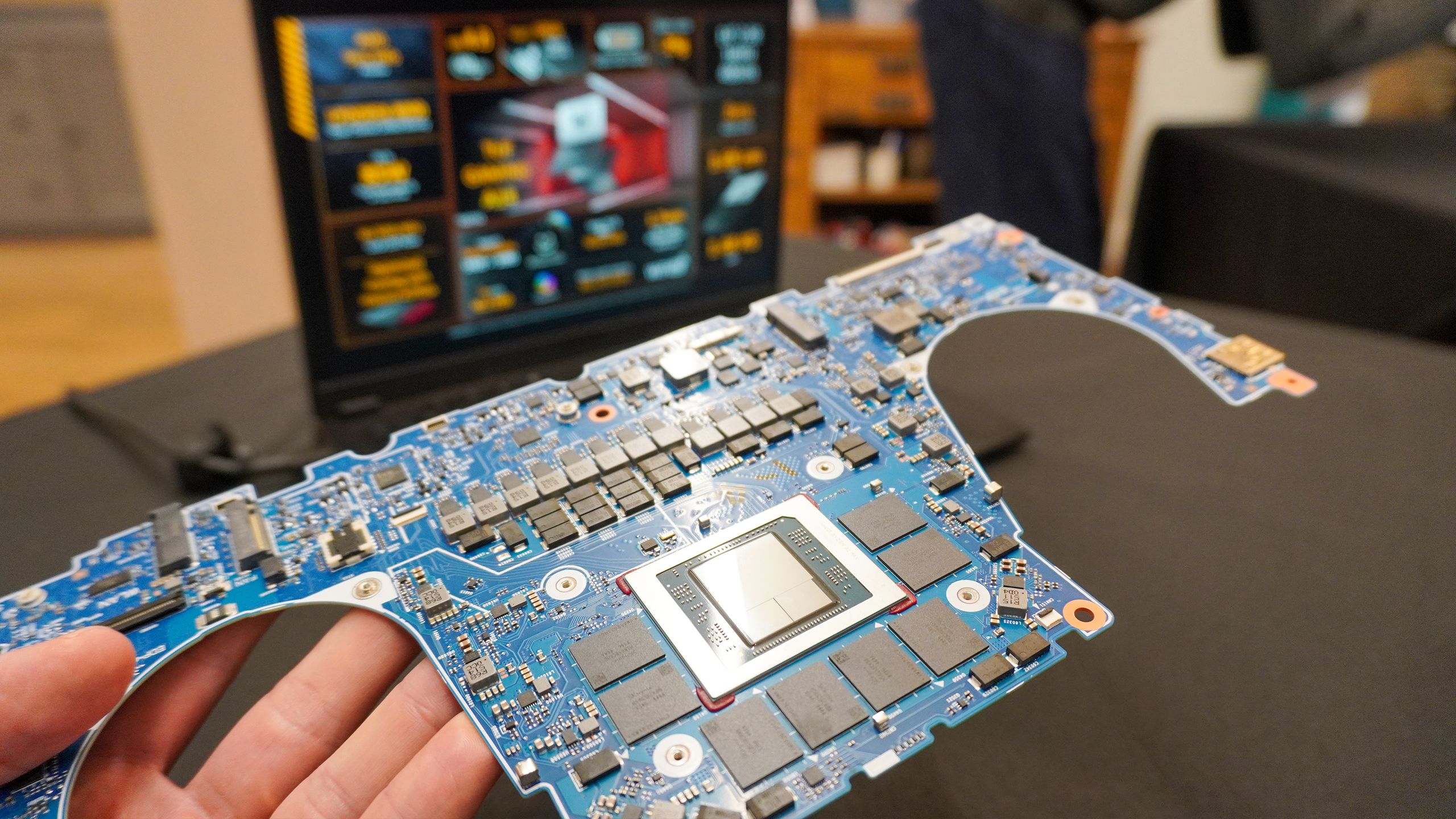
(Image credit: Future) With Nvidia widely rumored to unleash RTX Spark alongside Microsoft on October 7, AMD decided it couldn’t wait. Team Red executed a preemptive strike to not just show off its shiny new (and expensive) Ryzen AI Max+ Pro 495 silicon, the company cheekily rebranded itself as “Agentic Micro Devices since 2025.”Is this classic counter programming to plant a flag before Nvidia? Yes. But beneath the rush lies a piece of hardware with specifications so absurd they demand attention. Packing 16 desktop-class “Zen 5” cores and up to 192GB of unified memory, AMD’s built a brute-force x86 weapon designed to kill cloud AI subscription fees, take on Team Green and even make Apple a little nervous too.The 192GB cheat code (Image credit: AMD)To understand why AMD is sweating, look at what Nvidia is trying to pull off with RTX Spark. The team is aiming to make local AI agents accessible by pairing Arm-based compute cores with Blackwell graphics (a similar amount of cores that you find in the company’s desktop RTX 50-series GPUs) and unified system memory.Apple, of course, wrote this playbook years ago with Apple Silicon in the MacBook Pro — proving that fusing a CPU and GPU around a giant pool of memory is the ultimate setup for intense tasks and heavy local models. And while Apple built the sandbox that Nvidia’s trying to take over, AMD just decided to dump a truckload of concrete into it.If you want to run massive AI models locally on traditional laptops, the amount of memory means you simply cannot. Team Red’s Ryzen AI Max+ breaks that bottleneck through sheer volume to its digital brain:A 192GB shared reservoir: The CPU and GPU can share an enormous 192GB of memory running at a blistering 8.5 billion data transfers per second.The 160GB slider: I played with this on the Asus ProArt GoPro Edition with the AI Max+ 395. Using a feature called Variable Graphics Memory (VGM), users can carve out up to 160GB of that memory directly for graphics processing.The scale: This gives a single laptop more usable video memory (VRAM) than four desktop RTX 4090 cards strapped together. Not only is this huge for gaming (trust me, I tested it), but it allows for gargantuan 100+ billion-paramenter AI models to run entirely on-device and offline.And that offline bit is critical in my mind. While I’m always going to take a look at the sheer amount of memory being gobbled up and think “oh, so that’s why RAMageddon’s a thing,” I am a believer that local AI is the future over cloud models like ChatGPT or Gemini.Now, there are real-world examples to prove that.Get instant access to breaking news, the hottest reviews, great deals and helpful tips.Firing the cloud provider What meta concert should I check out next?? #vrconcert #vr #sabrinacarpenter - YouTube Watch On Tech enthusiasts are tired of hearing “AI” attached to every bit of basic spreadsheet math, so AMD’s brought in Emmy-winning production studio LightSail VR to show off the economic reality of local agents.This is the VR studio that recently caught a Sabrina Carpenter concert, and they deal with ultra-heavy 16K, 90 FPS stereoscopic 3D video for Hollywood. With client feedback pouring in across multiple projects, it was becoming overwhelming for the small team.Option one of using cloud models like OpenAI or Anthropic to coordinate this is impossible for two reasons:Strict Hollywood NDAs: Confidential scripts, clips or project schedules cannot leave the four walls of their studio.The cloud meter: Running autonomous agents that constantly re-index documents and shift production timelines would burn thousands of dollars a month in cloud AI token costs.So instead, LightSail VR build an in-house “production coordinator” agent on an AMD Ryzen AI Max desktop with unified memory — living directly inside the team’s personal Slack. It’s able to update schedules, rewrite spreadsheets and alert the team autonomously when an edit timeline shifts.And the payoff has been huge, with the studio able to manage six to nine concurrent productions with the personal effort required for just two, with zero data leaving the building and zero cloud AI token invoices.What does that mean for me? (Image credit: Future)But of course, you’re (probably) not producing 16K stereoscopic video for a Hollywood studio. Why should you care about a 192GB laptop processor? Simply put, the tech industry is currently trying to trap you in an endless web of AI subscription fees.Right now, using a generative AI agent to organize your life or draft your emails comes with a hefty monthly premium fee. By building a laptop chip with massive unified memory, AMD is effectively stuffing that cloud server into a backpack.That translates into two massive consumer victories:The death of the subscription tax: Buy the hardware once. After that, your autonomous digital intern can reorganize that messy hard drive, draft emails and analyze massive spreadsheets 24/7 without costing you a single cent in cloud AI costs.Absolute privacy: You no longer have to upload your tax returns, confidential work documents or personal schedules to a server in California just to get AI assistance. These gargantuan models can fit directly into the AI Max’s memory pool, so they run completely locally and offline.It’s not just about raw horsepower; it’s a hardware escape hatch from the looming cloud subscription era.The x86 moat against Arm (Image credit: Future)And that brings us to the core battlefield between AMD and Nvidia (and Apple to an extent).RTX Spark leans into Arm architecture. Arm chips deliver exceptional power efficiency — as Apple has proved for years — but running traditional Windows applications on Arm requires translation layers.And while Microsoft’s Prism emulation has improved massively (like Microsoft's engineer told me), translation layers still introduce power inefficiencies, occasional driver quirks and incompatibilities with legacy hardware.In my experience with AMD, the team spent a significant chunk of its time exploiting that vulnerability and repeatedly mentioning “Native x86” alongside there being “no emulation layer” for Windows and Linux.By sticking to the standard PC architecture of the past three decades, AMD avoids that trap entirely. Specialized software can run natively at full clip, older peripherals work out of the box, and when the work finishes, the integrated RDNA 3.5 graphics engine can natively fire up PC games without any chance of an emulator hiccuping mid-frame. (Image credit: Future)AMD’s scramble to share all of this two days before Nvidia takes the stage with Microsoft shows just how intense the pressure has become. Team Red is anxious that RTX Spark will set the narrative for what high-end AI laptops are supposed to look like.But by using native x86 architecture and an audacious amount of money, AMD has ensured that when Nvidia steps into the spotlight, it won’t be walking into an empty room. Follow Tom's Guide on Google News and add us as a preferred source to get our up-to-date news, analysis, and reviews in your feeds. More from Tom's GuideI tested the Asus ROG Zephyrus G14 (2026) like I was a student — its gaming, creator and AI performance is huge, but it comes at a costI just tested Windows 11 26H2 — here’s how to update now and why Microsoft finally fixed the two worst things about Windows 11I tested Microsoft’s fanless Snapdragon X2 Plus Surface Pro and Laptop: The MacBook Air should be terrified Jason brings a decade of tech and gaming journalism experience to his role as a Managing Editor of Computing at Tom's Guide. He has previously written for Laptop Mag, Tom's Hardware, Kotaku, Stuff and BBC Science Focus. In his spare time, you'll find Jason looking for good dogs to pet or thinking about eating pizza if he isn't already.
AMD just flaunted its own 192GB monster chip to spoil Nvidia’s RTX Spark party — Ryzen AI Max+ Pro 495 should worry Apple, too
Full Article
Original Source
Read the full article at Tomsguide →KhanList aggregates and links to publicly available news content. We do not host full articles from third-party sources. Always verify important information with original sources.