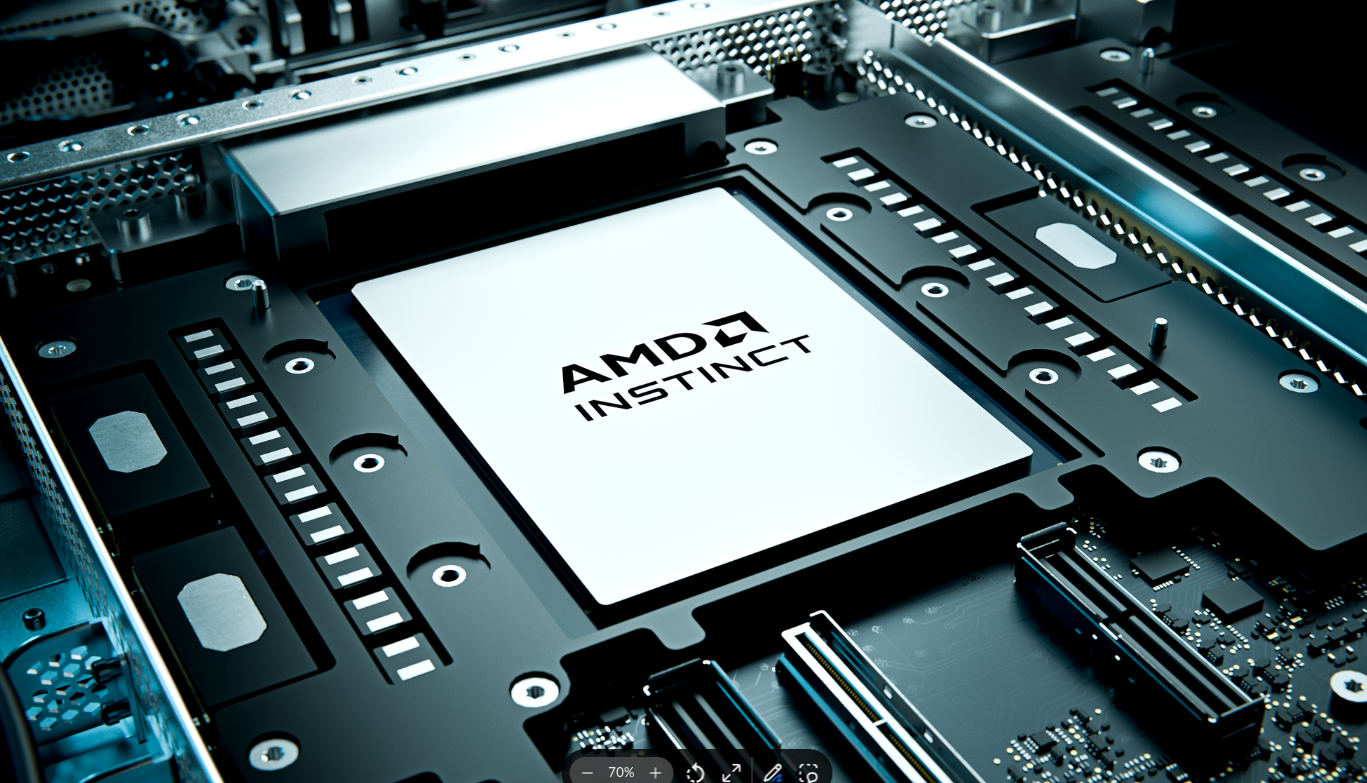
AMD debuts next-generation AI infrastructure for frontier models, agentic workloads and autonomous robots Advanced Micro Devices Inc. is pushing harder than ever to grab even more market share from Nvidia Corp. in the artificial intelligence chip industry. At its Advancing AI 2026 event today in San Francisco, the chipmaker announced a slate of updated hardware, including its next-generation AMD Instinct MI400 Series graphics processing units and the sixth-generation AMD EPYC central processing units for the most demanding agentic AI applications. The chipmaker didn’t stop at just silicon. It also revealed a major expansion into the realm of physical AI and autonomous robots. Its strategy here centers on the new Kria AI Solutions, the Ryzen AI Embedded X100 series processors and the new AMD Robotics Partner Network, taking on Nvidia in one of the industry’s most competitive and crucial industries. At the event, AMD Senior Vice President of AI Vamsi Boppana said it’s becoming necessary to use more specialized infrastructure to maximize the performance of the most advanced frontier models today. “The next generation of AI will span frontier AI, sovereign AI and scientific computing, and each requires infrastructure optimized for its unique demands,” he said. “The AMD Instinct MI400 Series extends our AI portfolio with purpose-built solutions optimized for the full spectrum of AI and HPC deployments, built on an open software foundation that gives customers the flexibility to innovate at every scale.” Specialized silicon for every workload AMD built the Instinct MI400 Series GPUs (pictured above) to address this challenge specifically, Boppana said. There’s a number of different chips in the series, including the Instinct MI455X GPU that’s engineered for high-volume inference workloads, AI training and fine-tuning within sprawling “AI factories.” Meanwhile, the Instinct MI430X GPU is geared toward sovereign AI and high-performance computing environments, delivering 288 teraflops of performance for advanced scientific applications. Both chips integrate the industry’s top-tier HBM4 high-bandwidth memory chips to support the deployment of larger models, and there are also encrypted GPU-to-GPU network connections to enhance the security of these workloads. Alongside these AI factories and scientific applications, AMD also wants to position itself as a key enabler of agentic AI in enterprise computing environments and power automated business operations. Agentic AI systems don’t just generate text – they can reason over data, make plans, execute code and use external tools to perform various kinds of work. But these sophisticated workloads require massive computational resources that cannot be provided by GPUs alone. Rather, what they really need are good, old-fashioned CPUs to perform tasks such as running agent sandboxes, coordinating background operations, managing memory states and ensuring data is constantly flowing into the GPUs. According to Dan McNamara, senior vice president and general manager of Compute and Enterprise AI at AMD, agentic workloads are made much more efficient when they’re powered by a combination of GPUs and CPUs. That’s why AMD is also unveiling its newest EPYC 9006 series server CPUs (below), made up of four specialized chips. The EPYC 9006 SP7 is designed for high-density agent sandbox execution, packing 256 cores and 512 threads to support greater numbers of agents per watt of energy. There’s also the EPYC 9006 SP8 CPUs, which are meant to provide right-sized efficiency for power-constrained devices with choices ranging from eight to 128 cores. The EPYC 9006X SP7, meanwhile, is aimed at data-intensive HPC and modeling workloads, and can hit speeds of up to 5.15 gigahertz with three times as much L3 cache available per core, compared to the standard SP7. Finally, AMD introduced the EPYC 9006 LP “Verano” CPU, which is a specialized low-power chip that’s purpose-built to act as an AI host node. For public cloud infrastructure providers and enterprises that need to deploy AMD’s chips at large scale, the company is offering the new Helios rack-scale data center system (below), which makes it simpler to get massive clusters of them up and running in the fastest time possible. Traditionally, data center operators faced a heavy burden in building up clusters of chips that can work in concert with one another, having to fudge together various fragmented networking components. This would often lead to integration headaches that would delay deployment timelines. To get around this, the Helios rack-scale system provides data center customers with preconfigured building blocks that can integrate AMD’s latest Instinct GPUs with the 6th Gen EPYC chips, plus its ROCm software and Pensando networking. Essentially, everything that’s required to get clusters up and running comes in a convenient package. According to AMD, a single Helios rack has 18 open-rack trays that can house a total of 72 GPUs, delivering up to 2.9 exaflops of peak FP4 performance, 1.4 exaflops of peak FP8 compute, and 31 terabytes of HBM4 memory. Focus on physical AI AMD doesn’t want to be confined to the cloud. It’s also a big believer in AI’s potential to impact the physical world by powering the next generation of autonomous robots. It wants to be at the forefront of that push, and it’s making a bid to do that with the launch of its new AMD Kria AI solutions (below), which are centered on the Kria AI Robotics Developer Platform. This is an integrated development platform that combines GPUs, CPUs, neural processing units and field-programmable gate arrays to power everything from a robot’s physical body to its intelligent brain. These resources can help autonomous robots to make more than 8,000 decisions-per-second while simultaneously enabling sub-millisecond vision-language-action reasoning, the company said. The AMD Kria platform is powered by AMD’s new Ryzen AI Embedded X100 Series processors, which combine up to 16 “Zen 5” CPU cores with an RDNA 3.5-integrated GPU and an energy-efficient NPU on a single system-on-chip. They’re designed to provide industrial-grade reliability in any environment, with AMD stressing confidence they’ll be able to operate in temperatures ranging from 105°C to -40°C without any problems for up to 10 years. To further its robotics push, AMD also launched the AMD Robotics Partner Network, which aims to bring together original design manufacturers, sensor providers and software vendors into an open ecosystem. The network will standardize on AMD’s ROCm software stack, which preserves around 75% of CUDA code during application migrations, allowing robotics makers to transition from Nvidia’s silicon with minimal trouble. With today’s announcements, AMD has shown that it can match the frenetic pace of silicon development set by its arch-rival Nvidia and provide enterprises with a real alternative to that company’s chips, which still dominate most AI data centers. In fact, AMD claims that its Helios rack-scale solution is a superior option for AI factories specifically, offering 15% greater peak FP4 performance and 50% greater HBM capacity while reducing token costs by up to 30% compared with Nvidia’s NVL72 rack systems. AMD didn’t say anything about when the new Instinct MI400 GPUs and EPYC 9006 series CPUs will be made available, but customers can expect the first samples to ship later in the year. Photos: AMD A message from John Furrier, co-founder of SiliconANGLE: Support our mission to keep content open and free by engaging with theCUBE community. Join theCUBE’s Alumni Trust Network, where technology leaders connect, share intelligence and create opportunities. 15M+ viewers of theCUBE videos, powering conversations across AI, cloud, cybersecurity and more 11.4k+ theCUBE alumni — Connect with more than 11,400 tech and business leaders shaping the future through a unique trusted-based network. Are you AWS customer? Support SiliconANGLE Financially by buying your AWS services from our Marketplace portal page and links. About SiliconANGLE Media SiliconANGLE Media is a recognized leader in digital media innovation, uniting breakthrough technology, strategic insights and real-time audience engagement. As the parent company of SiliconANGLE, theCUBE Network, theCUBE Research, CUBE365, theCUBE AI and theCUBE SuperStudios — with flagship locations in Silicon Valley and the New York Stock Exchange — SiliconANGLE Media operates at the intersection of media, technology and AI. Founded by tech visionaries John Furrier and Dave Vellante, SiliconANGLE Media has built a dynamic ecosystem of industry-leading digital media brands that reach 15+ million elite tech professionals. Our new proprietary theCUBE AI Video Cloud is breaking ground in audience interaction, leveraging theCUBEai.com neural network to help technology companies make data-driven decisions and stay at the forefront of industry conversations.
AMD debuts next-generation AI infrastructure for frontier models, agentic workloads and autonomous robots
Full Article
Original Source
Read the full article at Siliconangle →KhanList aggregates and links to publicly available news content. We do not host full articles from third-party sources. Always verify important information with original sources.