
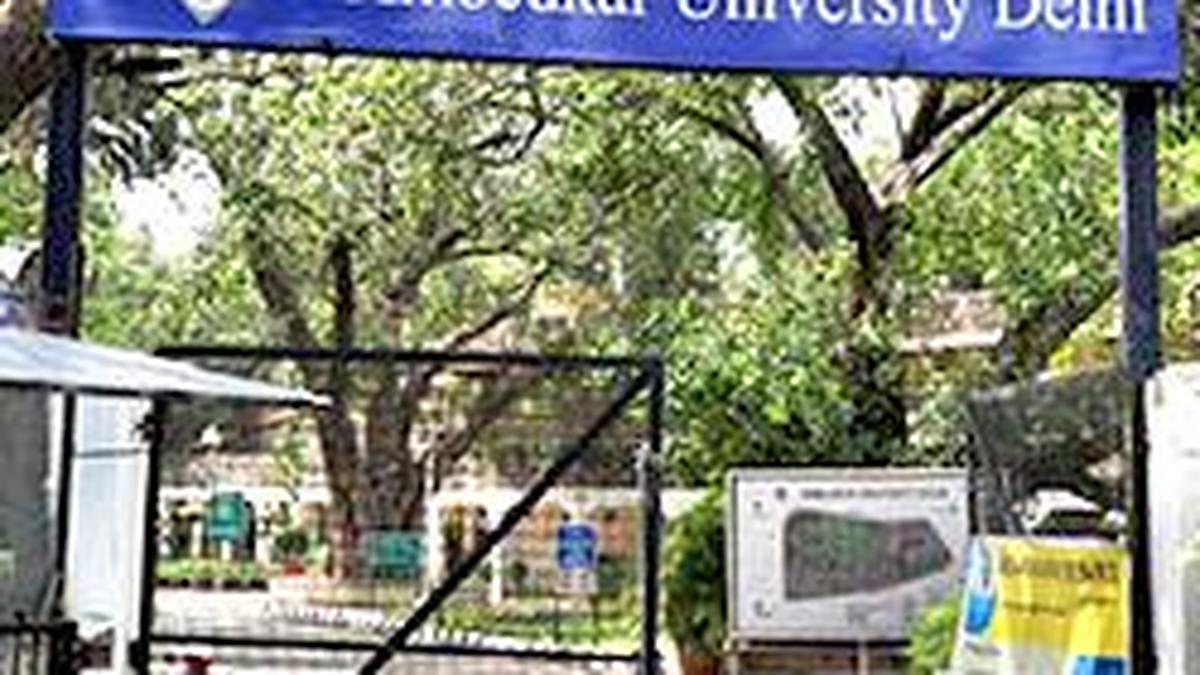
When the Delhi legislature established Dr. B.R. Ambedkar University Delhi (AUD) in 2007, the aim was to create a distinct public institution. Unlike the capital’s older central universities, AUD was conceived as a State university dedicated to the humanities, social sciences and liberal arts. Under founding Vice-Chancellor Shyam Menon (2008–2018), efforts were made to cultivate an academic culture grounded in interdisciplinary learning, pedagogical innovation and an egalitarian, convivial institutional environment. Its initial vision explicitly sought to integrate equality and social justice with academic excellence.(Sign up for THEdge, The Hindu’s weekly education newsletter.)After nearly two decades, the university is caught in a worsening standoff between its administration and its students. Open confrontations among students, doctoral scholars, and the administration at its Kashmere Gate campus have brought long-simmering grievances to the fore. This crisis points to a real change in the university’s functioning, marked by top-down surveillance, exorbitant fees, persistent delays in guest-faculty processes, and curbs on students’ everyday campus life.The unrest began with an official university order issued on July 31, 2026, by the Dean of Academic Affairs, titled Maintenance of Attendance-cum-Whereabouts Register for Ph.D. Scholars receiving Fellowship. Under this order, full-time researchers have to sign a daily attendance log, and they need prior approval from the administration before going out for field research, archival work, library visits, or conferences. The circular also warns that unauthorised absence will be punished with stipend deductions.Join THEdge LinkedIn groupIn the case of research scholars, this policy shows little understanding of how doctoral research works. Academic research in the humanities and social sciences is rarely confined to a desk. Fieldwork, external archives, and consultations with other institutions are part of the work itself. When student delegations met officials to protest the directive, administrators reportedly waved away their concerns. They compared doctoral scholars to Multi-Tasking Staff (MTS) and said the scholarship is a wage, so it can be monitored with a punch clock.The administration’s stance on the protests further highlights this institutional rigidity. When research scholars and student groups initiated an indefinite sit-in over mandatory attendance on September 28, 2026, the administration shut the campus gates, erected double police barricades, and deployed private security guards to secure the campus.Protesting students reported that security staff prevented them from bringing in food and essential medicines; a scuffle ensued, and some students were injured. Although the administration issued a new notification on September 30 modifying the wording regarding attendance, the scholars’ protest continued. They argued that the underlying structure, involving supervision by a clerk, remained unchanged, while major grievances concerning basic amenities and fees had been ignored.This pattern of administrative heavy-handedness has already drawn judicial scrutiny. In its judgment in Nadia v. Dr. B.R. Ambedkar University Delhi on March 13, 2026, the Delhi High Court set aside the university’s expulsion of a student who had participated in a campus sit-in. The High Court ruled that universities cannot suppress peaceful student protests or curb the expression of ideas merely because they conflict with administrative views. It called the expulsion disproportionate and legally unsustainable.Behind the barricades lies an everyday campus infrastructure in an increasingly visible state of neglect. While the historic Dara Shikoh Library within the complex was restored by the Archaeological Survey of India (ASI), the university’s regular academic and student amenities have declined. Classrooms across the heritage wing suffer from unchecked monsoon seepage that drips onto conference tables and warps ceiling tiles, leaving electrical wiring exposed. Sanitation facilities are in a similar state of disrepair, with washrooms across active blocks plagued by detached fixtures, flooded floors and stalls packed with maintenance debris.Beyond physical decay, the scarcity of shared spaces reflects a wider spatial enclosure. Students point out there are no accessible green spaces or outdoor seating. Meanwhile, the maintenance of well-kept lawns and gardens is confined solely to the administrative block, an area where student access is prohibited. This makes the gap between administrative and student areas obvious.These physical deficiencies sit alongside high costs for students. A comparison of selected regular M.A. programmes in the humanities and social sciences shows that AUD charges substantially more than some other public universities. Annual fees range from ₹1,200 to ₹2,400 at Calcutta University, ₹8,240 at Lucknow University and ₹10,000 to ₹12,000 at Panjab University; AUD operates on a significantly higher cost structure. Even within Delhi, where Guru Gobind Singh Indraprastha University sets annual MA fees at around ₹66,000 in its postgraduate brochure, AUD remains considerably more expensive. The Admission Brochure 2026–27 lists regular Master of Arts fees at ₹47,600 in the first semester and ₹41,600 in later semesters, while MBA fees reach ₹2,36,000 in the first semester alone. For doctoral scholars, official notices show dissertation fees rising from ₹7,000 a semester for the 2023 batch to ₹8,000 for 2024 and ₹9,000 for 2025 .Support for poorer students has also been rolled back. The university brochure states that full tuition fees are waived for students belonging to Scheduled Castes, Scheduled Tribes, and Persons with Benchmark Disabilities. There are provisions for tiered fee concessions based on income for families earning less than ₹6 lakh annually. In practice, upfront fee exemptions at admission have been replaced by a post-admission reimbursement mechanism. Admitted students must deposit the full fee upfront, with fee remissions dependent on retrospective review by an administrative committee, effectively turning a positive safeguard into a hurdle at the very point of entry.Doctoral researchers face a structural withdrawal of institutional support under the university’s fee framework. The Fee Notice for Monsoon Semester 2026 reveals how fee remissions have been limited. The university offers a fee waiver only for the coursework component of the first year, the charges for which are classified as tuition fees.From the third semester onwards, this charge is reclassified as a dissertation fee, ranging between ₹7,000 and ₹9,000 per semester; and alumni and student welfare fees are also applicable. Since fee waivers apply only to tuition fees, research scholars from all economic and caste backgrounds must pay the full semester fee out of their own pockets after completing their coursework, while existing travel grants and fieldwork allowances remain suspended.At the same time, while the university consistently charges a mandatory ‘Student Welfare Fund’ (SWF) fee in every student’s bill, students report significant disruptions and an absence of regular disbursements for essential book and commuting expenses. These fee notices warn that failure to clear outstanding dues within the stipulated timeframe will result in a daily late fine of ₹50, as well as the cancellation of enrollment and the declaration of a ‘zero semester.’Alongside this financial strain, there is also a severe shortage of accommodation at the university’s temporary campus. The university has no hostel beds of its own available for male students across any of AUD’s four temporary campuses. For female students, the total residential capacity across the university is limited to 85 seats, comprising 45 seats at IGDTUW’s Kaveri Hostel and 40 seats at the Savitribai Phule Hostel in Karampura. Students arriving from other cities are forced to rely on Delhi’s expensive private rental market. That raises the real cost of studying at a public university.Work on AUD’s proposed permanent campuses in Dheerpur and Rohini has faced persistent delays. The Directorate of Higher Education records that 40.12 acres at Dheerpur and 17.5 acres at Rohini were allotted years ago. In June 2026, the Delhi government approved ₹1,668 crore for the Dheerpur campus to cater to 8,000 students, but the site lingered at initial clearance stages for years while the university operated out of makeshift campuses.A few people now hold several key posts; for instance, the same person is simultaneously discharging the responsibilities of Chief Proctor, Dean of Academic Affairs, and Dean of the School of Letters. Under this arrangement, the very office that issued the controversial academic directive has also been tasked with taking disciplinary action against students in response to their protests. Alongside this centralisation, the legally mandated transparency has also been disregarded. Formal requests filed under the Right to Information Act, 2005, including an application dated September 21, 2026, asking for certified records on attendance rules, scholar room infrastructure, and maintenance spending, alongside online filings registered with the university’s nodal officer, have passed the mandatory 30-day statutory window without administrative replies.The unrest unfolding at Kashmere Gate is more than a disciplinary dispute or a quarrel over circulars. It is a clear indication of an institutional drift that views academic inquiry as contract labour, students as a source of revenue, and democratic dissent as an administrative nuisance. If a public university charges fees comparable to private institutions yet fails to provide basic civic amenities, accommodation and initial welfare support, it is no longer serving the public. The administration may think barricades and punch-clock registers will silence student anger, but they only widen the gap between the administration and its students. AUD needs to rethink how it is run. This starts with dropping the fortress mentality and bringing back the egalitarian spirit that once made the university so valuable.Rahul Verma is an independent researcher and sociology educator. Views are personal.
Ambedkar University Delhi’s administrative crisis
Full Article
Original Source
Read the full article at Thehindu →KhanList aggregates and links to publicly available news content. We do not host full articles from third-party sources. Always verify important information with original sources.