
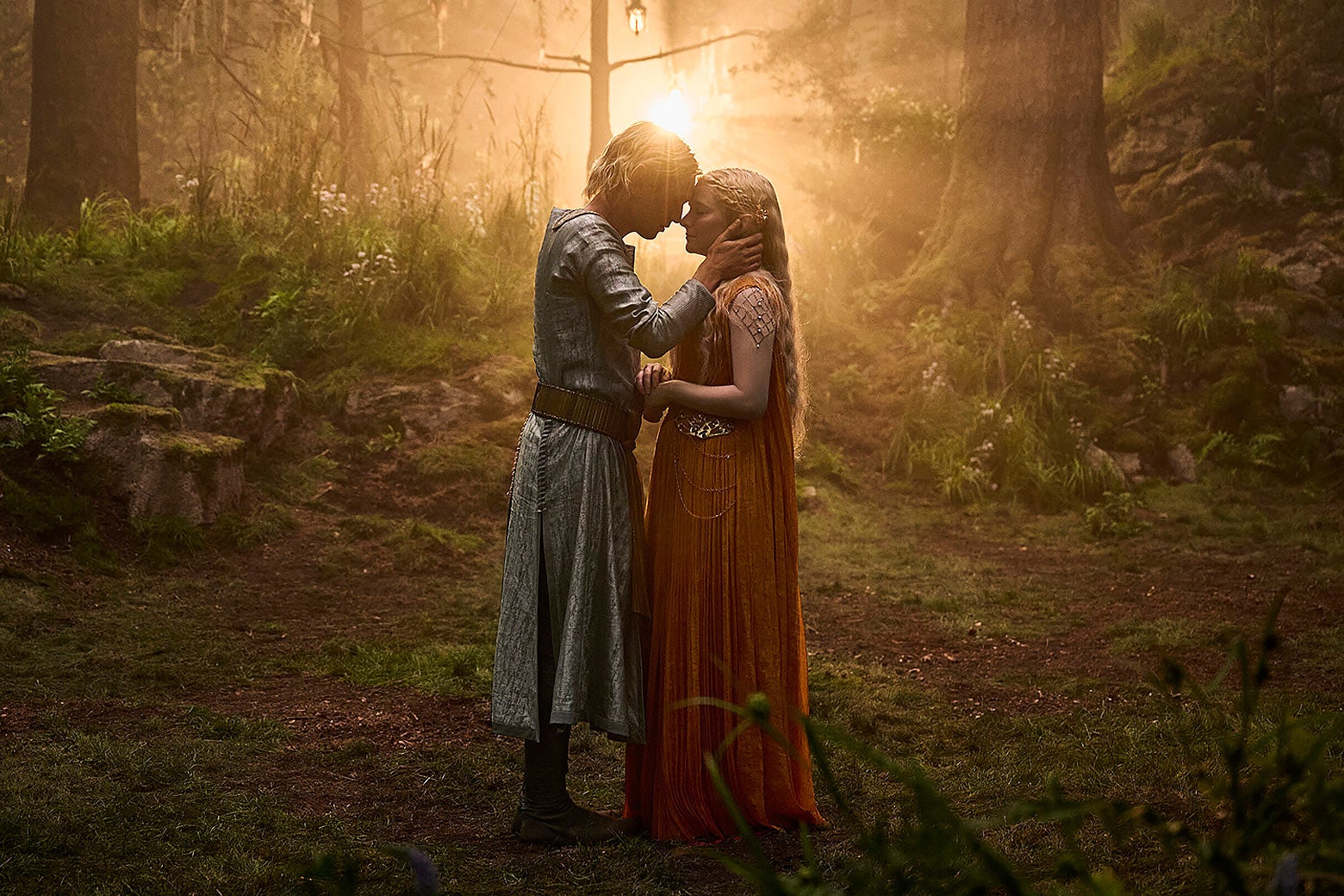
Television The Rings of Power Is Back, and It’s Going Full Romantasy The Prime Video series, now in its third season, just keeps moving further away from Tolkien. By Enter your email to receive alerts for this author. Sign in or create an account to better manage your email preferences. Unsubscribe from email alerts Are you sure you want to unsubscribe from email alerts for Laura Miller? Nov 11, 202610:00 AM Prime Video Sign up for the Slatest to get the most insightful analysis, criticism, and advice out there, delivered to your inbox daily. When a friend recently confessed to me that she’d gotten caught up in Prime Video’s J.R.R. Tolkien adaptation, The Rings of Power, because of the “dark romance” brewing between Galadriel (Morfydd Clark) and Sauron (Charlie Vickers), I was taken aback. As a longtime Tolkien buff, I’d casually clocked the undercurrent between the two characters throughout the first two seasons, but assumed it was just part of Sauron’s Great Deceiver playbook. A sort of fallen angel with no fixed corporeal manifestation, Sauron is more or less a version of Satan. By the Third Age, when The Lord of the Rings takes place, he’s more spectral than physical, a distillation of pure evil, but in the Second Age, when The Rings of Power takes place, Sauron has not yet fashioned the One Ring and must manipulate other characters—the elven smith Celebrimbor (Charles Edwards) in particular—to consolidate his power. Surely, I thought, he was simply capitalizing on Galadriel’s loneliness to deflect her from her single-minded pursuit of the murderer of her brother: Sauron himself. Well, I was wrong. Having watched almost all of the third season of The Rings of Power, which premieres with four of eight episodes on Wednesday, I can attest that the showrunners—two inexperienced and not noticeably talented writers, J.D. Payne and Patrick McKay—are leaning into that dark romance trope. The pair was recently asked by Nerdist if the introduction of Celeborn (Jamie Campbell Bower), Galadriel’s long-lost husband, in Season 3 was setting up “a bit of a love triangle,” and they replied, “The answer to your question is yes, absolutely.” To the Tolkien lover, that’s a dagger to the heart. I have yet another friend who dismissively refers to The Rings of Power as Galadriel, Mother of Dragons, and Season 3 seems intent on proving him right, too. The series’ first season, notoriously dull, still seemed somewhat committed to its source material back in 2022. While Tolkien wrote at length about the time period depicted in the series in both The Silmarillion and other works, Amazon Studios only obtained the rights to The Lord of the Rings, which contains a relatively brief overview of the Second Age. This understandably obliged Payne and McKay to embellish the storyline with non-canonical events and characters, most of whom have been disappointingly one-dimensional, their mouths filled with often unbearably banal dialogue. Furthermore, the action takes place in a dizzying number of settings with multiple plotlines that are difficult to keep track of even if you’re familiar with Tolkien’s invented world. Season 2 of The Rings of Power, while not exactly good, felt a bit more focused and was better received two years ago. A tragic subplot about a leader of the orc resistance added an interesting dimension to creatures depicted as utterly unsympathetic in the books. The further the showrunners get from Tolkien, the more assured the series has gotten, but, alas, also the more hackneyed. The operative model now seems to be: Let’s make a Game of Thrones that looks like Peter Jackson’s The Lord of the Rings, juice it up with plenty of sword fights, and toss in a hefty garnish of romantasy for the ladies. Sauron spends much of the third season sulking over being rejected by Galadriel and taunting Celeborn over her alleged preference for the Dark Lord. That’s when he’s not shoring up his reputation for cruelty by having potential ring servants fight each other to the death or casually feeding his orcs to a dragon (because, yes of course, there has to be dragon riding). This Sauron is both a petty spurned lover and a monster, which makes for an unlikely romance object. Or does it? “Every woman adores a Fascist,” Sylvia Plath wrote. “The boot in the face, the brute.” Disappointing, but she had a point. When asked to explain his own will to power, Vickers’ Sauron says that he feels “bliss” at the thought of making every living being “submit” to him, hinting that Galadriel will be first and foremost among his slaves. A handsome, coldly imperious dom, he seems increasingly shaped by fan service and the showrunners’ calculating awareness that for some viewers, a female lead being fought over by two hot guys is sheer catnip. (There’s even a subplot mimicking this dynamic among the dwarves in Season 3, though the hotness factor is dialed way down.) On the plus side, there are no Harfoots (precursors to the hobbits), with their hokey country ways, in the first seven episodes of Season 3 available to critics, and Tom Bombadil behaves less like a cookie-cutter mentor figure straight out of the Hero’s Journey playbook and more like the nature elemental he actually is. But these are virtues of omission, weak things there are simply less of in Season 3, more than an increase in excellence. To its credit, a few of the action sequences in the new season are genuinely exciting. But The Rings of Power continues to suffer from thin characters without interesting internal conflicts and a pervasive lack of humor. Amazon committed to five seasons of The Rings of Power when it bought the rights to The Lord of the Rings. The series’ first two seasons are the second and third most expensive per-episode TV productions ever (after Stranger Things’ fifth and final season), with an estimated total cost of more than $1 billion, making it likely the most costly series of all time. Yet Forbes reported that only 37 percent of the viewership for Season 1 stuck it out to the season’s end. At this year’s Comic-Con in San Diego, McKay assured potential viewers that they didn’t need to watch the first two seasons before jumping into Season 3, a statement that’s patently absurd and smacks of desperation. Maybe The Rings of Power can cobble together a respectable viewership from a collection of people with a motley assortment of interests: battle scenes and sword fighting, palace intrigue, romantasy, and the stray Tolkien fan who’s willing to forgive a multitude of sins just to see Alan Lee’s beautiful Tolkien illustrations brought to life. The series continues to look ravishing, but other than that, there’s not much left on the screen for the Tolkien lover who still cares anything for the misty, mysterious soul of his books. Amazon TV Romance Fantasy The Lord of the Rings
Amazon’s Lord of the Rings Series Is Going Full Romantasy. Tolkien Lovers, Shield Yourselves.
Full Article
Original Source
Read the full article at Slate →KhanList aggregates and links to publicly available news content. We do not host full articles from third-party sources. Always verify important information with original sources.