
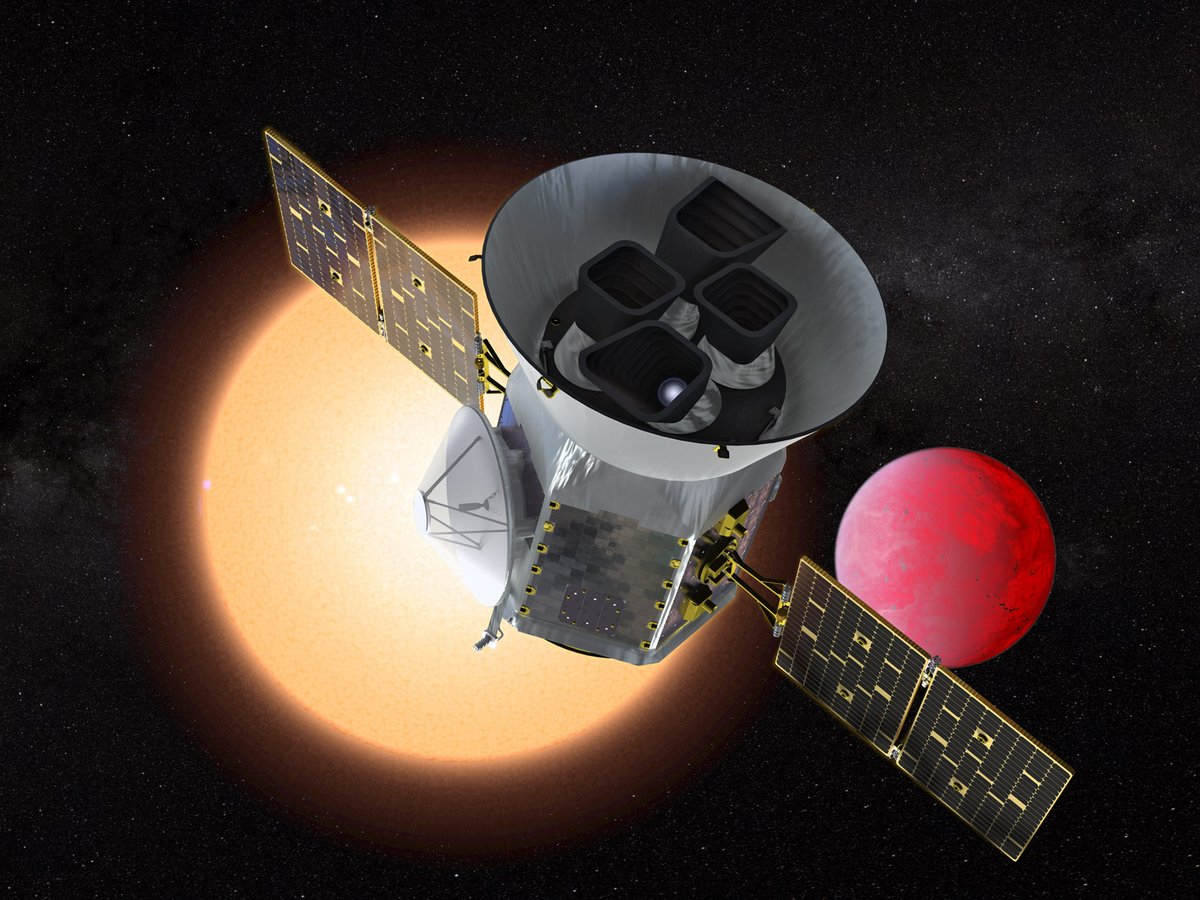
An amateur astronomer harnessed artificial intelligence (AI) agents to find a previously undiscovered exoplanet lurking in publicly available data.Pavel Rabtsevich, a Spain-based product manager who is a space-science hobbyist, was poring over data collected by NASA’s Transiting Exoplanet Survey Satellite (TESS), an exoplanet-hunting space telescope, when he noticed something odd. TESS looks for the subtle dimming caused by planets transiting, or passing in front of, their stars. Of the more than 126,000 target stars Rabtsevich was examining with a custom-built AI algorithm, his machine-learning assistant directed its focus toward one in particular: TIC 4206066. Located around 116 light-years away from Earth in the Orion constellation, the data indicated it dimmed for about two hours every three days.Curiosity piqued, Rabtsevich dug through the TESS archives for more data on the same star, finding an additional 22 instances of dimming. If the signal is confirmed as an exoplanet, the world would be a super-Earth around 1.4 times the size of our planet. Although likely a rocky world, its three-day orbit of TIC 4206066 would mean it has an estimated surface temperature of 1,000 degrees Fahrenheit (530 degrees Celsius).On supporting science journalismIf you're enjoying this article, consider supporting our award-winning journalism by subscribing. By purchasing a subscription you are helping to ensure the future of impactful stories about the discoveries and ideas shaping our world today.But stars can dim for many other reasons. In this case, for instance, Rabtsevich noticed the dips in TIC 4206066's light in 2018 tended to align with moments where TESS fired its thrusters, which may have skewed the results. For now, while Rabtsevich hopes this may be a new exoplanet, he acknowledges that all that can be confirmed is a “repeating transit-like signal in open data, with a plausible planetary explanation and alternatives that aren’t yet ruled out.”“Models agreeing with each other isn’t evidence,” he says. “What I rely on is a signal anyone can measure, calculations anyone can rerun, control samples, and rules published before the next data [sets] arrive.”The search couldn’t have been done without AI, Rabtsevich adds, noting that he used multiple agents and that the models “wrote the code, ran it and checked each other's work.” Even so, he maintains, “the research itself was mine: the question, the plan, the rules, the computing, the decisions on every candidate and what to publish.”The potential for at least one exoplanet orbiting TIC 4206066 seems “solid,” says Greg Laughlin, a former planet-hunting astronomer at Yale University who now works in the AI industry. Rabtsevich’s analysis is “a great example of human-AI teamwork,” he adds: large language models like Claude and Codex have proven effective at combing astronomical literature for overlooked discoveries.If there is indeed an exoplanet circling TIC 5206066, Rabstevich may not actually be the first to have seen it. Pablo Mercader Perez, a PhD student at the Massachusetts Institute of Technology and member of the TESS team, says the signal was picked up by a detection filter in 2020, but was ultimately rejected due to a lack of conclusive evidence. Since then, TESS has conducted much more observation of that part of the sky.“Thanks to this, we got much more data than we had before for this particular star system, and the signal became a lot clearer,” Perez says. In terms of statistical significance, he adds, “this planet candidate became effectively detectable only in January of this year.”A deep learning model developed by Perez’s team has also flagged the potential exoplanet, he says,“Independently but also not public yet, a search performed by Prof. Michelle Kunimoto using her software called LEO-Vetter had also selected this planet candidate already back in early 2026, which is another way in which it would almost certainly have been alerted in the official list in the next few months,” Perez says.Other amateurs, either entirely on their own or taking cues from Rabstevich’s exciting candidate, are now pursuing additional AI-assisted dives into public data sets from TESS and other NASA missions, with some reporting promising early results.In the meantime, Rabstevich's calculations have prompted NASA’s TESS team to reexamine the star once the spacecraft’s orbit around the sun brings the target into position in November. He’s also recruited several other astronomers to look at the star and critique his findings, which include a speculative additional exoplanet in a more distant orbit around the star.Regardless of who might claim the discovery, “it’s exciting that the parent star has been put on TESS’s high-cadence list, which should elevate the confidence in the detection,” Laughlin says. “There’s every reason to expect that this candidate super-Earth will pass further tests and make it into the official census.”
Amateur astronomer harnesses AI to find a possible hidden exoplanet
Full Article
Original Source
Read the full article at Scientificamerican →KhanList aggregates and links to publicly available news content. We do not host full articles from third-party sources. Always verify important information with original sources.