
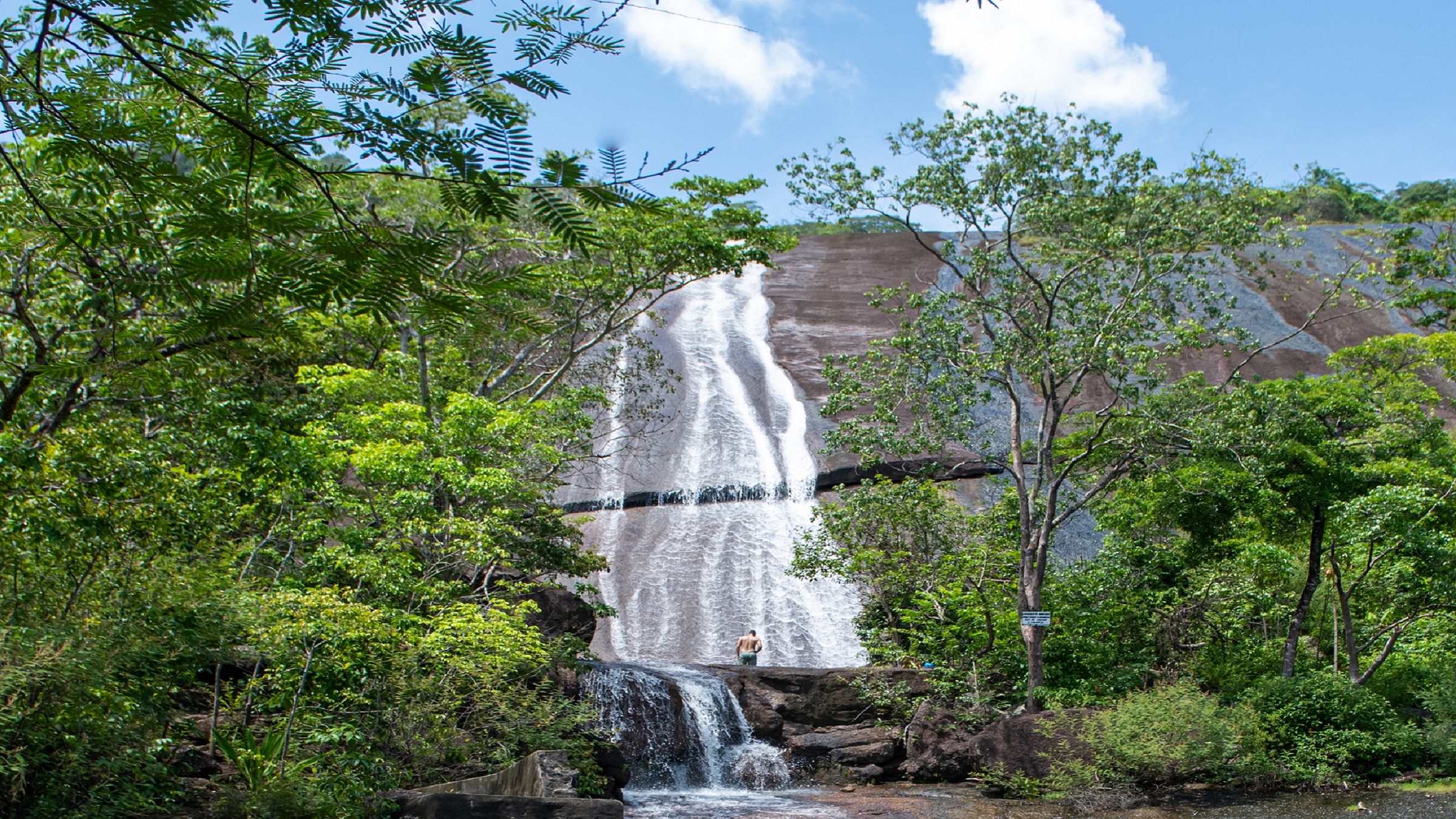
Driven by a “super El Niño,” reduced rainfall in Roraima has lowered water levels in the state’s main rivers, cutting off the flow of seasonal waterfalls that form in the mountains, including the cascade known as Véu de Noiva.By drying up the waterfall earlier than usual, climate change is directly hurting regional tourism, which local residents and surrounding communities rely on for their livelihoods.Guides and tourism specialists say the drop in tour bookings has forced the sector to reinvent itself, while the state government operates under a state of emergency to prepare for environmental fallout from El Niño. BOA VISTA, Roraima — “For those who live off the river, water isn’t just scenery: It is also a road, work and income.” That is how tour guide Fredson Guedes, known as “Tarzan,” learned to view the natural world around him over the course of his 55 years. “I work entirely with nature and depend heavily on it. Just the other day, I was at Serra Grande [an ecotourism destination in the municipality of Cantá, Roraima], working at the Véu de Noiva [bridal veil, in Portuguese] waterfall, but now there is no waterfall anymore. It dried up.” In the Amazonian region of Serra Grande in Brazil, about 50 kilometers (31 miles) from the state capital, Boa Vista, the seasonal waterfall known as Véu de Noiva usually draws visitors from May through early September during Roraima’s rainy season. That changed in 2026. By late July, the water that defines the landscape had already vanished. Fábio Wankler, a geologist and professor at the Federal University of Roraima (UFRR), points to a “super El Niño” as the driver behind the disruption. The phenomenon, unusually intense this year, has triggered a series of shifts in weather patterns that, across various parts of the country, “have caused longer and more intense periods of drought,” he said. The effects are felt daily. The waterfall, whose cascading flows resemble the delicate lace of a wedding gown, sits along one of the primary routes traveled by Guedes, who navigates the Branco River to reach it at least twice a week. That same river supplies drinking water to Boa Vista’s population, winds beneath the pillars of the Macuxis Bridge and sustains several freshwater beaches across the capital’s metropolitan area. Mongabay traveled the tourist route to the waterfall in late July for what unexpectedly became the guide’s final expedition of 2026. The lack of rain was so severe that the trip was nearly canceled. “If there’s no water, it’s not worth taking you,” Guedes said. The Véu de Noiva waterfall is already dry, months ahead of schedule. Image courtesy of Ivaldo Araújo. Shifting weather conditions were quick to make themselves felt along the route: While heading down the Branco River, sandbars and shallow stretches required cautious navigation; on the return trip, the boat even ran aground at one point due to low water levels. What river guides and residents are witnessing reflects a broader drop in precipitation. Across Roraima, rainfall has remained below historical averages throughout the year, according to the National Institute of Meteorology (INMET). The abnormal deficit extended even to the historically wettest months, such as June and July. The seasonality of the tourist attraction depends directly on stable rainfall patterns and the region’s geological features. When the water fails to come, there is simply no waterfall to see. “Water is stored mainly in fractures [in the bedrock] and in shallow, moist soils at the top of the mountains. The replenishment of these ‘reservoirs’ occurs during the rainy season, while the forest prevents the water from evaporating rapidly,” Wankler said. For Ivaldo Araújo, owner of the farm where the waterfall is located, the vanishing rains have dealt a heavy financial blow. In a normal year, he said, “the high season lasts about five months and we receive, on average, 6,000 visitors.” But after only three months of rain, tourist numbers plunged by half, leaving Araújo with an estimated loss of about $500,000 Brazilian Reais — the equivalent of around $100,000. Guedes also lost income. “I used to make R$1,200 [$238] a week working just two days [Saturday and Sunday],” he said. With visits to the waterfall cut short, his weekly earnings have fallen to around 800 reais ($159). “I adapt: I run trips to the beaches, rent kayaks and stand-up paddleboards and organize trail hikes, whatever day of the week it is,” he said. Elen Dias, a tourism technician and business owner in the sector, said the drop in rainfall disrupted a travel route that had been “on the rise” in recent years, threatening an entire network that depends on visitors for a living. “Behind every tour are boats, guides, drivers, restaurants, accommodations and local businesses,” she said. “It’s on rainy days that the economy heats up.” Tour guide Fredson Guedes, known as “Tarzan,” stands in front of the boat he uses to take visitors to the Véu de Noiva waterfall in Cantá, Roraima. Image by Felipe Medeiros. Crisis extends beyond tourism According to the National Oceanic and Atmospheric Administration (NOAA), the 2026 El Niño has a 75% chance of becoming the most intense recorded since 1950 — earning it the nickname “super.” The phenomenon forms as equatorial Pacific waters warm. It gathered strength in June and intensified in August, with effects projected to stretch into early 2027 and alter rainfall patterns for months across the Amazon and beyond. As a result, Wankler said, environmental risks are likely to mount. The list of possible consequences includes “an increase in burnings and forest fires,” as well as “a regional water crisis that could lead to shortages and losses for agricultural and livestock production,” according to the geologist. Prompted by the climate disruptions forecast for 2026, the Roraima state government declared a state of emergency in early September and formed an integrated task force to coordinate preventive actions. The administration pledged to deploy more firefighters across all 15 municipalities and drill artesian wells to prevent water shortages. The emergency decree remains in place for 180 days. The pillars of the Macuxis Bridge, seen from the Boa Vista waterfront, stand exposed due to low water levels in the Branco River. Image by Katarine Almeida. In mid-September, a team from Brazil’s Ministry of Health went to Roraima “to evaluate the state’s capacity to respond to the impacts of the drought and dry spell on the health of the population and the operation of health services.” Wankler said a public health crisis could stem primarily from smoke produced by fires in the Amazon region. In August, the federal government registered “the highest number of hotspots on historical record for the period in Roraima,” documenting 87 outbreaks through Aug. 27 — surpassing the previous August record of 78 hotspots set in 2023. “It is urgent to modernize how water resources are planned and managed. And actions need to be developed, such as early warning systems, contingency plans, funds for populations to rebuild their activities and incentives to diversify income sources for communities dependent on a single productive activity,” Wankler said. For Guedes, who is among those directly impacted by climate change, the shifts across Roraima’s landscape and the premature end of the waterfall’s seasonal cycle have arrived far earlier than expected. “I used to think: ‘No, it will only be [with] our grandchildren.’ But [the climate crisis] is already starting with us. Now, in the present. Right now we are already feeling it,” he said. A section of the Taumanan Waterfront in Boa Vista, Roraima, is washed by the waters of the Branco River. Image by Katarine Almeida. Banner image: Visiting area of the Véu de Noiva waterfall in Cantá, Roraima. Image by Katarine Almeida. Edited by Lucas Berti. This story was reported by Mongabay’s Brasil team and first published here on our Portuguese site on Oct. 1, 2026. Credits Topics
‘Already feeling it’: Northern Amazon waterfall season ends early, hurting livelihoods
Full Article
Original Source
Read the full article at News →KhanList aggregates and links to publicly available news content. We do not host full articles from third-party sources. Always verify important information with original sources.