
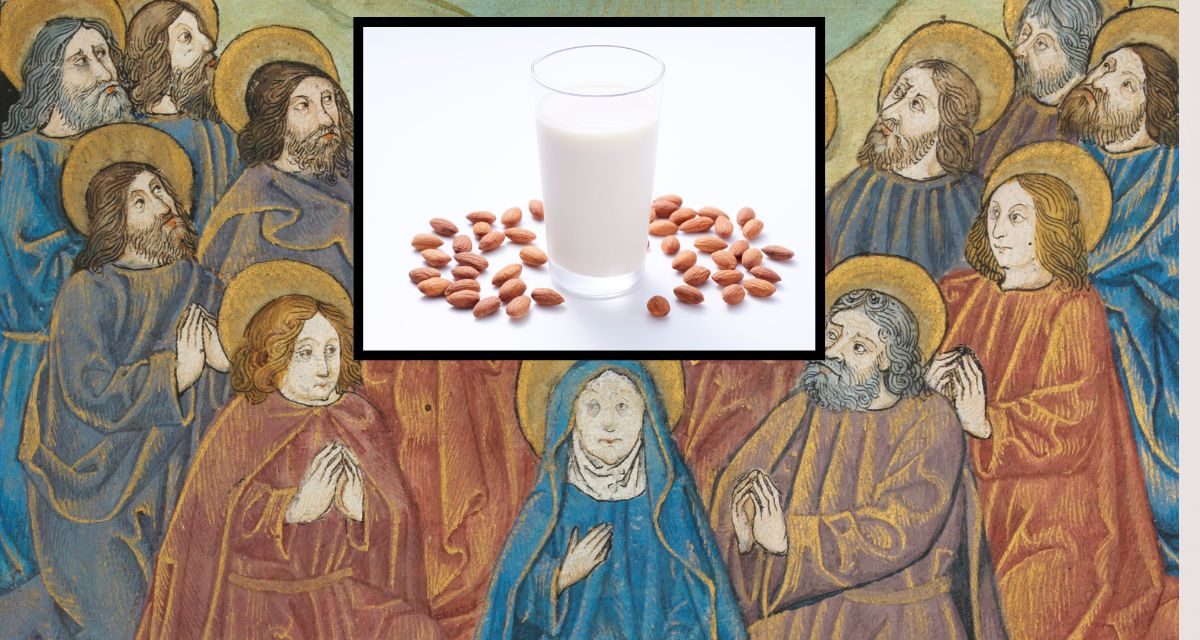
If you’ve ever ordered an almond milk latte, odds are you weren’t picturing yourself participating in a culinary tradition that goes back to the Middle Ages. But almond milk isn’t a modern invention created for the age of newly discovered dietary restrictions and lactose aversion. People in medieval Europe were making and cooking with it centuries ago, and they had a particularly practical reason for doing so. Not to mention a religiously motivated one. During Christian fasting periods, particularly Lent, medieval rules prohibited the consumption of certain animal products, including dairy, for a good chunk of the year. For cooks accustomed to making rich dishes with milk, butter, and eggs, that created a culinary conundrum. A medieval stained glass panel from Canterbury Cathedral, c. 1175 – c. 1180, depicting the Parable of the Sower, a biblical narrative. Wikipedia Thankfully, almond milk, which had already been well established in Middle Eastern cuisine, offered a solution. For one, it was fairly simple to make. Grind almonds, mix them with water, and strain the resulting liquid. Done. And, once made, almond milk could do milk’s job of thickening sauces, soups, stews, and desserts. Obviously, this chameleonic quality could provide the perfect culinary loophole. A 14th-century German cookbook called Das Buch von guter Speise, for example, features several Lenten fasting recipes that utilize chicken or fish cooked in thick almond milk as a dairy substitute. Other medieval recipes used almond milk with rice, dates, and sugar to make sweet dishes appropriate for Lent. However, if you think almond milk is expensive now… There was one catch, though. Almonds weren’t exactly cheap in medieval northern Europe. They were imported on a large scale, and the cost of getting them there made them a relatively luxurious ingredient. But for cooks who could get their hands on almonds (namely those who worked in wealthy households), they offered a remarkably useful way to keep making rich, satisfying dishes during a fast. Point being, your almond milk latte has a surprisingly old ancestor. It just happened to be invented long before anyone had to ask whether the barista could make it extra foamy. Your oat milk has ancient relatives, too Various vegan milk ingredients. Canva And almond milk was hardly the only plant-based milk with an ancient backstory. Humans have been turning plants into milk-like drinks for thousands of years. Coconut milk, for example, has roots going back roughly 5,000 years, while rice milk was being made in China by around 1000 B.C. Soy milk also has a long history, with references to it appearing in Chinese sources nearly 2,000 years ago. Even oat milk, which can feel like the ultimate symbol of the modern coffee-shop era, has been around for decades. Swedish food scientist Rickard Öste developed the modern version in the 1990s as an alternative for people who couldn’t digest cow’s milk. So while the cartons lining today’s grocery store shelves may be relatively new, the basic idea behind them is anything but.
Almond milk is about 800 years old, and medieval cooks had a clever reason to make it
Full Article
Original Source
Read the full article at Upworthy →KhanList aggregates and links to publicly available news content. We do not host full articles from third-party sources. Always verify important information with original sources.