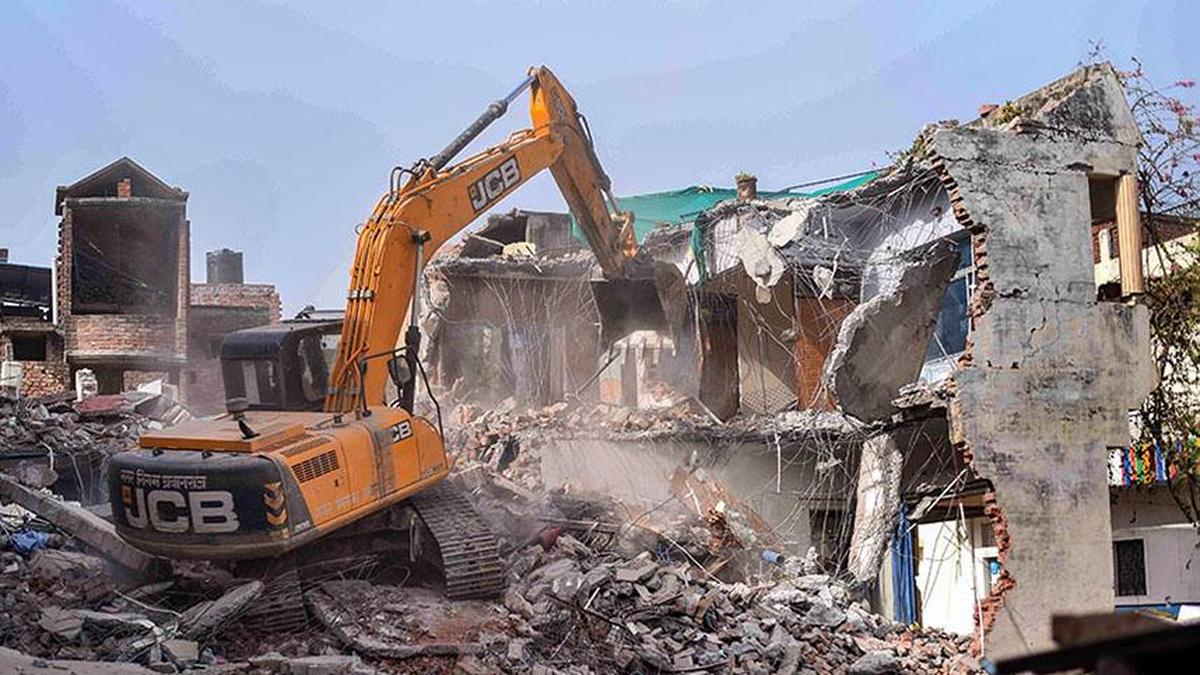
A Division Bench of the Allahabad High Court has delivered a split verdict in a case of “bulldozer action” anticipated by the petitioners on their homes and properties. Two judges contemplated whether the High Court can issue additional safeguards against demolition beyond those laid down by the Supreme Court. Following the verdict on Monday (July 20, 2026), the difference in opinion of the two judges led the matter being referred to the Chief Justice for placing it before a third judge.The case arose from a petition filed by three residents of Uttar Pradesh’s Hamirpur district, who alleged that their residential house and commercial establishments had been sealed and were under threat of demolition after an FIR was registered against one of their relatives under the Protection of Children from Sexual Offences (POCSO) Act and the Uttar Pradesh Prohibition of Unlawful Religious Conversion Act.The petitioners contended that they were not accused in the criminal case and that the accused had no ownership interest in their properties. They argued that the administrative action affected not only their home but also their sources of livelihood, including a lodge and a saw mill.The State maintained that the proposed demolition was unrelated to the FIR and was being considered because the structures had allegedly been constructed on irrigation department land without an approved building plan.The matter was heard by a Bench comprising Justices Atul Sreedharan and Siddharth Nandan. While both judges agreed that demolition proceedings must comply with the Supreme Court’s directions and follow due process, they differed on whether the High Court could impose additional safeguards governing such action.Justice Sreedharan observed that demolition of homes had increasingly become an instrument of executive action and quoted Urdu poet Bashir Badr’s lines: “log toot jate ek ghar banane me…tum taras nahi khate bastiyan jalane me” (people face ruination in just making a home and you feel no remorse setting ablaze entire settlements).‘Perceived bloodlust of society’He said demolition of homes was an action by the State which aims largely to satiate the “perceived blood lust of a society fed on a staple diet of bulldozer justice over the electronic media, social media and messaging platforms...”Referring to the Supreme Court’s rulings on the issue, Justice Sreedharan said the executive had no authority to declare a person guilty of an offence, as guilt could be determined only through judicial scrutiny. Consequently, he held, the State could not demolish the property of an accused as a form of punishment without following due process.Addressing the State’s contention that the proposed action related to unauthorised construction, Justice Sreedharan observed that no dwelling came up overnight and that authorities responsible for regulating construction often failed to act because of political patronage or corruption.“Over decades, the average Indian has normalised corruption. It is no longer wrong as long as one does not get caught. Even in the rankings of Transparency International 2025 report, India ranks at 91 amongst 182 nations, but even that does not shame us. The recent controversy relating to the theft of donations at the Ram Temple is the proverbial last straw on the camel’s back. Nothing can shame a people who remain unfazed by the theft at the Ram Temple which epitomises the nadir of the Indian’s integrity,” the judge observed.He added that the collective absence of integrity affected every institution, including municipal authorities, whose dishonesty enabled individuals to construct buildings in violation of municipal laws. The judge further observed that rampant corruption could result in the concentration of wealth in the hands of a few, widening inequality and creating conditions for future civil unrest.“If the State is serious, actually serious, about curtailing corruption and retrieving India from the abject morass of dishonesty and complete lack of integrity, it should consider amending the Prevention of Corruption Act, 1988 to include the death penalty for those convicted of corruption,” he suggested.Justice Sreedharan proposed two additional safeguards. He held that authorities should ordinarily refrain from demolishing the dwelling of an accused person for two years from the registration of an FIR, describing immediate demolition under the guise of enforcing municipal laws as a “retributive exercise of executive discretion”. He also directed that where an allegedly unauthorised dwelling had existed for more than three years, authorities should ordinarily issue a one-year “notice of intent” before initiating demolition proceedings.Other judge at varianceJustice Nandan disagreed with both directions. In his separate opinion, he held that no fixed period could be prescribed restraining statutory authorities from exercising powers under the Uttar Pradesh Urban Planning and Development Act, 1973. Such a direction, he said, would effectively keep the operation of the statute in abeyance.Justice Nandan observed that there was a presumption that statutory authorities would act in accordance with law and the principles of natural justice. He added that any person aggrieved by such action could seek appropriate relief before the High Court.In view of the divergence of opinion, the Bench referred two questions to the Chief Justice for placing the matter before a third judge. The reference will determine whether the High Court, while exercising jurisdiction under Article 226 of the Constitution, can restrain authorities from taking action under the 1973 Act for a fixed period of two years, subject to exceptions, and whether authorities can be directed to issue a one-year “notice of intent” before initiating proceedings under municipal laws.
Allahabad HC delivers split verdict over bulldozer action on homes, properties of accused persons
Full Article
Original Source
Read the full article at Thehindu →KhanList aggregates and links to publicly available news content. We do not host full articles from third-party sources. Always verify important information with original sources.