
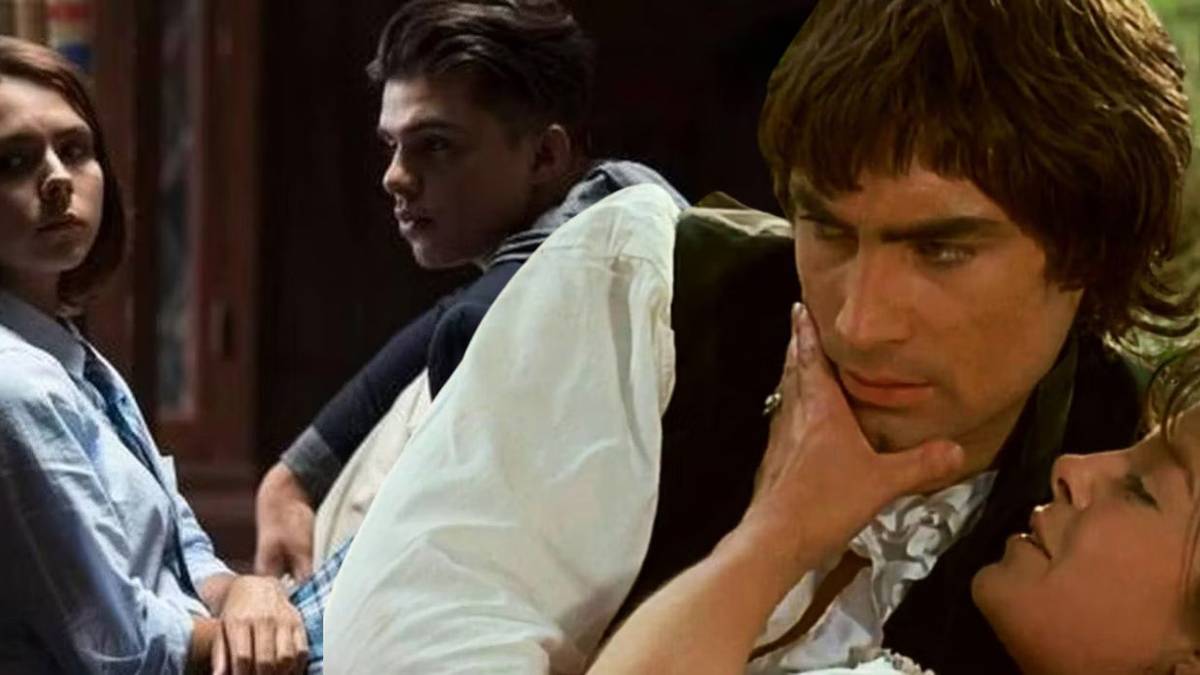
The best Wuthering Heights movie is hard to determine, as the classic Emily Brontë novel has been adapted several adaptations over the years. As one of the most famous love stories of all time, the source material continues to draw storytellers in with the challenge of adapting the timeless story. Part of the challenge of bringing Brontë's book to the screen is the sprawling nature of the novel, both in terms of space and time. The story follows two families over two generations. However, the best Wuthering Heights movie adaptations usually skimp out on one of the storylines. When it comes to the best Wuthering Heights movie, it ultimately depends on viewer preference, as each adaptation differs in style and the plot points borrowed from the 1847 novel by Emily Brontë. Nonetheless, in terms of overall quality, there are ways to pinpoint which among these adaptations is the best Wuthering Heights movie or series. As different as they are, like all the Wuthering Heights references in Twilight reveal, these movies prove how deeply Brontë's work remains embedded in the cultural zeitgeist. Wuthering Heights (2003) The 2003 adaptation is generally considered to be the least appreciated of the Wuthering Heights movies. The basic premise is the same: a young woman named Cate accepts a marriage proposal from Edward, but remains in love with another man, Heath, after she's married. This movie introduces a musical aspect as the characters sing original songs throughout, but the effort ultimately wasn't successful. Though it's far from being the best Wuthering Heights movie, the songs are great, which makes this MTV-produced adaptation unique. Most of the songs are performed by Erika Christensen (Julia from Parenthood), who plays Cate, and Mike Vogel (Barbie from Under the Dome), who plays Heath. The charm of the songs comes from the fact that executive producer Jim Steinman produced the album, and he credits the book, Wuthering Heights, for his power ballad, "It's All Coming Back to Me Now," which Celine Dion covered. Wuthering High (2015) 2015's Wuthering Heights Lifetime movie adaptation re-imagines Cathy and Heathcliff as two California high school students. The teenage Heath is adopted by the wealthy and prominent Earnshaw family and begins a romantic relationship with his new step-sister. The basic premise is there, but this falls far from what viewers would expect from an adaptation of Wuthering Heights. A more teen-based drama, the 2015 Wuthering Heights movie stars James Caan as the patriarch of the Earnshaw family, easily the most recognizable face in the entire film. This Wuthering Heights adaptation received no critical review average on Rotten Tomatoes, but the low 31% rating from the Audience Score shows that it never connected as an adaptation of the source material or as a movie standing on its own. It also doesn't help that, at only 88 minutes, Wuthering High never had a chance to properly tell the full story. Wuthering Heights (2026) Wuthering Heights, directed by Emerald Fennell and starring Margot Robbie and Jacob Elordi, has quickly become one of the most polarizing adaptations of Wuthering Heights by Emily Brontë. Though its Rotten Tomatoes and Metacritic scores suggest a mixed-to-positive reception, critical opinion is sharply divided. Some reviewers praise the film’s lush cinematography and bold sensuality, arguing that Fennell embraces the story’s toxic obsession with operatic flair. Others feel the adaptation sacrifices the novel’s emotional depth and moral complexity for glossy aesthetics, reducing a generational tragedy to a stylized romance. The result is a visually striking but hotly debated reimagining that continues the story's long history of divisive screen interpretations. Emerald Fennell never claimed her Wuthering Heights would be a faithful adaptation, a stance reflected in the quotation marks around the title, and she called the film her own response to the book. The second generation is entirely absent from it, along with Catherine's older brother Hindley, who is a source of Heathcliff's abuse in the novel. Wuthering Heights reached digital platforms on March 31, including Amazon Prime Video, Apple TV and Fandango at Home, with commentary by Fennell. An American Sign Language version, performed by Leila Hanaumi and Giovanni Maucere and directed by Justin Jackerson, is available there too. The 4K UHD, Blu-ray and DVD editions followed on May 5, with Fennell's commentary and several behind-the-scenes featurettes among the special features. Wuthering Heights (1962) Released in 1962, the BBC television adaptation of Wuthering Heights is shorter and mostly focuses on the first half of the book with some great performances by Claire Bloom as Cathy, Keith Mitchell as Heathcliff, and Patrick Troughton as Hindley. The set is minimal and doesn't have many, if any, outdoor shots, which is odd considering what a big part the Yorkshire moors play in the novel. The outdated production value and over-the-top drama make this one difficult to watch for modern audiences, though it has its moments. Currently, while the BFI has this movie in its library, the company has refused to allow it to stream or receive any public screenings today (via BFI). Claire Bloom earned a Grammy Award nomination for Best Spoken Word Album when she returned to the role of Cathy 17 years later for an audio version of Wuthering Heights, losing to Orson Welles' audio version of Citizen Kane. Wuthering Heights (1967) This 1960s adaptation of Wuthering Heights was a BBC multi-episode miniseries that aired on television and finished with decent ratings. Ian McShane and Angela Scoular star as Heathcliff and Cathy, and it is a decent adaptation of the original novel that is set during the same period and attempts to follow the original text. The movie shifts between more of a stage play and a movie, so it feels a bit lost at times, but overall it's a decent adaptation with some fine acting. What helps this Wuthering Heights adaptation stand above some others is the outdoor scenes, which show the desolation of the Yorkshire moors, with barren trees and a foreboding horizon. While the 1962 movie failed to show almost any outdoor scenes, despite their importance to the story, this version ensured that the location and setting remained a strong part of the story. Sadly, the master tapes were wiped, so the only versions available are black and white film copies transferred to DVD. Wuthering Heights (1950) The 1950 version of Wuthering Heights, a made-for-TV movie, suffers from the low production values that one would expect from a project like this during that particular era. An unexpected element present is the inclusion of Charlton Heston, although at that time he wasn't a mainstream celebrity yet and was starring in several Studio One releases. On top of Wuthering Heights, he also had roles in the TV movie versions of Jane Eyre (1949), The Taming of the Shrew (1950), and Macbeth (1951). This adaptation features melodramatic performances and production values that make it far from being the best Wuthering Heights movie. However, the source material is relentlessly dramatic, so perhaps all the melodrama can be forgiven considering when it was made, and under a studio situation that puts out multiple editions of these dramatic adaptations every year. Wuthering Heights (2011) The 2011 adaptation of Wuthering Heights forgoes any emphasis on the romantic in favor of a focus on the raw elements of the story, from the setting to the characters. This retelling was considered too rough for some, who felt that the film might have benefited from paying closer attention to the more romantic, traditional elements of the novel. However, this may be the best Wuthering Heights movie for those who love the gothic world of Emily Brontë's tale of love, obsession, and revenge. It's certainly the most beautifully shot Wuthering Heights adaptation, winning the Best Cinematography award at the Venice Film Festival. The 2011 movie, made in North Yorkshire, chose to pass on big-name stars like Natalie Portman and Michael Fassbender and instead went with Kaya Scodelario as Catherine and James Howson as Heathcliff (via Digital Spy), focusing mostly on their childhood and adolescence and less on the later years of their lives. James Howson was the first Black actor to play Heathcliff on screen, in Andrea Arnold's low-key, bleak 2011 film. That makes it a rare Wuthering Heights adaptation that actually addresses Heathcliff's ambiguous racial background. By casting Howson opposite Scodelario, Arnold adds a necessary layer of social subtext, according to Tom's Guide. Wuthering Heights (1970) Starring Timothy Dalton as Heathcliff and Anna Calder-Marshall as Cathy, 1970's Wuthering Heights is one of the more critically praised and loyal adaptations of the book. This version puts up a good fight for the title of best Wuthering Heights movie for its honest interpretations of the internal struggles of the main characters. Had the movie adapted the entire book instead of following the previous convention to adapt only the first half, it may have ended up as the best adaptation ever. The movie was also a box-office success, making over $2.2 million, while picking up a Golden Globes nomination (for Michel Legrand's music score). Not only was the movie a financial success and a critical darling, but it also almost received a sequel called Return to Wuthering Heights. It is unclear if this would have allowed a second movie to finish the story from the book. Abismos de Pasión (1954) Luis Buñuel's 1954 Mexican film Abismos de Pasión, also known as Wuthering Heights, turns Catherine and Heathcliff into Catalina, played by Irasema Dilián, and Alejandro, played by Jorge Mistral. Buñuel begins his version midway through the text, with Alejandro's return from exile. The blissful nurturing of the pair's love is left for the audience to infer from the violent machinations that follow. Wuthering Heights (2009) This may be the most popular version of Wuthering Heights, despite possibly being the least faithful to the book. There are changes to the order in which the events of the story are told, as well as several minor additions that, depending on one's view, add to the relationship between Cathy and Heathcliff. Other moments that are considered iconic from the book are left out, such as Cathy's ghost at the window and Heathcliff overhearing her speech to Nelly. However, the performances of the leads are good, with Charlotte Riley and the now-Hollywood-A-lister Tom Hardy displaying great chemistry. Even Hardy's strange wig took nothing from the fact that he may be the best version of Heathcliff. Another very familiar face for many fans is Rick Grimes himself, as Andrew Lincoln stars as Edgar Linton in this version of the story. While it was, in the end, a series that mostly had highlights from the source novel, it remains one of the more entertaining retellings.
All Wuthering Heights Adaptations Ranked
Full Article
Original Source
Read the full article at Screenrant →KhanList aggregates and links to publicly available news content. We do not host full articles from third-party sources. Always verify important information with original sources.