
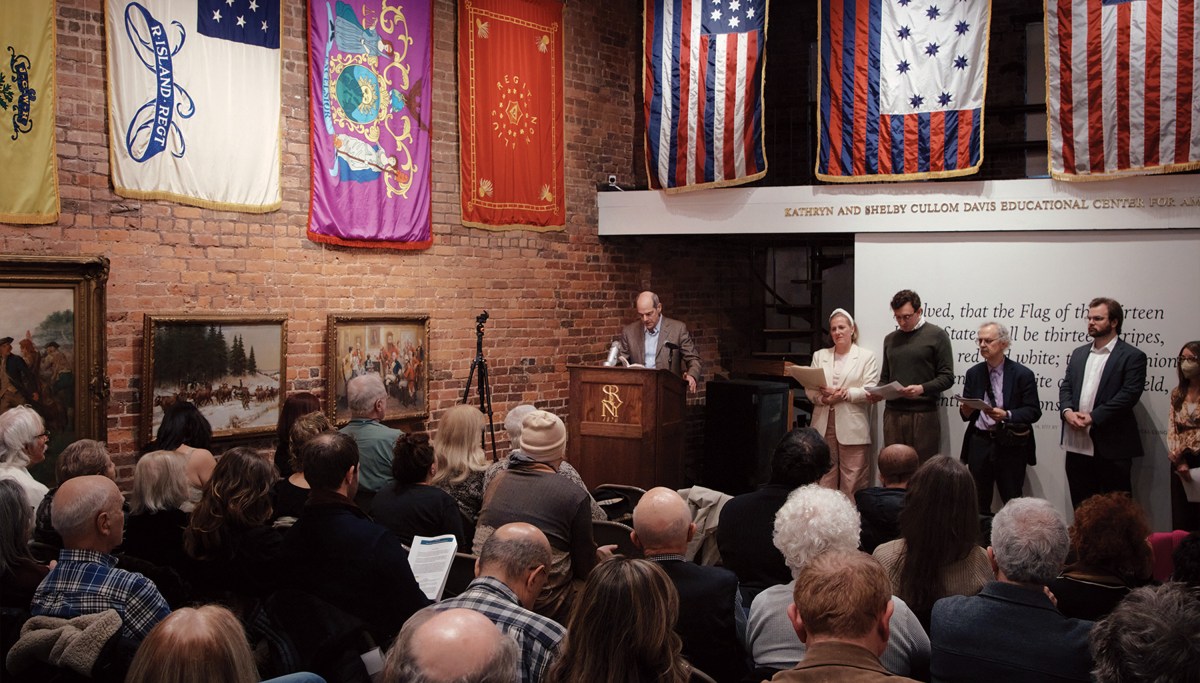
The promulgation of the Declaration of Independence on July 4 was by far the most momentous event to occur in 1776. Yet, it was by no means the only momentous event to occur in 1776. Before the glow from July’s celebrations of America’s 250th birthday fades entirely, it’s worth taking a few moments to acknowledge some of the other happenings that made 1776 a true annus mirabilis, a miracle year. Published on just the 10th day of the new year, Common Sense was the first sign of how epochal 1776 would be. Thomas Paine’s earthshaking pamphlet, just 47 pages in its first edition, articulated the case for independence with an urgency and force that galvanized his new countrymen. Paine played no small part in convincing them that independence was what they were fighting for and, therefore, was the only acceptable outcome of their incipient rebellion. “The cause of America is in a great measure the cause of all mankind,” he proclaimed. The ferocity with which Paine urged his fellow Americans to embrace that cause has lost none of its power. The year’s literary sensations weren’t confined to the western side of the Atlantic. Two of the most celebrated books in the English language were published in early 1776. On Feb. 17, the first volume of The History of the Decline and Fall of the Roman Empire was released to the public. Written by Edward Gibbon, the most continental of the great 18th-century British literary figures, this epic narrative of “the triumph of barbarism and religion” fused the vast erudition of antiquarians and other scholars with the mode of philosophical history dominant at the time. Most readers perceived none of that. What they were scandalized (or delighted) by was Gibbon’s irreverent and ironic treatment of Christianity. Readers were clued in to what they were in store for by his observation in chapter II that no writer would dare attempt to expose his country’s gods “to public ridicule” unless they were already “the objects of secret contempt among the polished and enlightened orders of society.” A man orates selected readings from Thomas Paine’s “Common Sense” during an event commemorating the 250th anniversary of the pamphlet’s publication at the Fraunces Tavern Museum on Jan. 10, 2026, in New York. (AP Photo/Andres Kudacki) Britons barely had time to digest Gibbon’s rich meal when they were offered a veritable feast on March 9 in the form of An Inquiry into the Nature and Causes of the Wealth of Nations. Adam Smith’s tome is a work of such diverse, sprawling proportions that I couldn’t even begin to summarize it here, but his discussion, in Book III, of commerce’s spread across Europe is worth highlighting. Smith was perhaps not the first to draw the crucial link between the expansion of commerce and the rise of personal liberty, but he gave it arguably its classic formulation when he noted that as burghers were exempted from feudal obligations, they “became really free in our present sense of the word Freedom.” The commerce of the towns “gradually introduced order and good government, and with them, the liberty and security of individuals,” to the country. It did this in particular by giving the “great proprietors” something to spend their money on besides innumerable hordes of retainers. And so, in one of the great historical ironies, they squandered their might “for a pair of diamond buckles perhaps, or for something as frivolous and useless.” Commerce’s emancipatory effect, according to Smith, was something that only his fellow Scotsman David Hume had hitherto appreciated. It was therefore appropriate that Smith’s magnum opus, which built on Hume’s insight, appeared just months before Hume’s death in August. Though today his reputation rests primarily on his seminal philosophical tracts, this titan of Scottish letters was known in his day more for his hugely popular multivolume history of England. He was also a prolific essayist who wrote on a variety of subjects. Two of the most frequent were politics and economics. As Hume had begun to realize, however, they were often the same subject. “Trade was never esteemed an affair of state till the last century,” he noted in “Of Civil Liberty.” And in the aptly titled “Of Commerce,” written in the 1750s, Hume advanced what was still a novel proposition: that “the greatness of a state, and the happiness of its subjects … are commonly allowed to be inseparable with regard to commerce.” Ancient republics seem more powerful than modern states because they had no commerce and therefore could employ all hands on public works or put them to arms. Contemporary rulers may be tempted to “return to the maxims of ancient policy,” but Hume advises them against entertaining such notions, as “ancient policy was violent, and contrary to the more natural and usual course of things.” There’s no going back to the old days, however much some might desire to resurrect them. “Sovereigns must take mankind as they find them, and cannot pretend to introduce any violent change in their principles and ways of thinking.” In their own ways, Paine, Gibbon, Smith, and Hume embodied the Enlightenment principle that the future is more important than the past. More than any other, it was this idea that motivated that great movement. At least in the English-speaking world, 1776 was the year in which it was determined that, having turned to the future, there would be no turning back from it. Evidently, 1776 was a year for words, and not just in English. 1776 was also the year Jean-Jacques Rousseau began his last work, the Reveries of the Solitary Walker. Unfinished at his death two years later, the Reveries, the final in a set of autobiographical texts he composed in his last years to justify himself to others and, above all, to himself, portrays the Genevan philosopher at his most appealing and sympathetic, especially in the Fifth Walk, an essential meditation on the interaction of time and happiness. Rousseau is arguably the quintessential modern, as he was the first to diagnose dissatisfaction with modernity as the perennial and defining condition of modernity.Few events have had a greater impact on the modern world than the Industrial Revolution. The first Watt-Boulton steam engine was installed in March 1776 in Staffordshire. Three months later, the great 19th-century landscape artist John Constable, whose paintings attempted to preserve the world industrialization was driving to extinction, was born in Suffolk.The Declaration of Independence was adopted on July 4. Eight days later, Captain James Cook, the last great seafarer of the Age of Exploration, embarked from Plymouth upon his third voyage. On the first two, Cook and his men had become the first Europeans to explore the east coast of Australia, witness surfing, circumnavigate New Zealand, and set foot in New Caledonia. This third one was commissioned to search for the Northwest Passage. Cook failed, but as a consolation, he and his crew in 1778 became the first Europeans to visit Hawaii, where, in a dispute with the natives, he was killed a year later. Unlike Britain, Spain’s presence in North America was growing in 1776. On Nov. 1, the seventh mission in Alta California, Mission San Juan Capistrano, was founded by the Franciscan missionaries who sought to bring the word of God to the native population. Three weeks earlier, on Oct. 9, the sixth mission had been established: Mission San Francisco de Asìs.THE FRENCH NOBLEMAN WHO LOVED AMERICA All the while, the Revolutionary War raged. The siege of Boston, which started when the shots were fired at Lexington and Concord the preceding year, ended in March. Engagements persisted throughout the year, from the Burning of Norfolk on Jan. 1 to the Battles of the Rice Boats (March 2-3) and the Cedars (late May), through those of Long Island (Aug. 27), White Plains (Oct. 28), Fort Washington (Nov. 16), and Fort Lee (Nov. 20). The last four were part of a series of British victories that placed the rebels on the precipice of defeat. The dire situation prompted Paine’s lament in the first American Crisis, published on Dec. 19, that “these are the times that try men’s souls.” On Christmas night, six days later, George Washington crossed the Delaware. Apparently oblivious to all that was transpiring around them and intent only on their own concerns (as seems to be the tendency of youth in every age), on Dec. 5, five students at the College of William & Mary founded Phi Beta Kappa, progenitor of collegiate Greek-letter organizations, fraternal and academic. Varad Mehta is a writer and historian. He lives in the Philadelphia area. Find him on X @varadmehta.
All the many things that happened in 1776
Full Article
Original Source
Read the full article at Washingtonexaminer →KhanList aggregates and links to publicly available news content. We do not host full articles from third-party sources. Always verify important information with original sources.