
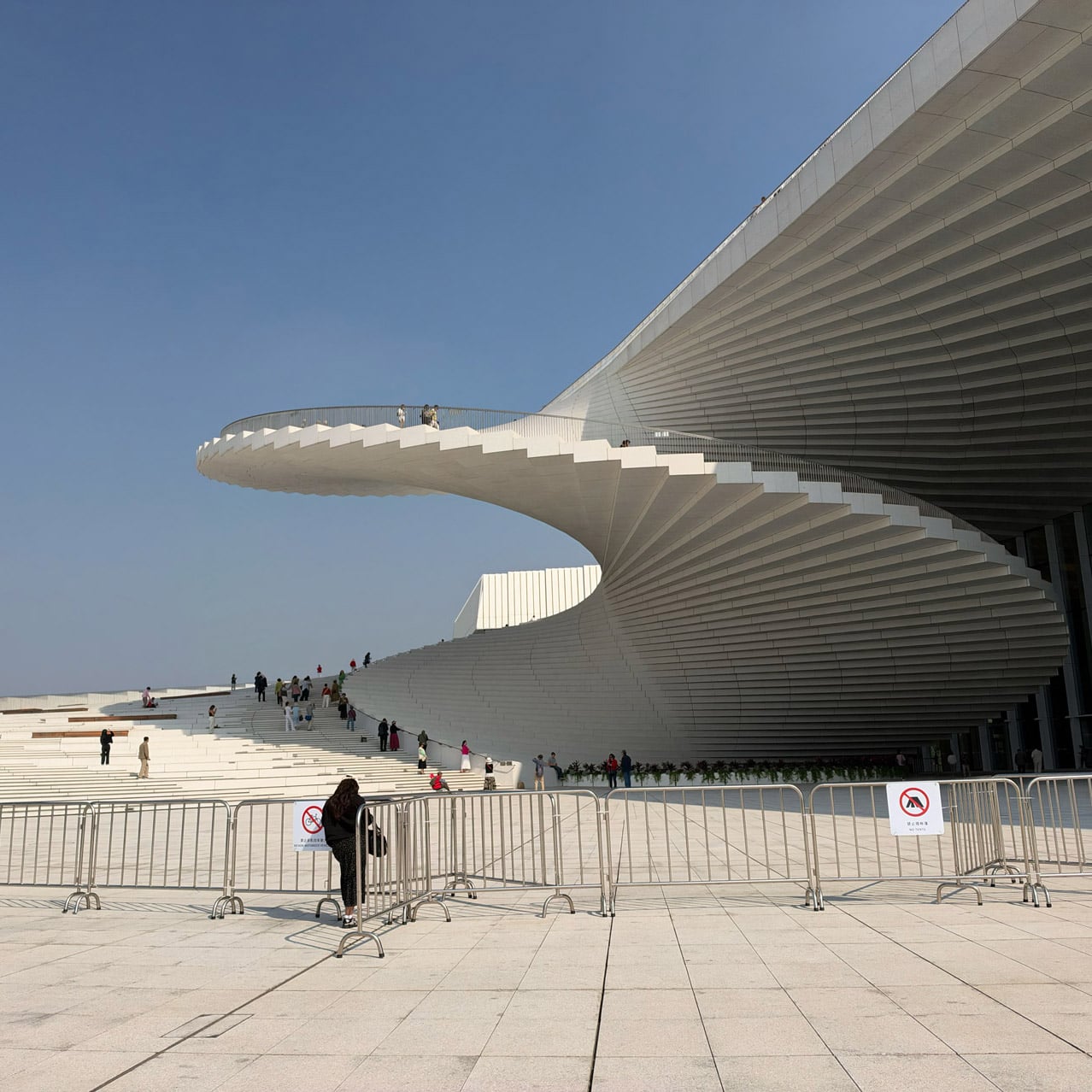
Controversy over visitors having to pay to access the walkable roof at the new Shanghai Grand Opera House brings into focus the need for architects to be realistic about how buildings operate, writes Aaron Betksy. Photo by Kaia Wang The beauty of many recent Chinese buildings is that they are also landscapes. You can walk up to them, around them, and through them, but also over them. Ma Yansong‘s buildings are often hills that you are invited to climb: the new Shenzhen Bay Cultural Center is a case in point, as is the Quzhou Sports Center, which actually is five different scalable hills, but his oldest major building, the Harbin Opera House of 2015, also offers a path over the auditorium. The Kowloon High Speed Train Station, designed by Andrew Bromberg of Aedas, is meant to be a continuous curve rising over the waiting hall you can ascend to view over to Hong Kong Island. And now Snøhetta’s just-completed Shanghai Opera House offers you a cantilevered stair with a view back over the river to the city. Many building owners who have paid a little extra to get that architectural rizz have realized, once they see their building overwhelmed by selfie takers, that they can monetize their outlooks There’s only one problem: sooner or later, you will hit a barrier, usually makeshift and consisting of moveable fences and lots of yellow and black tape. Sometimes the restrictions are monetary. Many building owners who have paid a little extra to get that architectural rizz have realized, once they see their building overwhelmed by selfie takers, that they can monetize their outlooks and prospects. The Shanghai Opera House is the latest case: to ascend that-stairway-almost-to-heaven you must pay 50 RMB, or about eight bucks. That last move has raised the consciousness of the masses to a much higher degree than the inability to climb Mount Ma in various cities. The digisphere is not happy. Apparently, people feel that photographing themselves against an urban view should be a right, even if the institution giving them that opportunity invested (albeit, in this case, mainly through state funds) in making that experience possible. Nor is this a problem only in China: all over the world, buildings that were designed to be explored in three dimensions are often subject to restrictions. The fluidity of which architects dream drowns in a sea of concerns about safety and security. In Europe, the restrictions are a bit more akin to the maze airports have put in your way between security and the gates: you can get to the top of MVRDV’s Depot in Rotterdam or Herzog & de Meuron’s Elbphilharmonie in Hamburg for free, but you have to figure out how, and are meant to be tempted to buy at least a drink along the way. In our experience economy, that seems par for the parcours to me. Space and views are among the most valuable luxuries on offer, so, until the revolution comes, I do not see the big deal. A both bigger and smaller issue is the barriers themselves. Even those who confront them in Shanghai and don’t mind forking over the yuan find that the kluges stand in the way not only of free access, but also of the views and of the architecture. You can ignore the Eyes in the Sky hidden in the ceiling, but not the fences That is because the architects never intended the fences to be there in the first place, so they did not design them into the building. They are the most obtrusive part of the many signs, furnishings, and security devices that festoon buildings especially in China, but all over the world as well. The architect Theo Deutinger has written a wonderful compendium, Handbook of Tyranny, listing and diagraming many of the devices that control our movements. Many of them we do not notice, but those that are added after construction stick out the most. You can ignore the Eyes in the Sky hidden in the ceiling, but not the fences. Ironically, part of the reason they are so obvious in China and other Asian countries is because until recently there were so many fewer of them. When the Harbin Opera House opened a little over a decade ago you could clamber all over it, and the same was true of the Kowloon train station. In recent years, local authorities have become concerned about the same issues that have restricted flows in the Western world. That is largely because of heightened accountability: you can’t easily sue if you trip in China, but local authorities can face consequences from government over mishaps in buildings they oversee – and architects there tell me this is increasingly common. To be clear, beyond the aesthetic concerns these developments are not entirely negative. Accessibility provisions have often been poor in China, but recently ramps and other devices are opening more spaces to those with mobility issues – including toddlers and older people who might enjoy these urban landscapes the most. Architects design tiered complexity at the risk of eliminating many users, as Steven Holl, for instance, found out in the case of his Brooklyn Library. The solution should be relatively simple: architects should design both accessibility and risk-avoidance into their vertical landscapes. Ma’s Lucas Museum in Los Angeles and its surrounding park, designed by Mia Lehrer, already do so (pictured left). There is no reason beyond economics and design complexity that people should not be guided and seduced up and over buildings, even if they might have to pay for that privilege. When Zaha Hadid started on her folds and later curves, she dreamed of a truly open architecture in which urban life would move without barriers That leaves only a deeper issue, which is that of the difficulty of fulfilling the promise of fluid space. When Zaha Hadid started on her folds and later curves, she dreamed of a truly open architecture in which urban life would move without barriers in and out of covered and even conditioned places. Blobitecture or parametricism offered the same prospects, and Wolf Prix has been screaming for an “open architecture of the open eye, the open mind, the open heart” for decades. Objective reality stands in the way. Buildings are still buildings – both because of the limits of what structures and conditioning systems can do, leading to the hoary problem of where you put a door, or even a toilet, with sufficient headroom in a blob – and because somebody pays for them. Inside, as Rem Koolhaas once said, “all conditioned space is conditional” and outside we are finding that the same is true. You have to pay to play, or for right of way. As is so often the case, the mountable building landscapes that have been constructed with increasing frequency and at larger and larger scales in the last few decades are more promissory notes for a future open society than built utopias. You can go with the flow and climb any building or mountain, but sooner or later economic and regulatory reality will bring you back down to earth. Aaron Betsky is a senior design associate at Carlo Ratti Associati, a visiting professor at Kean University and a visiting lecturer at the University of Pennsylvania. He was previously a professor at Virginia Tech School of Architecture and Design and president of the School of Architecture at Taliesin. He has written more than a dozen books on architecture, design and art, including Landscrapers: Building with the Land, published in 2002. Dezeen In Depth If you enjoy reading Dezeen’s interviews, opinions and features, subscribe to Dezeen In Depth. Sent on the last Friday of each month, this newsletter provides a single place to read about the design and architecture stories behind the headlines. Read more
"All over the world, buildings designed to be explored in 3D are subject to restrictions"
Full Article
Original Source
Read the full article at Dezeen →KhanList aggregates and links to publicly available news content. We do not host full articles from third-party sources. Always verify important information with original sources.