
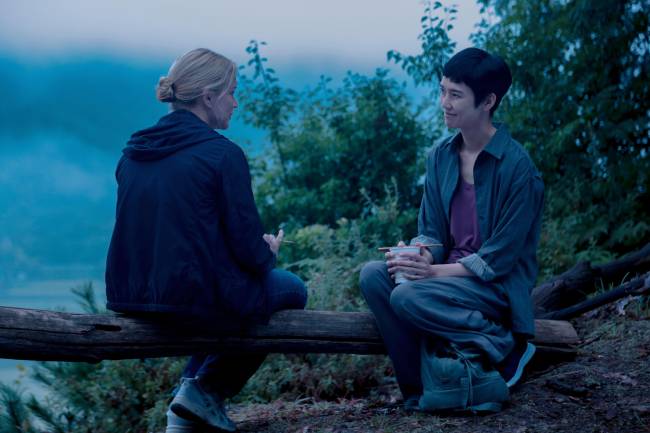
It is an unorthodox sequence. In the middle of “All of a Sudden,” Mari (Tao Okamoto) pulls out a whiteboard and markers to diagram the principles of nature vs. capitalism for her new friend Marie-Lou (Virginie Efira). The scene lasts 11 minutes and digs into material you would expect in a university seminar, not the latest cinematic achievement from the Oscar-winning director of “Drive My Car,” Ryūsuke Hamaguchi. While a guest on this week’s Filmmaker Toolkit Podcast, Hamaguchi acknowledged the whiteboard is not what we generally consider to be cinematic, but then again neither is the three-hour-and-17-minute film about two women who form a powerful bond by talking about life, their life’s work, and the ever so sexy topic of eldercare for dementia patients. And yet “All of a Sudden” blew away the world’s toughest critics at Cannes. Now, its distributor, Neon, heads into this weekend’s holiday theatrical release believing it has a legit shot at winning over the more commercially oriented Oscar voters — and becoming one of the (increasingly common) foreign-language Best Picture nominations. Neon similarly released “Sentimental Value” and “The Secret Agent” to Best Picture nominations the year before. The whiteboard scene is not an extraneous aside, but a critical turning point in the women’s relationship. We asked the film’s writer/director why it not only works, but was deemed vital to the film. “In trying to answer why this somehow works, I think there’s a few layers to it,” said Hamaguchi while on IndieWire’s Filmmaker Toolkit podcast. “And one maybe is because it really is something that is far removed from what is generally considered as cinematic. Perhaps because of that, it brings about a certain suspense, where you wonder, ‘OK, what is this for? What is this actually going to do?’ And there’s a certain sense of wondering that happens.” The scene comes a little over an hour into the film. Neither woman wants their magical evening to end. Mari follows Marie-Lou to her job as director of a nursing home, where she struggles to implement her passion project, “Huminitude,” a patient-centered care method based on touch and eye contact, which Mari sees in action. What prompts Mari’s whiteboard seminar is an attempt to help her new companion put into perspective the resistance she faces in implementing Huminitude and open the door to problem-solving. “I think the second part [of why the scene works] really comes down to the efforts of the actors that are performing this scene,” said Hamaguchi of Okamoto and Efira, who shared the Best Actress Prize at Cannes. “For Tao, I think it was an incredibly difficult scene to perform because first of all she really needed to understand all of the concepts that she was describing here and to really understand everything intellectually. And so in her preparation she did read a lot of the relevant books to really understand what she is talking about.” Hamaguchi believes the key to his dialogue-driven film is not necessarily how the words are spoken, but the performance of the listening and how the words are received. In Efira’s whiteboard scene, we see a shift from determined frustration to open enthusiasm that changes the direction of the film itself. “All of a Sudden”NEON “The attitude of listening that Virginie portrays in this moment, I think, is very important and really supports this scene,” said Hamaguchi. “She’s not uninterested in what is going on, but in fact she feels that this is something that she should really be exploring together and she’s there and very much present. And I think this attitude of interest and curiosity really starts to work on the audience as well. And so in that sense I think ultimately this scene really works because of the actors’ performances.” One topic that comes up in most post-screening Q&As is that both actresses were not working in the native language. Hamaguchi himself had to work with an interpreter to direct his leads. This is not the first time Hamaguchi has worked this way. On the podcast, he said that, in his experience directing the play inside “Drive My Car,” the language barrier was less of a hindrance and could even aid actors in listening to one another, as shown in the whiteboard scene. “I felt that, in fact, this kind of difficulty that exists can in fact provide an environment for even more heightened concentration than you might have if you were speaking the same language,” said Hamaguchi. “ I think that actually when you can actually hear a lot and get a lot of information from somebody’s voice, you can, in fact, precisely feel just how concentrated the person is when they’re saying something by listening to their voice.” Ryūsuke Hamaguchi directing Virginie Efira and Tao Okamoto on the set of “All of a Sudden”NEON Asked if any of his collaborators or producers ever questioned the whiteboard scene after reading the script, Hamaguchi said no, and speculated why: “Because it’s so unusual, I think people understood that this is something that I really wanted to do.” “There were some questions around, ‘This section feels a little long. Is there anything we can do about that?’” recalled Hamaguchi, adding that he made a concerted effort to cut his four-hour script to a three-hour, 16-minute running time. “For me, I was ultimately trying to bring in the shortest version that I felt was accurate for this moment. But ultimately, there is this understanding that this moment is a very important turning point within the film, and so I believe that the producers also understood this.” “All of a Sudden” is now playing in select theaters. To hear Ryūsuke Hamaguchi’s full interview, subscribe to the Filmmaker Toolkit podcast on Apple, Spotify, or your favorite podcast platform. You can also watch the full interview on YouTube
‘All of a Sudden’: Why Does an 11-Minute Scene Centered on a Whiteboard Lecture Work So Well Onscreen?
Full Article
Original Source
Read the full article at Indiewire →KhanList aggregates and links to publicly available news content. We do not host full articles from third-party sources. Always verify important information with original sources.