
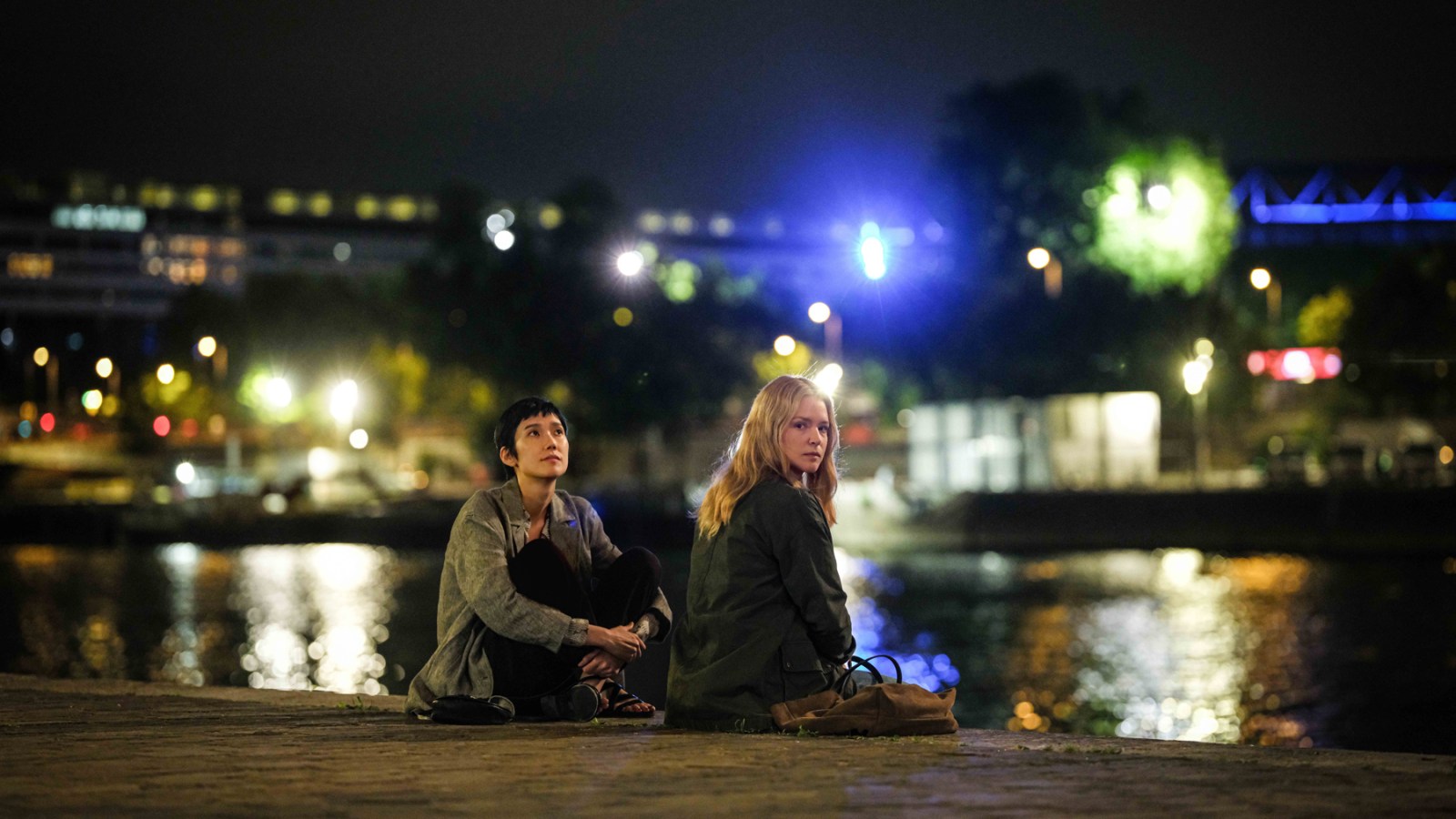
The filmmaker behind 'Drive My Car' returns with a long, gentle look at a friendship between a healthcare worker and a terminally ill playwright that brims with humanity We go to the movies for any number of reasons: to laugh, to cry, to care (bless you, Nicole Kidman), to be thrilled or scared or see if Spider-Man makes it out of a scrape with a supervillain alive. The notion that we might be drawn to films so we can listen to other people talk — to be not just voyeurs but eavesdroppers — isn’t usually one of the top reasons for spending a lot of time sitting in the dark and staring at shadows on a screen. It’s a show-don’t-tell medium. Still, there are a handful of auteurs who excel at making the art of conversation seem everything from enthralling to downright cinematic. Tarantino loves letting his characters digress at length in between violent set pieces and gratuitous shots of feet. The work of French writer-director Eric Rohmer is synonymous with long sequences of people doing nothing more than chatting about intellectual matters great and small. (His work also gave us one of the all-time great 1970’s cine-disses.) If Louis Malle had made nothing but My Dinner With Andre, he’d still be considered canon-worthy. Richard Linklater, Jean Eustache, Whit Stillman — all first-rate movie conversationalists. And then there’s Ryusuke Hamaguchi. As anyone who’s seen the Oscar winner Drive My Car and Happy Hour — his 2015 magnum opus that clocks in at a little over five hours, and frankly could have sustained itself for twice that running time — will tell you, the Japanese filmmaker can take extended scenes of discussion and turn them into the sort of exchanges that make you lean forward. If anyone could make a connect-the-dots presentation about capitalism, healthcare, and burnout cycles scrawled onto a whiteboard in real time feel absolutely compelling, it’s him. That happens to be the centerpiece of his latest drama All of a Sudden, an ironic title for a masterwork intent on taking its time and giving its characters plenty of space to ruminate. The end result is all the better for it, too. This is the type of movie that prizes philosophical pursuits over pulse-pounding chases, and the spark of communicating ideas over crass spectacle. It’s admittedly not for everyone. For filmgoers who find two human beings connecting over reflections on life, death, art, and caretaking, however, Hamaguchi’s astounding ode to empathy as an emotional foundation for coexistence is nothing short of manna. Editor’s picks The person giving that impromptu whiteboard lecture is Mari (Tao Okomoto), a Japanese playwright and theater director who’s mounting one of her productions in Paris. The woman on the receiving end of this Socio-economics 101 lesson is Marie-Lou (Virginia Efira). She is the director of a memory-care facility, overseeing a half-dozen or so patients. Marie-Lou is a staunch advocate for “humanitude,” a four-pillar methodology developed in France for treating those enduring various stages of dementia and Alzheimer’s. (Hamaguchi himself became familiar with this technique when his grandmother was being cared for roughly a decade ago.) The younger members of her staff are slow to adapt to this ideology that emphasizes touch and “verticality” over more traditional treatment plans; the older nurses are flat out refusing to learn it at all. The uphill battle of fighting for what is, in Marie-Lou’s eyes, a more humane way of healthcare is taking its toll on her. It’s pure coincidence that Marie-Lou happens to meet Mari after an encounter with a developmentally disabled kid (Kodai Kurasaki) and his grandfather (Kyôzô Nagatsuka), who happens to be an actor in Mari’s play. The two hit it off, and after a performance, hang out and talk, talk, talk through the wee small hours. By the time we witness Marie-Lou being schooling on how the world works via whiteboard, you can tell the bond between these two is tight. Lifelong friendships have been forged over less. Hamaguchi is using a 2019 collection of letters between Maho Isono and Makiko Miyano, known in some English editions as You and I: The Illness Got Worse, as a foundation here — which makes All of a Sudden something like an adaptation, and the equivalent of an epistolary movie. Correspondence is king here; it just happens to be occurring face to face instead of one post at a time. Like Isano, Marie-Lou comes from a medical background. And like Miyano, a philosopher by trade, Mari has a tendency to think big thoughts and emphasize the way that the “littlest” people make up (and are at the mercy of) a far bigger picture. It’s worth noting Miyano was diagnosed with terminal cancer when she met her pen pal — a condition that Hamaguchi passes on to Mari as well. Time is something that seems to contract, expand, and often feel like it stops still in the director’s work. But in terms of Mari and Marie-Lou’s story, it’s very much of the essence. Their time together is fleeting, and the last thing they’re taking for granted. Related Content Kyôzô Nagatsuka, center, in ‘All of a Sudden.’ NEON All of a Sudden is filled with languorous side trips, large chunks of stand-alone bits of business, and segments centered around caretaking that almost feel like process movies unto themselves. A performance of Mari’s play is essentially seen in full, then partially reprised near the end. Training sessions and testimonials from family members and loved ones of patients share screen time with our central duo’s chatathons. Anyone squeamish over the idea of a group foot massage (part of the humanitude’s more experimental notions of engagement between facility workers and their wards) may want to leave for popcorn before the film hits its three-hour mark. Mari wants to return to Japan to deal with her illness, so Marie-Lou goes with her. So does the movie. Trending Stories Yet Hamaguchi’s not simply letting seemingly tangential events or the daily drudge of work luxuriously play out for their own sake. Every minute is accounted for story-wise, and not a moment is wasted. He’s not painting a portrait so much as a mural, one that keeps its central duo in constant focus even as its generous with its supporting players and peripheral bits of business. We should note that both Efira and Okomoto are equally outstanding, solo and in tandem, and equally adept at holding up their ends of the long conversations that punctuate the filmmaker’s meditations on how one spends what little time they have on this hurling rock in the cosmos. There’s a rapport happening between the two that bypasses cultural backgrounds, different performing styles, separate languages — the dialogue moves back and forth between French and Japanese so fluently that it sometimes takes you a second to realize when switches between tongues. The lingua franca here is a shared understanding of the need for companionship and the joy of communication. Not for nothing did both of them share the Best Actress award at Cannes. It’s thrilling to watch what is, at its base, an origin story of a friendship, even if we know it’s a brief one — because we know where this ends. Yet Hamaguchi wants to acknowledge that quality, not quantity, is what matters in terms of togetherness. That applies to the humanism that underlines every thing that’s on screen as well, and that particular quality is in abundance. The movie may seem to drift, to detour, or to determinedly test one’s patience when examining things outside of Mari and Marie-Lou’s rich discussions about the world they live in, and the world they’ll leave behind. Yet All of a Sudden is all of a piece, and makes listening in feel like an honor. Hamaguchi is delivering an eloquent statement about the need for looking after one another in a myriad of different ways, ranging from creativity to giving someone a good farewell. Despite keeping one eye on death, it’s a primer for a possible way to live a good life — and the rare movie that may change yours.
‘All of a Sudden’ Is the Rare Movie That May Change Your Life
Full Article
Original Source
Read the full article at Rollingstone →KhanList aggregates and links to publicly available news content. We do not host full articles from third-party sources. Always verify important information with original sources.