
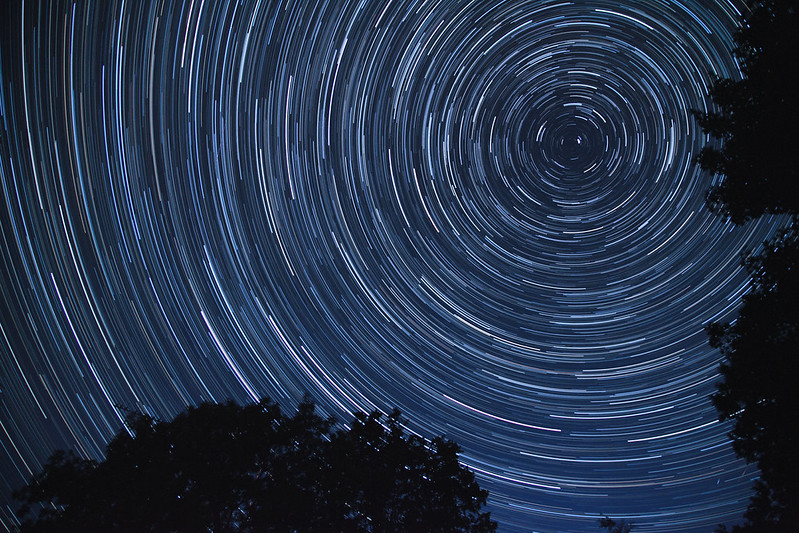
All you really need for stargazing is your eyes and dark skies . . . right? bobthemagicdragon / Flickr (CC BY-NC-ND 2.0) Summer skies used to be more reliably clear in Oregon. Now, with weather changes and wildfire smoke increasing every year, each clear night feels like a gift. Obviously, I want to make the most of these opportunities, which is why I’ve been trying to guard against gear creep, that ever-present need to grab “just one more thing” before I head outside for the night. I can spend too much time wrangling “stuff” and miss out on what’s directly above me. To be honest, I’ve been doing a lot of multitasking lately with my stargazing. I’ll have my little smart scope tracking and imaging the deep-sky object du jour while I’m searching through Stellarium to plan what to target next — and very often, I’m doing this from the comfort of my living room while watching another episode of Grantchester or Stargate: Atlantis. It’s amazing what I can see on my little tablet screen, but I worry that I’m missing out on the true magic of the summer night sky, with Vega, Deneb, and Altair overhead, Antares and Scorpius low on the horizon, and the Teapot trailing close behind. There’s also the concern that, with all of my “necessary” accoutrements, I’m the architect of my own FOMO. What if I wanted to get back to the absolute basics — and the basic joy — of stargazing? To reclaim that sense of awe that sparked my fascination with the night sky, I could just step outside, my hands empty, and look up. But I get tired and dizzy if I stand for too long, so I should probably take a comfortable chair. That’s all I need: just a collapsible reclining camp chair and the stars over my head. Except I live close to a big city, and my eyes are getting older, so a pair or two of low-power binoculars is a good idea. This is all I need: a pair of 7×35 binoculars, a portable camp chair, and the sky above. But, you see, in these light-polluted conditions, it’s not always so easy to identify the few stars I’m able to make out, even with the binoculars. A good star chart is a helpful companion, and the Stellarium app on my phone is even better. So this, truly, is all I need: Stellarium on my phone, a small planisphere, a pair of low-power binoculars, a portable camp chair, and the night sky just outside the door. You can see where this is heading. Because a red-light lantern really can’t be overrated for preventing accidents in the dark and keeping nocturnal wildlife (mostly) at bay. Of course, to make the most of my time outside and to truly appreciate the cosmic marvels above, I really should go ahead and set up my little smart scope so I can find and appreciate the star clusters, nebulae, galaxies, and other treasures I’d otherwise miss. And since I’ve started using my smart scope in EQ mode, I need a particular tripod, too. For a good night of stargazing, really all I need is my old SLIK tripod, my Dwarf 3 smart scope, the iPad Mini to run the smart scope, a rechargeable red-light lantern, my fully charged phone (with the Stellarium app), a small planisphere that glows in the dark, a lightweight pair of low-power binoculars, and a comfortable camp chair that lets me recline. And perhaps a small table for my tablet, phone, lantern, and planisphere? A snack and a water bottle would be good, too, plus a sturdy sack to carry most of my gear. Oh! And the night sky. Before I know it, I can find myself with a full backpack plus a chair bag slung over my shoulder, and a little table in one hand and a tripod in the other — just to set up a few yards from the back door. And I haven’t even mentioned blankets, the Tigger onesie, or aperture fever. Our ancestors had none of these things at hand or even in their imaginations when they looked up after dark. Okay, so they probably found a comfortable place to sit or stand for hours while they did their stargazing, but they made their own star charts. I imagine the earliest skywatchers looking up on their long, overnight vigils, the stars mirrored in their eyes as the Milky Way drifted silently east to west. They traced patterns in the sky and handed down celestial stories for the ages. My backyard stargazing is fast-food by comparison: easy, quick, and calorie- (that is, wonder-) dense. Every once in a while, I consider challenging myself to spend the full night outside — preferably under darker conditions than suburban Portland’s Bortle 7 — with no agenda other than bearing witness to Earth’s rotation as I watch the cosmos go by. Realistically, though? I won’t give up the camp chair, the low-power binoculars, the astronomy app, or the red-light lantern, because the marauding raccoons still make me nervous. As for everything else? I’d argue that what’s truly required to enjoy a clear night outside are an eagerness for discovery and a decent Bortle rating. That’s all I need.
All I Need for a Night of Stargazing Is...
Full Article
Original Source
Read the full article at Skyandtelescope →KhanList aggregates and links to publicly available news content. We do not host full articles from third-party sources. Always verify important information with original sources.