
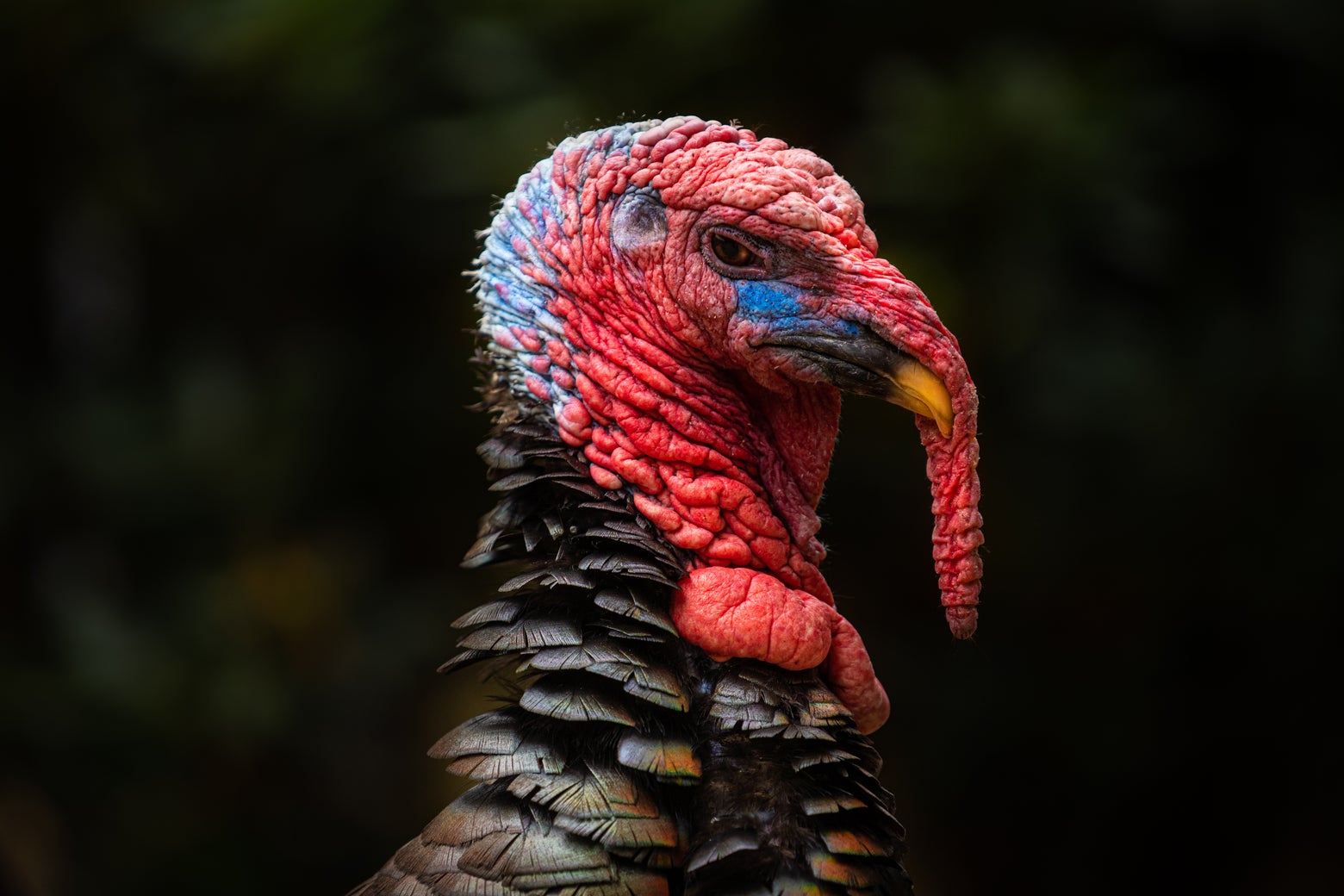
Footage by Lydia McMahon/Storyful via Getty Images UGC Life The Revenge of the Turkeys In suburbs across the country, gangs of wattled warriors are turning the tables on innocent Americans. Why are they attacking, and can anything stop them? In suburbs across America, marauding bands of young males, hormones boiling, are stalking our quiet streets—and attacking unsuspecting citizens without warning. For Lili Korbuly-Johnson, it happened in late December, when she was taking out her compost. The assailant appeared beside her on the sidewalk, first following closely, then physically pushing against her. Her screams had no effect, so she sprinted across the icy street in St. Louis Park, Minnesota, and managed to get herself on the other side of a car that had slowed down to help. “If you go now, you can outrun him!” the driver yelled to her, and she bolted back to her condo before collapsing in a shaking heap. She felt genuinely scared, but also a little bit foolish. The cause of her panic wasn’t a bag snatcher or a snarling dog. It was a bird: a wild turkey. She was set upon again a few months later by, she believes, the same repeat offender. This time she stood her ground, whacking him with her purse until he fled the scene. Korbuly-Johnson is only one victim in a recent nationwide outbreak. Turkeys will take on anyone, from schoolchildren in Wisconsin to 83-year-olds in California. Bike riders aren’t safe, nor pregnant women, nor even hustling A.I. entrepreneurs: “I got attacked by a turkey at a train stop. Here’s what it taught me while building my startup.” Turkeys have harassed UPS drivers in Connecticut, the USPS in Ohio, and Amazon drivers in New York. They’ve taken on cops in Georgia and Wisconsin, even getting a Bay Area woman out of a speeding ticket. Some individuals become local legends, like “Kevin” from Massachusetts, “Gladis” and “Gregory Peck” from Minnesota, and “Gerald” from California, who terrorized Oakland residents for five months in 2020. (A wildlife capture professional posed as a “frail, old woman,” Gerald’s favorite target, to lure him in.) To be clear, turkey attacks aren’t fatal, but they are dangerous. These avian aggressors can weigh upward of 25 pounds, and they can flap, jump, and peck in what can be a relentless and maniacal pursuit. Male turkeys—called “toms”—grow spikes of hard keratin on the backs of their legs that they use to battle each other. These “spurs” are also effective on people, sometimes drawing blood and prompting trips to urgent care. “Turkeys, all modern birds, are literally dinosaurs,” says Steve Brusatte, paleontologist and author of The Story of Birds: A New History From Their Dinosaur Origins to the Present. “So if you live in the United States, being attacked by a wild turkey is as close as one can get to being attacked by a velociraptor.” These run-ins can also inflict psychological wounds. “I feel like it’s pathetic to have PTSD from going up the hill to do your recycling,” Korbuly-Johnson told me of her close call in Minnesota, “but I’m still scared.” For a while she carried a broom for protection when she went outside, and when she’s out with her husband and they see turkeys, she has him menace around like Bigfoot to protect her from the birds. “I wish they didn’t scare me,” she said. “I wish I could say that they don’t scare me.” And yet, when she was interviewed by the local news, the resulting story attempted to straddle the line between serious and silly. The reporter discussed the growing number of altercations involving turkeys in greater Minneapolis to a soundtrack of plucking strings and humming kazoos. Wild turkey attacks are happening all over the country, but most of us don’t know why they’re increasing or how to feel about it. So I decided to call up the experts—animal handlers, scientists, historians, and injured parties—and talk turkey: Why is this Thanksgiving staple suddenly turning the tables on us, and what, if anything, can we do about it? To understand why this epidemic of turkey-on-human violence is happening now, it’s important to first understand the perpetrators’ checkered history. After all, the national turkey takeover is surprising, considering that only a century ago the species was nearing extinction. Turkeys have been in North America for millions of years. They’re the largest bird in the group Galliformes, or landfowl, which also includes dozens of species of quail and pheasant, and more. While there were once several different species of turkey, today there are just two: the resplendent ocellated turkey (Meleagris ocellata) of Central America, and Meleagris gallopavo, our neighborhood wild turkey. Although its range was until recently limited to parts of what is now Mexico, the eastern half of the United States, and southern Quebec and Ontario, it has now also been introduced across much of the American West and has taken up residence in every U.S. state except Alaska. The reason people have spread wild turkeys around is also one of the reasons they were almost exterminated from the face of the earth: They’re delicious. Thanks to their large size, tasty meat, and relative abundance, wild turkeys were a dietary staple of many Native Americans. They were first domesticated by the Mayans in what is now Mexico an estimated 2,000 years ago, and it was these birds that made their way to Europe on Spanish ships in the 1500s. They became immensely popular livestock across the Continent, so much so that domestic turkeys made a return trip to their native lands with English colonists in the 1600s. Today there are roughly 450 million domestic turkeys kept around the world, and though their numbers are dwarfed by that of chickens (the domesticated version of Asia’s red junglefowl, or Gallus gallus), they are one of the most numerous birds on earth. Though they’re the same species as their wild relatives—these distant cousins do, occasionally, interbreed—the domestic population has been bred to emphasize the parts humans love, with the result being enormous breasts and juicier legs. These features have disadvantages for the turkeys, however, leaving many domestic birds so fat they’re unable to fly, or even breed. Still, that’s not to say that the wild turkey isn’t good eating: It remains a common game bird, with a leaner, darker meat and more intense flavor. But while domestic turkeys, bred by humans, boomed, wild populations cratered. Though the wild birds always had a special place in the minds of Americans (many of us know the famous story of Ben Franklin suggesting that the wild turkey, “a Bird of Courage,” be the national symbol over the “Coward” that was the bald eagle), they were driven to the brink of eradication by the twin forces of habitat loss and the new human neighbors who were gobbling them up. The effects were felt first in the populous New England states, where in some areas up to 80 percent of the turkey’s forest habitats were cleared for agriculture in the 1800s. The species was completely extirpated from Massachusetts, Connecticut, Maine, and Vermont by the mid-1800s and hung on in other states only in remote outposts. It’s thought that it reached its low point in the 1930s, when only about 30,000 birds remained in the wild. But it wasn’t too late. The wild turkey rebound began after World War II, when state wildlife agencies began reintroduction programs that trapped turkeys from remaining strongholds and relocated them to states with regenerating forests and new restrictions on hunting. Turkeys flourished, and today there are estimated to be more than 6 million of them in the U.S.—a tremendous conservation success story. Their comeback was thanks in large part to a new kind of emerging habitat, one that provided the turkeys with a host of advantages: the suburb. “Suburbs typically offer a mix of woodlots and openings,” says Doug Little of the National Wild Turkey Federation, “and this mix of habitat, along with backyard bird feeders being prevalent, can offer abundant food sources throughout the year.” The suburban bounty includes a high abundance of insects needed by turkey chicks in the spring and summer, Little says, as well as fruit like dogwood berries and heavy seeds like acorns and beechnut for turkeys to fatten themselves on in the fall and winter. Plus, though there are predators in the suburbs, they’re too busy eating other stuff to concern themselves with prey as imposing and fearsome as the turkey. Sure, raccoons and opossums will raid nests and eat turkey eggs, and larger predators, such as hawks, owls, foxes, and coyotes, may snack on baby turkeys, or even the occasional adult. But suburbs also serve up easier meals, such as mice, rats, rabbit, and pet cats, not to mention the leftover goodies from our garbage cans. “Predators in suburbs may just have a broader menu of options, buffering their impacts on wild turkeys,” Little says. This is only part of the “human shield hypothesis,” advanced, when it comes to turkeys, by Michael Chamberlain, a professor at the University of Georgia and founder of the Wild Turkey Lab research project. “There’s a growing awareness in the academic world that wildlife species are adapting to urban and suburban areas, and they’re very likely drawing benefits like reduced predation, high availability of resources, protection from hunters,” he says. In a recent study, Chamberlain and his co-authors found that female turkeys who nested near human activity—areas that also had fewer predators—had better survival rates. “As you continue to see suburban sprawl, particularly in the Northeast, turkeys are essentially protected in those areas, and they’re not hunted and they’re not persecuted at all and they’re very productive,” Chamberlain says. “I think these problems [of rampaging posses of turkeys] are going to grow through time.” So that’s how turkeys came to rule America’s suburbs, but why are they bothering to attack humans? Horny young males are, as in so many species, a big part of the problem. Gallinaceous birds like turkeys are famous for their complex mating displays, in which males compete for the attention of females by dancing, strutting, and fluffing themselves up. For wild turkeys, this means much more than just fanning their tails. To impress females and prove their dominance to each other, males in breeding condition grow a series of accessories, including beards (a cluster of long, coarse feathers protruding from their chests), long wattles dangling from their necks, and warty caruncles on their heads—all of which are crowned by the snood, a fleshy protuberance that sprouts from the area just in front of their eyes. Most of the time, the snood simply hangs foppishly over their faces, but when turkeys become excited, their snoods become engorged with blood and become erect. (Perhaps this feature helps compensate for their phalli, which are minuscule.) In other words, a male wild turkey is built to impress the ladies, and he takes this task very seriously. Bryant Aardema/Getty Images And no such stud is complete without his wingman. Wild turkeys engage in what’s known as polygynous-promiscuous mating, which means that although there’s a group of males that hang around with a group of females during the breeding season, usually just one of the males gets to mate with the females. However, even though there’s a pecking order, with one dominant male, the other males in the group protect him because it’s their flock at stake. “They all sort of operate together,” says Chamberlain. “There’s three or four or five of them. They’ll strut or they put their tails up in the air, or fan their wings towards the ground, or gobble at the same time, and so they’re functioning as a breeding group, even though only one gets to mate.” Often, male turkeys in such a troop are related as brothers or half brothers. Though that may sound like an odd setup for us, it works out for all the toms. The nondominant males support the dominant male (“like a backup singer,” as one researcher put it), and they chase away potential rivals, giving the alpha male more time to focus on breeding. In return, since they’re related to the alpha, the nondominant birds benefit indirectly by passing on some portion of their DNA. These betas may not get kids of their own, but they get nieces and nephews. Still, it’s not as if the nondominant birds are thrilled about it. “A lot of these nondominant birds are just biding their time,” says Chamberlain, waiting for the day when they can have the rule of the roost. They need to be prepared to swoop in if something happens to the head of their brotherhood, and so they’re still coursing with testosterone and ready for a fight throughout the spring. That’s when these other confrontations happen, Chamberlain says. “So they see a reflection or a human being, or they walk by a car and they see an image in the window, and they get extremely aggressive, because they’re wired to be that way in the spring.” And while gang activity from nondominant males explains most of the spring incidents—if you read the news, you’ll find that the majority of the stories are from March, April, and May—it’s not the only reason turkeys lash out. The other reason isn’t unique to wild turkeys at all but is a familiar story wherever man meets beast: People just get too close. “What we’re seeing with wild turkeys isn’t unlike what we’re seeing with many wildlife species that live close to humans,” Chamberlain says. “They’re tolerant until they’re not.” It’s the same story in suburbs across the country with elk or deer or alligators: people and animals struggling to share the same space. Chamberlain thinks that Lili Korbuly-Johnson’s wintertime flap in Minnesota may have been one of these kinds of encounters, in which she unwittingly entered the turkey’s personal space and the turkey reacted combatively. Wild turkeys are somewhat unusual among suburban creatures, though. Elk and alligators are not common backyard visitors, and most other animals—deer, foxes, coyotes, raccoons, opossums, rodents, bats, etc.—are either nocturnal or generally shy around humans. Not wild turkeys. They strut around in broad daylight, right through parks and yards and other places humans like to call their own. It’s hard to imagine another species that we’d tolerate in such proximity, especially if they were as unruly as turkeys can be. But the fact is, we like turkeys. If you saw a turkey trotting around your neighborhood, you’d probably be more likely to snap a photo for your group chat than freak out. So far, even towns with turkeys that have been known to cross the line have had a difficult time taking action. The poster city of America’s seemingly contradictory relationship with wild turkeys might be Phoenix, Oregon. Wild turkeys aren’t native to Oregon, but they were introduced by hunters in the early 1960s. They were successful—approximately 45,000 wild turkeys live in Oregon today, and thousands are hunted each year—but some birds found refuge in cities and towns that provided plenty of food but no threat from hunters. Phoenix was one of those towns. There, turkeys “lose their fear of humans and become aggressive to protect what they now see as their territory,” says Hadassah DeJack-Reynolds, executive director of the Tikkun Olam Farm Sanctuary, which has offered to help with what has become a headache for many in town. This spring, the birds began getting feisty, chasing schoolchildren and motorists and leaving one woman who was out for a jog with a bloodied hand. People were afraid to leave their homes, and town officials decided it was time to act. The mayor collaborated with a local wildlife trapper on a plan to bait and trap the birds, then transport them to a meat processing facility for eventual donation to a nonprofit organization. Officials scheduled a City Council meeting to approve the plan and end the saga of the bullies … until almost everyone spoke against it. Despite all the harassment, people liked having the birds around. The turkeys were spared. DeJack-Reynolds says that residents’ feeding the turkeys is the main reason the animals are getting so comfortable in Phoenix. “Residents will put food out for them because they enjoy having them in their yard,” she says. “I understand that people are naturally drawn to these beautiful birds and want to engage with them,” but “feeding and interacting with them is what can ultimately cost the turkeys their lives.” The town instead passed an ordinance in early September “restricting the feeding and attracting of wild animals.” Towns looking to fight back against the turkeys do not have many options. Culling wild turkeys, even in “humane” ways and when the meat supports needy citizens, as was proposed in Phoenix, is not generally a popular solution. Towns all over the country have banned the intentional feeding of wild turkeys, and many more discourage it, but it’s difficult to be completely effective unless you also ban the feeding of songbirds (which ordinances like Phoenix’s do not), since bird feeders can easily but unintentionally provide food for turkeys. Hunters are more than happy to lend a hand. Official wild turkey hunting seasons exist in 49 states—every one that has a viable turkey population—and hunters kill an estimated 690,000 wild turkeys each year. Turkey hunting is permitted in many suburban jurisdictions if strict regulations are followed and when personal permission is obtained when hunting on private property. “You only need 10 or 12 yards when you’re bow hunting,” says Blaine Cardilli, a writer and longtime hunter from Maine. “You can set right up in someone’s backyard or garage.” Most of the turkeys he’s seen going berserk are young males—“bully jakes,” as they’re known—scrambling for their place on the social ladder. “You’ll have a couple strutters [dominant males], and then a bunch of bully jakes operating like a New York or Los Angeles gang—they’re like a little turkey MS-13—and they’ll come in and challenge them.” Hunters are eager for towns to allow them to help out with problematic suburban turkeys, in part because while turkey numbers are fairly steady as a whole, they’re decreasing in rural areas. Experts point to a number of potential causes for the declines, especially the continuing loss of hardwood forest habitat and excess hunting (especially early in the spring, which may throw off turkey social hierarchies). A labor-intensive but widely satisfactory way forward is trapping turkeys from suburban areas and sending them to the country. In Texas, for example, hundreds of turkeys have been transported from states as far away as Maine and released into the large swaths of habitat in the eastern part of the state. But for most suburbanites, the best option may be to just learn to live with their feathered neighbors. The vast majority of the time, the turkeys peacefully go about their business and inspire much more than they frighten. (I’ve personally seen dozens of kids stand in open-mouthed awe as the harmless resident flock at the Gilsland Farm Audubon Center, where I work, parades past in full regalia.) And for those certain months when turkeys might be looking to cause trouble? The advice from Michael Chamberlain, of the Wild Turkey Lab, sounds similar to counsel you’d give anyone about navigating around others in a suburban environment: “Let them be. Don’t need to go out of your way to avoid them, and don’t go out of your way to get close to them.” It’s practical guidance, though perhaps too late for people who’ve been on the receiving end of a turkey attack, like Lili Korbuly-Johnson, who remains haunted by her ordeal. “I don’t hide my fear that well, and I try not to look in their direction,” she says. “It’s annoying as hell.” Still, just like many American towns, she doesn’t have an answer to the growing turkey threat. “I know they have a right to be where they want to be,” she says. “I just wish I could convey that they should stay on their side and we’ll stay on ours … or else you’ll become dinner.” Animals Environment History Science Nature
All Across America, the Turkeys Are Turning the Tables on Us
Full Article
Original Source
Read the full article at Slate →KhanList aggregates and links to publicly available news content. We do not host full articles from third-party sources. Always verify important information with original sources.