
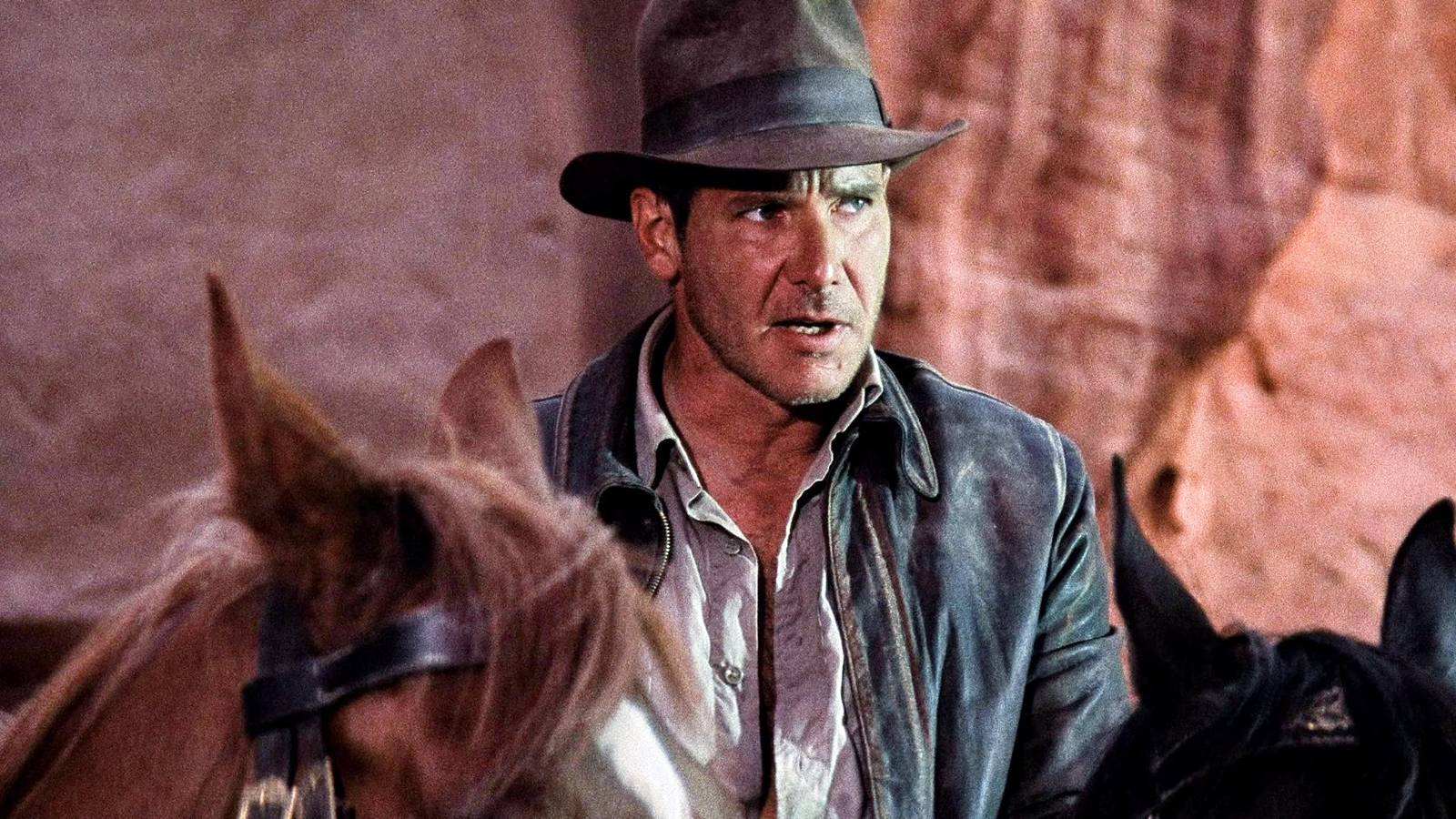
The master Steven Spielberg is probably most commonly associated with sci-fi movies, and while some of his best sci-fi movies did set the blueprint for lots of sci-fi filmmakers in his wake, he has always been surprisingly versatile when it comes to his genre choices. What matters the most to him are stories that make his audience feel. Spielberg helped invent the very idea of blockbuster filmmaking. Even when he's telling stories in high-concept genres like hard sci-fi or historical biopics, he is as focused on the same tenets of his approach to story. Whether you're watching a Spielberg thriller, his visual identity is instantly recognizable. And it's arguably in the adventure genre where Spielberg's eye for spectacle, character, and heart converge best. Over the past five decades, Spielberg has directed some truly great adventure movies. In fact, even some of his harder genre movies, like Jurassic Park and E.T., which are primarily sci-fis, hit a lot of the same beats as traditional adventure movies. But because they are primarily sci-fis, they don't qualify in this ranking. We're sticking with pure adventure movies, and since cutting his teeth in the early 1970s, Spielberg has made seven, but which is the best? 8 Indiana Jones and the Kingdom of the Crystal Skull If you were to take some of the more venomous criticism of the fourth Indiana Jones movie to heart, you would think that The Kingdom of the Crystal Skull was an irredeemable disaster that dragged the good name of Indiana Jones into the mud. Released 19 years after Temple of Doom, it is a step down in quality, but rewatching it now, some of the harsher critiques feel a little unnecessary. The most baffling complaint centers on the reveal that aliens are real and visited Earth, as if that is any less believable than the biblical and supernatural elements of the original trilogy. Spielberg being a master of sci-fi, embracing an alien invasion story also makes a lot of sense. Some fans also saw The Kingdom of the Crystal Skull as simultaneously too much like the first movie, damning it with direct comparisons. The replacement of the Nazis with Cold War enemies, headed by Cate Blanchett's Irina Spalko, does slightly take something away from Indy's original spirit, but it was never enough to really sink the movie. This is fundamentally not a terrible movie... It's just a little wayward in its good intentions. The addition of Shia LaBeouf's Mutt was also far from the catastrophe that was claimed, and there are some really good set pieces and a lot of the same magic that made the original trilogy great. 7 The BFG An unfortunate box office bomb, Spielberg's expensive take on one of Roald Dahl's most famous fantasy adventures is widely remembered as one of his more disappointing releases. But, there's nothing really wrong with Spielberg's adaptation. It's beautiful, thanks to his reunion with frequent collaborator Janusz Kamiński, the music is great because John Williams was brought in again, and the acting performances, led by the brilliant Mark Rylance as the BFG, are all very good. It is arguably more of a Spielberg take on the story than a truly faithful Roald Dahl adaptation because Spielberg couldn't resist the temptation to shave off some of the darker edges. The result of that is, while it's incredibly charming and very witty, it doesn't quite have the moral complexity of the original story, which might explain why it didn't quite land at the box office. It also didn't help that it was released at the same time as Finding Dory. Look a little more closely at The BFG, and it's not massively different to E.T., given that it's also about an unconventional friendship. While calling it a classic is perhaps a little bit overcooked, it remains technically very impressive and a fun bit of Spielbergian whimsy and wonder. 6 The Adventures of Tintin It almost feels unfair to rank The Adventures of Tintin quite so comparatively low because it is a great film and a very strong adventure, but it just doesn't quite have the same cultural impact or footprint as some of the movies that beat it here. Spielberg had actually picked up the film rights to The Adventures of Tintin way back in 1983 and then reoptioned them in 2002. There was then a troubled early production, so it was delayed until 2011, with Jamie Bell replacing original star Thomas Brodie-Sangster. But Spielberg was always a self-confessed fan of Hergé's work, and The Adventures of Tintin draws from multiple stories with the kind of faithful commitment to the spirit of the originals that only a fan could really capture. And despite this being motion-captured animation with an iconic character in its own right, it does rather feel like it could be a young Indiana Jones adventure. Spielberg uses the same thrilling storytelling approach, there are great set pieces, the character work is excellent, and it has that same confident swashbuckling feel as the Indiana Jones movies. There's also a great nostalgic element to it that really sells Spielberg's patented Amblin sense of wonder, and it's grown remarkably in charm over the years. Thankfully, we're finally about to get a new Tintin sequel from Peter Jackson after many years of trying. 5 Hook Bafflingly rejected by critics when it was released, Hook was thankfully embraced more by audiences who looked on Spielberg's embrace of sentimentality more favorably than the professionals. It's an inventive take on the already very familiar story of Peter Pan, leaning into some patented Spielberg emotional existentialism at the same time, and the world-building of Neverland is just delightful. Robin Williams offers a surprisingly restrained performance as the middle-aged Peter Banning, who has grown up and unthinkably forgotten his past in the magical world of Neverland, sparring across courtrooms rather than with real-life pirates. The rest of the young cast is great alongside Williams, and everybody's having a lot of fun. But the best performances are definitely Bob Hoskins as Smee and, of course, Dustin Hoffman as the delightfully theatrical and surprisingly nihilistic Captain Hook. It might not be the most challenging or narratively complex movie that Spielberg has ever made, but the sense of wonder here is palpable, and it's exactly what a family adventure blockbuster should be. 4 Indiana Jones and the Temple of Doom At the time of its release, Temple of Doom tricked critics into believing that it might be too dark for its core audience, but over the years, the reception of the second Indiana Jones movies has only grown. It is absolutely darker than Raiders of the Lost Ark, but not to its detriment. Instead, there is an admirable refusal to speak down to the family audience who would have been drawn in by the first movie. It makes no apologies for the fact that it's a brilliantly imaginative adventure that has more grown-up elements alongside some goofy ones. If there are criticisms, it's not quite as precise as Raiders of the Lost Ark, even if lots of people do vehemently back it as the best of the original trilogy. It is a wilder and more violent movie than the first, but it often gets forgotten how much sillier it is, in a good way. The addition of Short Round was also a very smart move to keep the levity and make sure that it wasn't too intense for younger audiences. Meanwhile, the action sequences are fast-paced and actually rather relentless, and it feels more in line with the early movies Spielberg was paying tribute to, even if some critics saw its darker elements as a little challenging. 3 Indiana Jones and the Last Crusade The critical reception to Temple of Doom's darkness may have been somewhat overblown, but Spielberg still listened to it, opting to go in a more lighthearted direction with 1989's The Last Crusade with a little more comedy thrown in. It is a fundamentally more charming movie, and a lot of that comes down to the brilliant decision to cast Sean Connery as Indiana Jones's father. The chemistry between Connery and Harrison Ford was excellent and helped explain some of Indy's more prickly character traits very well. The Last Crusade feels like a living tribute to the lost B-movie era, has some excellent action sequences, and at times feels like the most swashbuckling of the trilogy. There is also an admirable attempt to get under the skin of Indiana Jones, which could have derailed the adventurous spirit of the story, but it all zips along very quickly. None of the journey to the heart of Indy's darkness really compromises that - if anything, it just enriches the character and allows for the interplay between Connery and Harrison Ford to take the stage it deserves. 2 Raiders of the Lost Ark Image via MovieStillsDB While the Indiana Jones trilogy is one of the most definitive movie events of the 1980s, Raiders of the Lost Ark belongs to an entirely different era, offering a modern take on serial films that had been popular decades earlier. It was, of course, George Lucas's idea, but his decision to focus on Star Wars paved the way for Spielberg to take over and create a brain trust that also included Lawrence Kasdan, the scriptwriter. Remarkably, early polling revealed little audience interest, but it went on to be the highest-grossing film of the year, with audiences spellbound by its set pieces and Harrison Ford's immediately iconic performance as the whip-snapping archaeologist. Raiders of the Lost Ark was instrumental in establishing the blueprint for later comic book movies because it was so inherently inspired by the childhood stories told in serial movies and comic books. It was also a huge part of establishing the identity of blockbuster movies and still feels like pure escapism even watching it now. It outstrips the other Indiana Jones movies, not just because of its novelty, but also because it has better villains. The story of the Nazi race to find the Ark of the Covenant is just slightly more compelling than the other MacGuffin-led stories. Even beyond Ford's career-defining performance as Indiana Jones, the supporting characters are crucially strong enough to hold their own. Karen Allen's Marion Ravenwood offers spirited moxie alongside him, John Rhys Davies' Sallah basically set the model for all adventure movie sidekicks, and the villainous duo of Paul Freeman's René Belloq and Ronald Lacey's sadistic Gestapo agent Arnold Toht were brilliantly cartoonish in their villainy. It's still a joy to rewatch now, and every time you do, you're overcome with the wish for this franchise to continue on forever. 1
All 7 Steven Spielberg Adventure Movies, Ranked
Full Article
Original Source
Read the full article at Screenrant →KhanList aggregates and links to publicly available news content. We do not host full articles from third-party sources. Always verify important information with original sources.