
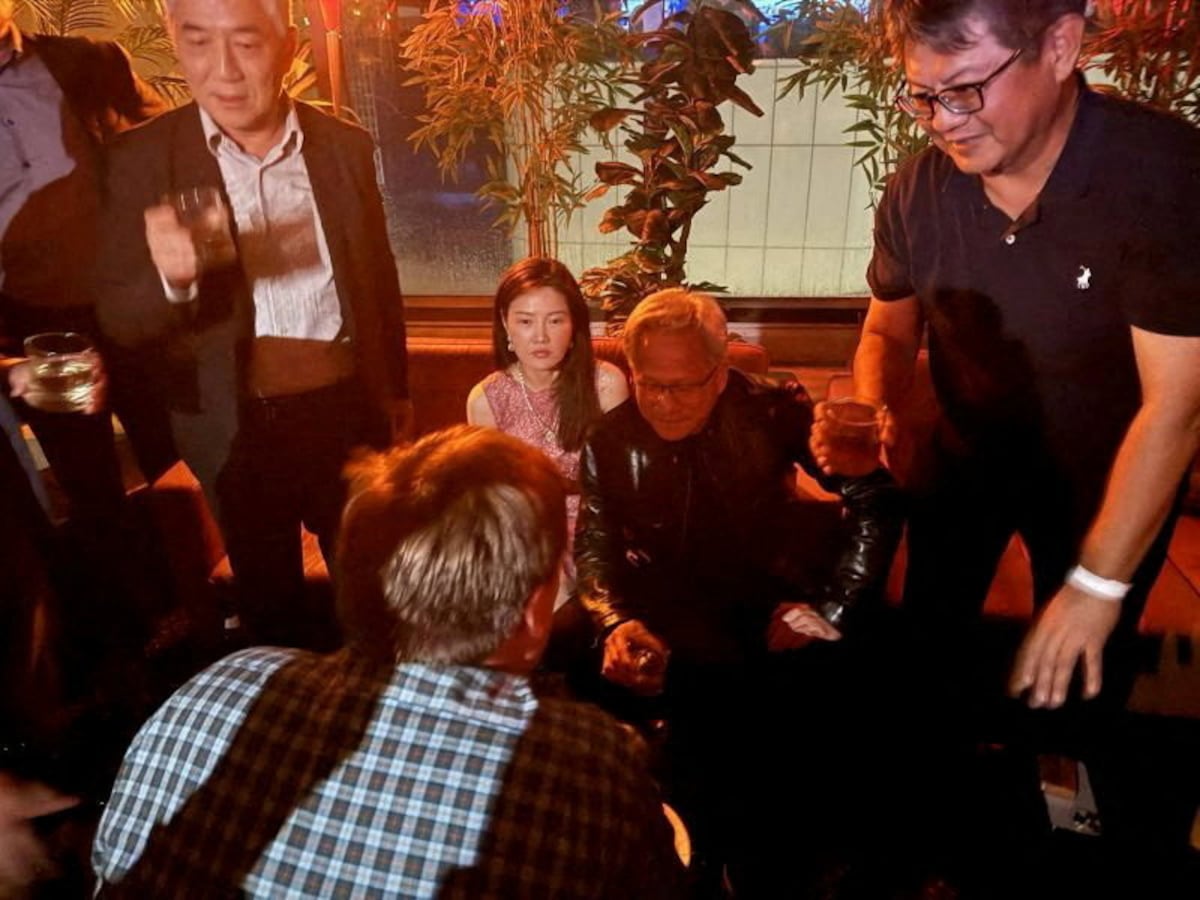
China on Monday rejected allegations that Huang Le, also known as Alice Huang and reportedly romantically involved with Nvidia CEO Jensen Huang, worked for Chinese intelligence services.“The so-called Chinese spy allegation is unsubstantiated. It is nothing but smears against China,” Foreign Ministry spokesperson Guo Jiakun said at a press briefing.Beijing was responding to reports that prompted the chipmaker Nvidia to launch an independent investigation, announced on Sunday, the same day its founder acknowledged having been unfaithful to his wife.The revelations have rattled the company’s market value, with shares falling by as much as 6% in premarket trading. Asked by another reporter whether he was explicitly denying that the businesswoman had worked for Chinese intelligence, Guo repeated the same formula. He provided no further details about a woman about whom little is publicly known.Suspicions of espionage first emerged on October 29, when The New York Times reported that U.S. intelligence agencies had concluded that Huang was passing information to Beijing. The newspaper cited anonymous sources familiar with the surveillance operation. On November 6, it reported that China’s Ministry of State Security had allegedly recruited her to obtain information about U.S.-made chips and potentially influence Nvidia to promote increased sales to China. According to the newspaper, that assessment appeared in a memorandum circulated among senior U.S. officials.The Financial Times later reported that a U.S. intelligence assessment described her relationship with Jensen Huang as romantic. The evidence has not been made public.The New York Times had already drawn attention to Huang in October 2025 while investigating Megaspeed International, the Singapore-based data-center company where she worked. That report described her meetings with Nvidia’s founder and U.S. inquiries into the company’s chip purchases, but it neither alleged that they were having an extramarital relationship nor identified her as a spy.Huang is a Chinese citizen and is not related to the businessman, who is of Taiwanese descent, despite sharing his surname. Her age, education, place of birth and current residence have not been made public. Nor is it known when she left China or whether she ever settled permanently in Singapore.A profile on Simuwang, a Chinese fund database, states that she spent four years working in the media and eight in the financial sector. It lists positions as a reporter at Hunan TV and CCTV, assistant to the head of HSBC’s private-banking division, and vice president at CITIC Securities. AFP has been unable to verify that résumé or identify who compiled it. EL PAÍS has likewise been unable to corroborate those background details, which have been repeated in numerous profiles published in recent days.Bloomberg found firmer documentation of her business activities in Shanghai. In a 2016 post on the official account of investment firm Shanghai Hexi Investment Management, she appeared among the company’s executives. The firm had invested in 7Road, a Chinese video-game company whose international operations later gave rise to Megaspeed.Records reviewed by the Singaporean press show that the company was incorporated in 2015 as 7Road International. In March 2023, it adopted the name Megaspeed, and Huang joined as managing director. Ownership was then transferred to Huang Le Limited and, in November, to Swiftdata, controlled by Singaporean businessman Tan Yong Pong. By November 10, 2023, Huang had resigned as a director. It is unclear when she stopped being involved in the business.Photographs of the relationshipAlthough it is not known when she first met Nvidia’s founder, there is photographic evidence of the two together in Taipei in June 2024. According to Parker Schmitt, chief executive of software company NetThunder, who spoke to The New York Times, Huang Le offered, in front of a group of executives, to arrange for Jensen Huang to join them; he appeared shortly afterward. A source close to Nvidia said he had already planned to attend and arrived with two other executives.AFP has reviewed footage from a dinner in May 2025, during Computex, Taipei’s annual technology trade show, that shows the pair exchanging affectionate gestures and leaving in the same car.The scale of Megaspeed’s business helps explain Washington’s concerns. According to corporate records cited by The New York Times, a Malaysian company linked to Megaspeed purchased at least $4.8 billion worth of advanced equipment incorporating Nvidia technology between June 2024 and February 2026. Those purchases took place after Huang had resigned as a director, and there is no evidence that she personally oversaw them.Megaspeed leases computing capacity to Chinese clients, including e-commerce giant Alibaba, allowing them to use those processors without physically importing them into China. The U.S. is investigating whether restricted chips were also diverted to China. Nvidia says it has found no evidence of smuggling.Behind the controversy lies the technological rivalry between the world’s two leading powers. Since 2022, the United States has restricted exports of advanced processors to China on national-security grounds, citing their potential military applications. Those restrictions were introduced during the presidency of Joe Biden.But Jensen Huang, one of the most influential figures in the artificial intelligence industry and someone with direct access to current U.S. President Donald Trump, has argued for easing those controls. In May, he was part of the delegation that accompanied the Republican president on a trip to Beijing. Trump described him on Sunday as “an honorable guy” and voiced support for him remaining at the helm of Nvidia. The chairs of three House committees have asked him to appear at a closed-door hearing on November 18, Reuters reported.Singapore has confirmed an investigation into Megaspeed but has denied it was investigating Huang Le over her alleged ties to Chinese intelligence. She has not publicly responded to the allegations. Nvidia says it has no reason to believe that corporate secrets or U.S. national security have been compromised. In his letter to employees, the company’s chief executive acknowledged the affair, without mentioning Alice Huang by name, and pledged full cooperation with the investigation.Sign up for our weekly newsletter to get more English-language news coverage from EL PAÍS USA Edition
Alice Huang, the suspected Chinese spy at the center of the Nvidia controversy
Full Article
Original Source
Read the full article at English →KhanList aggregates and links to publicly available news content. We do not host full articles from third-party sources. Always verify important information with original sources.