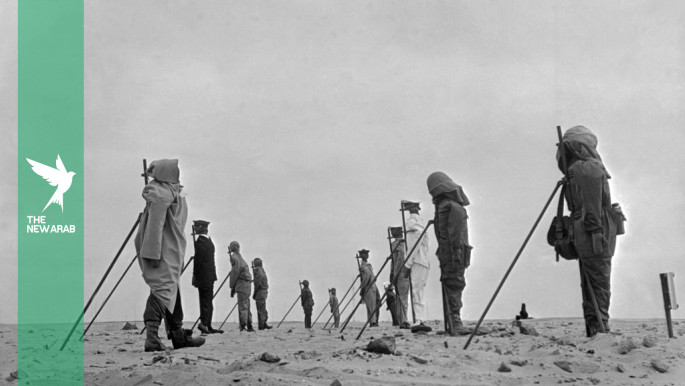
Algeria launches digital map to document France's colonial environmental crimes Authorities say the project could help preserve national memory and support efforts to establish France’s responsibility for colonial-era environmental damage. A group of dummies set up on the French nuclear weapons testing range near Reggane, Algeria, before France'ss third atomic bomb test, 27th December 1960 [GETTY] Algeria has launched a preliminary national digital map to document sites damaged by French forces during the country's colonisation, in a move officials say is intended to preserve national memory and help establish international responsibility. The platform was unveiled on 7 July during the first session of the Joint Ministerial Committee on Environmental Memory, under the supervision of Algeria’s Ministry of Environment, coinciding with the 64th anniversary of independence from France, which colonised Algeria from 1830 to 1847. The map is expected to catalogue sites bombed with napalm, areas exposed to banned toxic gases, and places affected by nuclear radiation, drawing on scientific studies and historical testimony. Environment Minister Kawther Krikou said the platform would be updated gradually as field studies and investigations identify new sites. Mohamed Lahcen Zeghidi, coordinator of the Algerian Committee for History and Memory, said the project was an important step in documenting the environmental legacy of colonial crimes and their impact on human and animal health, vegetation and ecosystems across Algeria. Hussein Abdel Sattar, director of the National Centre for Studies and Research on Popular Resistance, said re-examining colonial crimes that affected ecosystems was necessary to understand the scale and duration of the damage and to build a scientific approach that links memory, environmental protection and environmental justice. He cited nuclear explosions, chemical weapons, napalm attacks, mine-laying and resource extraction as among the crimes and practices under review. Why it matters France’s colonial rule in Algeria left environmental damage that Algerian officials now describe as environmental crimes, including scorched-earth tactics and contamination linked to military activity. The most significant case is France’s nuclear testing in the Algerian Sahara — the health and environmental effects of which remain a live issue in Algeria’s memory and reparations campaign. International humanitarian law protects the environment during armed conflict, while the Rome Statute prohibits attacks carried out with knowledge that they will cause widespread, long-term and severe environmental damage, though that standard is difficult to meet and rarely applied. However, legal experts note that the chronology is crucial — many of the worst abuses predate modern treaty rules and the International Criminal Court, making war-crimes language more useful as a moral and analytical framing than as a straightforward basis for prosecution. Related Articles
Algeria launches digital map of colonial environmental crimes
Full Article
Original Source
Read the full article at Newarab →KhanList aggregates and links to publicly available news content. We do not host full articles from third-party sources. Always verify important information with original sources.