
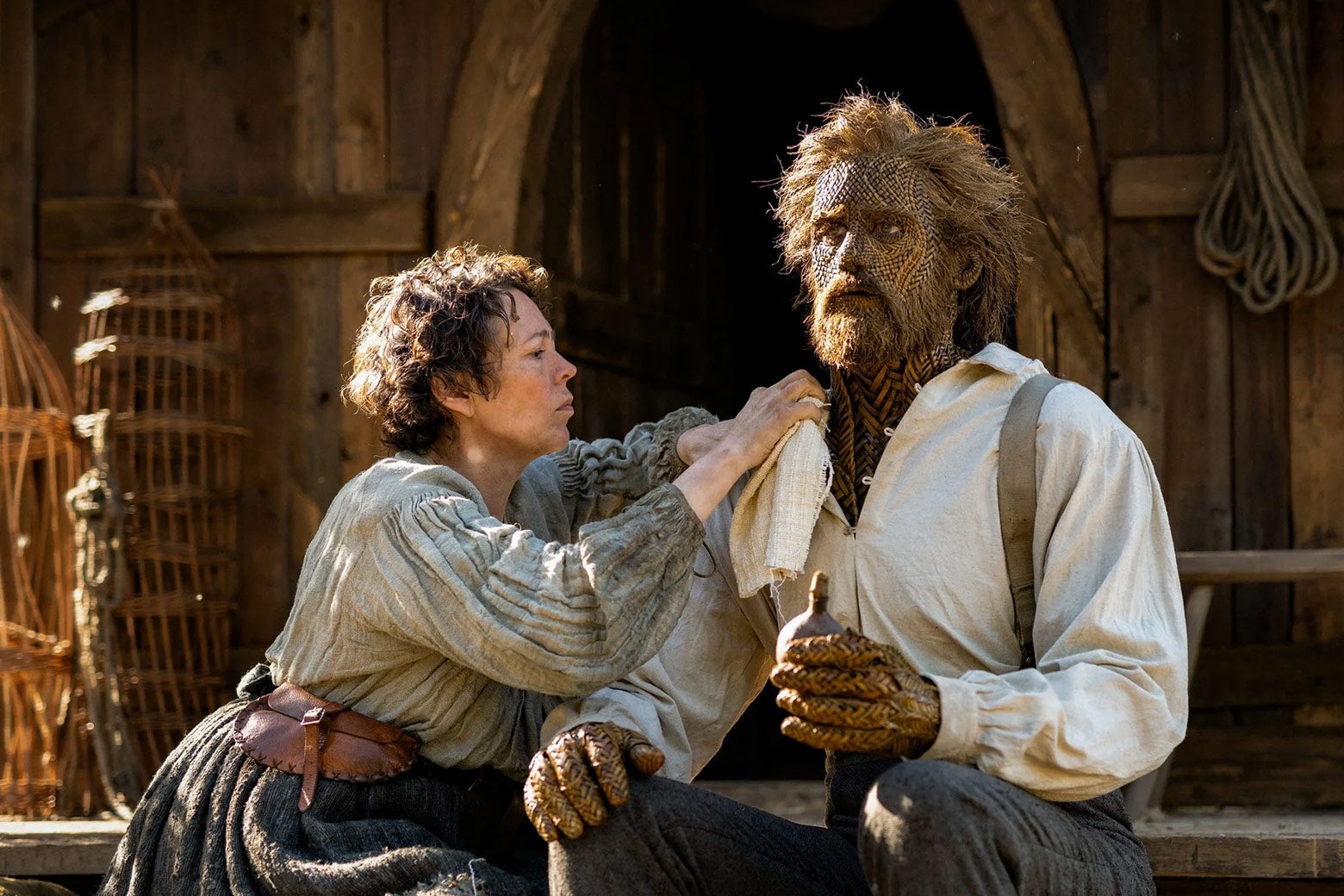
Wide Angle An interview with author Ursula Wills about the origin of the story, the changes between the source material and the movie, and what Alexander Skarsgård is like in person. By Enter your email to receive alerts for this author. Sign in or create an account to better manage your email preferences. Unsubscribe from email alerts Are you sure you want to unsubscribe from email alerts for Rebecca Onion? Oct 30, 202610:00 AM Black Bear Pictures Sign up for the Slatest to get the most insightful analysis, criticism, and advice out there, delivered to your inbox daily. The movie Wicker, starring Olivia Colman as a cranky, lonely fisherwoman who commissions a basket weaver (Peter Dinklage) to make her a husband (Alexander Skarsgård, with the aid of some tremendous prosthetics), is odd, hilarious, and delightful. People who memed its trailer release a few months ago will find the full film, newly out for wide release, to be just as saucy and silly, an exploration of patriarchal marriage, gender roles, and the power of mean girls that plays out in a faux-medieval setting full of jealous villagers who really don’t like how nice and helpful the Wicker Husband turns out to be. Wicker is a truly romantic tale, with what I can only describe as a Monty Python sense of humor. The story of how Wicker became a movie is just as singular. British writer Ursula Wills’ short story “The Wicker Husband” sat on a now-obscure website for years before a producer contacted her out of the blue. There’s a vogue for commissioning movies based on unpublished short stories (including Reddit posts!) right now, but I’m not aware of any other “smut with a sentient object” tales to have struck pay dirt. When you read Wills’ story, you see what the producers saw in the material: The story builds a little world in very few words, weaving a framework that’s strongly defined, but also easy for a movie to embellish with just a detail here and there. Wills and I spoke recently about the origins of the story—renamed “Wicker” for the e-book version—as well as the changes made for the movie, and what it was like to have this older bit of work resurrected and made famous nearly two decades later. Our conversation—which does contain a few spoilers—has been edited and condensed for clarity. Slate: Tell me how you came up with the idea for the original story, “The Wicker Husband.” Ursula Wills: I was visiting this place in Cornwall, where this guy who was a basket maker had done up this art trail around a millpond with wicker creatures. I got the idea because there was a full-size wicker man statue fishing out of the pond. But when the trailer came out and it all started going a bit viral, I was like, People are going to ask me where I got the idea from. These people live in the back of beyond in Cornwall, and I need to go and talk to them. So I went down and talked to them, and they’re absolutely thrilled, and they think it’s extremely funny that their creation is having all this extra life. The guy that made the original wicker man statue, he doesn’t run the place anymore, his kids do. He says he’s going to make a new wicker man now, for next summer, so people can go see it. It was about 20 years ago that I saw the original statue, so I asked about that one, and he said it was gone. I asked how long it lasted, and he said a well-maintained one lasts about three years. So that’s about the span of the Wicker Husband’s life. Oh, poor Wicker Husband! He’s not going to last! Did you commonly write in a fairy-tale mode like that, or was “Wicker” an exception? I’ve got a book coming out with 12 other short stories, in April, and people can see I sometimes do write in that fairy-tale style, and I tend to do that for the shorter pieces. When I write longer pieces with more characters and points of view, I switch into a bit more of a modern sort of style. But in “Wicker,” I was really, really aiming for that fairy-tale writing style, and it was partly me setting myself a little challenge, because it is quite hard to write a new fairy tale without rehashing all the existing ones. So I felt like I achieved that really well. I was quite pleased with myself. And then you posted it online, right? It was on a site called East of the Web where you could go and read various short stories. I think I posted it there in 2008, and then it was up there for years and years and years, and we took it down eventually when we sold the film rights. It’s not used so much now, but it was quite a popular site at the time. Remember when being able to read literature on the internet was a bit more of a new thing? They curated what went up there—you had to apply, and they put stuff on if they thought it was good enough. But you didn’t get paid for it, I bet. Oh, no, I didn’t get paid for it! So it went up in 2008 and then for a number of years it just was up there and … nothing? Oh, sometimes random people would send me emails going, Can I translate this for my college project? Sometimes people would pop up and be like, I want to turn this into a play. And I’d be like, OK, come back to me when you’ve organized something proper, or whatever. I think when the film inquiry came through, that came straight to my agent. So at least we knew it was somebody who knows that you need to speak to the agent—clearly someone a bit more professional. I wasn’t convinced it would become a movie. I thought, Maybe something will come of that—whatever. But getting to the actual shooting stage rolled surprisingly quickly. Once they got their teeth into it, they really moved it forward quite fast. I was impressed by that. Are you a reader of romantasy? I know a lot of people who are talking about this movie a lot online are fans of that genre. I know it’s a big deal at the moment, but I guess I wouldn’t classify myself as a fan of romantasy. But on the other hand, some of the things that I have read a lot of are quite adjacent to that. So I will quite happily read fantasy, or sci-fi, and also romance, but I don’t think I’ve ever got into that place where the two of them gel. I read lots, and I read lots of random things, including old fairy stories, which have always interested me. Ghost stories and old Victorian books, too. I read an interview with the producers and they described Wicker as totally original, not fitting into any bucket. I guess it’s partly a folk horror movie, and there’s some body horror, like when the Basket Weaver’s third creation, the Wicker Woman, attacks the Butcher, at the end. I was there when they were shooting that Wicker Woman scene, because I visited the set a little bit. The shoot was much bloodier than the final cut of the film. So I think they cut the film to maybe lean a little bit more towards the romance side. In the final cut, there’s a little bit less blood, a little bit less fire than there could have been. Tell me about your first reaction to the movie. Was the London premiere the first time that you had seen it, or had you had access throughout? It was not the first time I’d seen it, but it was the first time I’d seen it with an audience, so it was great to hear their reactions. Because I wasn’t going to Sundance, I did see it in a private showing for some of the production people in January. I was quite nervous when I went to see it, and it was in a really, really small test cinema in London. I sat right by the speaker. There are lots of creaking noises in the movie, as you know, and I was getting the full effect of all the creaking noises. And afterwards, the producer said to me, “What did you think?” And I was like, “I don’t know, the soundtrack’s a bit much?” And he went, “Oh, you should have heard it before I made them turn it down.” I did want to ask you about the changes they made to your story. One thing I noticed, the main antagonist, the Tailor’s Wife (played by Elizabeth Debicki), has far more of a backstory. But also, in your story, the female main character is more of a girl than an older woman. What did you think about this change? In the story, that main female character’s called “the ugly girl,” and actually, when you’re looking for an actress to play a part when that’s the headline name of the character, that’s pretty hard. A lot of actresses wouldn’t actually want that on their résumé. But the character wasn’t really meant to be defined by age. It was just her being generally a bit of a social outcast. To me, this was not a big deal as a change. Olivia Colman, as soon as she came on board to be the Fisherwoman, I was like, Oh my God, she’s going to be epic. But I was glad when they cast Alex Skarsgård for the Wicker Husband, because originally they’d been talking about having Dev Patel in the part, and he would’ve been amazing, but he is a lot younger than Olivia Colman, and I didn’t want it to be like, Oh, a woman just needs a younger man, do you know what I mean? I didn’t want that to be the message. It’s very much about having a man that actually respects her, rather than having a man who’s younger and fitter or whatever. So when Alex Skarsgård came on board, I was like, Oh yeah, they are a similar sort of age, so that’s good. Yeah. And he’s so good in it. He’s so good at being just a little freaky. He’s a very chill person in real life. He’s very chill on set and everything. Another big change from the story is that, in the movie, the Wicker Husband chooses to be in love with the Fisherwoman, while in the story, the question of his agency doesn’t come up. People are raising this question. It’s like, Oh, does he have free will, or is he just kind of her sex slave? I don’t know if I ever really resolved that in the story, but it’s OK for it to be an open question. Some of the lines in the film do actually come from the story. When he says he was “made to be with her,” he’s stating a fact, as well as saying something romantic—there’s a double meaning. And when he says that without her, he would never have seen the clouds—he understands these things to be true. So there’s an element of gratitude in his feelings toward her. But all the Wicker people, in my head, did have free will. Take the Wicker Woman. She could turn around and run away, after she’s presented to the Butcher; no one could harm her because she’s completely covered in massive spines. But she decides to stay and fight, instead. Their characters are partially based on what kind of wood they’re made of—the Wicker Woman is made of blackthorn, which is very hard, whereas willow, which is what the Wicker Husband is made of, has got a chemical in it that, if you boil it, can be a painkiller. I wanted his personality to come from the tree. Oh, I see—he’s a person who resolves the Fisherwoman’s pain. That makes sense. It’s interesting to me that people are discussing his free will, but I don’t have a clear-cut answer. Same with the ending—it’s quite ambiguous in the story, what happens in the ending. That was my intention, but I think the film left it quite ambiguous as well. Well, in the story, it’s a little more of an open question—the villagers look for the wicker husband, the “ugly girl,” the wicker baby, and the basketweaver, and can’t find them. But in the movie, you get to see them all going away together, sitting in a wagon full of all the villagers’ best stuff that they’ve given the basket maker to try to win the wicker woman—including the bakers’ extremely beautiful multilayer cake. It’s a happy ending, of sorts, for now! That’s true. They got away with the stuff! Books Movies United Kingdom Romance
Alexander Skarsgård’s Horny New Movie Is a Riot. The Story That Inspired It Is Just as Singular.
Full Article
Original Source
Read the full article at Slate →KhanList aggregates and links to publicly available news content. We do not host full articles from third-party sources. Always verify important information with original sources.