
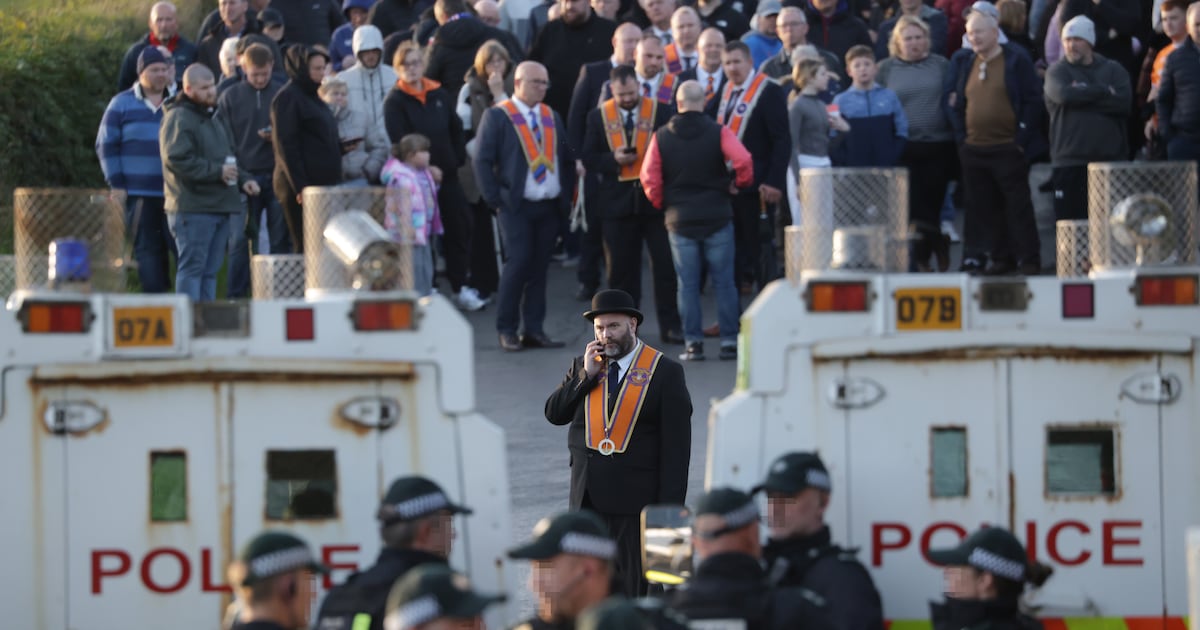
A line from Joan Baez’s Diamonds and Rust summed up my feelings on Sunday morning: “Well, I’ll be damned, here comes your ghost again.” I had gone to bed in 2026 and woken up in the mid-1990s, when long drawn-out protests between Orange Order members and local nationalist residents at Drumcree in Portadown, Co Armagh, were as much a part of the summer holidays as ice-cream and trips to the beach.It was one of only two moments – the other was the unionist response to the Anglo-Irish Agreement in 1985 – when I feared that Northern Ireland might actually topple into the abyss, such was the fury between unionists and nationalists. Protests and violence spread across the province and even threatened the nascent peace process, which had begun with the IRA and loyalist ceasefires in August and October 1994.On July 11th, 1995, following a compromise of sorts with the nationalist protesters who were blocking a parade, David Trimble and Ian Paisley, their hands joined aloft, led the march back down Garvaghy Road. It was this moment of supposed triumph that was reckoned to have earned Trimble the leadership of the Ulster Unionist Party two months later. Ironic, really, because it is unlikely that any of the other four contenders would have delivered the Belfast Agreement. After another two years of summer protests and violence, in 1996 and 1997, the parade was barred from its “traditional route” in 1998 and has not completed it since.So why is it back on the agenda 28 years later? Partly because it has remained with the unsorted baggage and unfinished business that wasn’t dealt with when the Belfast Agreement crossed the line; and partly because there was a general feeling across unionism that since the issue seemed to have settled, it was better to leave well alone. The Orange Order repeatedly asked for permission to parade again, but never to the extent that it wanted to breathe fresh life into the protests and standoffs. READ MORE[ Drumcree: Where are we now and what happens next?Opens in new window ]The real change, however, has been the new willingness by elements of unionism, particularly loyalism and the Orange Order, to engage as active participants in what they increasingly describe as a culture war. A willingness that ties in with a post-Brexit recognition that unionism has too often been on the losing side since around 1972 – when the Northern Ireland parliament was closed – while nationalism, particularly Sinn Féin, has, according to them, been “rolled over to and facilitated by” successive British governments.The three main turning points leading to this willingness were: the loss of the overall unionist majority in the Assembly in 2017; Sinn Féin emerging as the largest party in 2022, entitling Michelle O’Neill to the role of First Minister; and the 2023 Framework Agreement between the UK and EU, which Jim Allister MP, leader of the unionist TUV, described as reducing Northern Ireland to semicolonial status. With the shadow of a Border poll hanging over local politics, and unionism increasingly of the view, especially after the Assembly was rebooted in February 2024, that it was not serving its interests, it looked to culture-war tactics as a new strategy. Its belief that unionism wasn’t being properly recognised and organised as a coherent single identity meant that it had to find new ways to mobilise. It wanted to be recognised as a big stakeholder within the system, able to push back against what it feels is a downgrading of its specific culture and history, as well as its broader identity within pan-UK unionism. [ ‘It’s like going back in time’ – after 28 years, communities stand off on Garvaghy RoadOpens in new window ]Put bluntly, it was fed up with what it regarded as the enabling of all-Ireland culture, history, narrative and Irish unity inevitability at the expense of its own history, culture, identity and narrative; all of which has its roots in the Plantation more than 400 ago – an identity that pre-dates the identity Americans celebrated earlier this year. In the past few months it has taken a more nuanced approach to seeking permission to parade again; not insisting on substantial numbers nor on accompanying bands. It even agreed to parade at 8am rather than 1pm. For those who have monitored this over the past 30 years, these were seen as substantial concessions. Certainly enough for permission to be granted by the Parades Commission and two subsequent court rulings afterwards. Yet, on Sunday morning, hundreds of nationalist residents, accompanied by local Sinn Féin MLAs and councillors, as well as First Minister Michelle O’Neill, were unlawfully blocking what had been designated a lawful parade.First Minister Michelle O'Neill speaking to the media in Portadown on Sunday, with Sinn Féin leader Mary Lou McDonald. Photograph: Charles McQuillan/Getty This outcome was inevitable. There is no such thing as the gracious acceptance of court decisions in matters like this. A victory for one side is always viewed as a loss for the other, and loss must always be contested. The tensions surrounding these contestations will always involve heavy policing and the sucking into pro and anti positions of the mainstream political parties and their electoral bases. At these times, of course, there is no role for the middle ground, other than that of observers.[ Decades after flashpoints of the 1990s, Drumcree is just as dangerousOpens in new window ]The past is always in front of us in Northern Ireland. That’s why progress, co-operation, genuine power sharing and tangible evidence of reconciliation is still absent just two years away from the 30th anniversary of the Belfast Agreement. The relationship between unionism and nationalism – especially between the DUP and Sinn Féin – is already toxic. Today they are staring into the abyss. The peace process is at its weakest point since April 1998. Some will argue that, like the lyrics in Shirley Bassey’s song, this is “just little bits of history repeating, and I’ve seen it before and I’ll see it again.”But this time it feels different. Quite different. The centre has collapsed. The grassroots are despondent. I don’t see a route leading to either political or societal stability. Alex Kane is a political commentator and former communications director of the Ulster Unionist Party
Alex Kane: Northern Ireland is staring into the abyss. The peace process is at its weakest since 1998
Full Article
Original Source
Read the full article at Irishtimes →KhanList aggregates and links to publicly available news content. We do not host full articles from third-party sources. Always verify important information with original sources.