
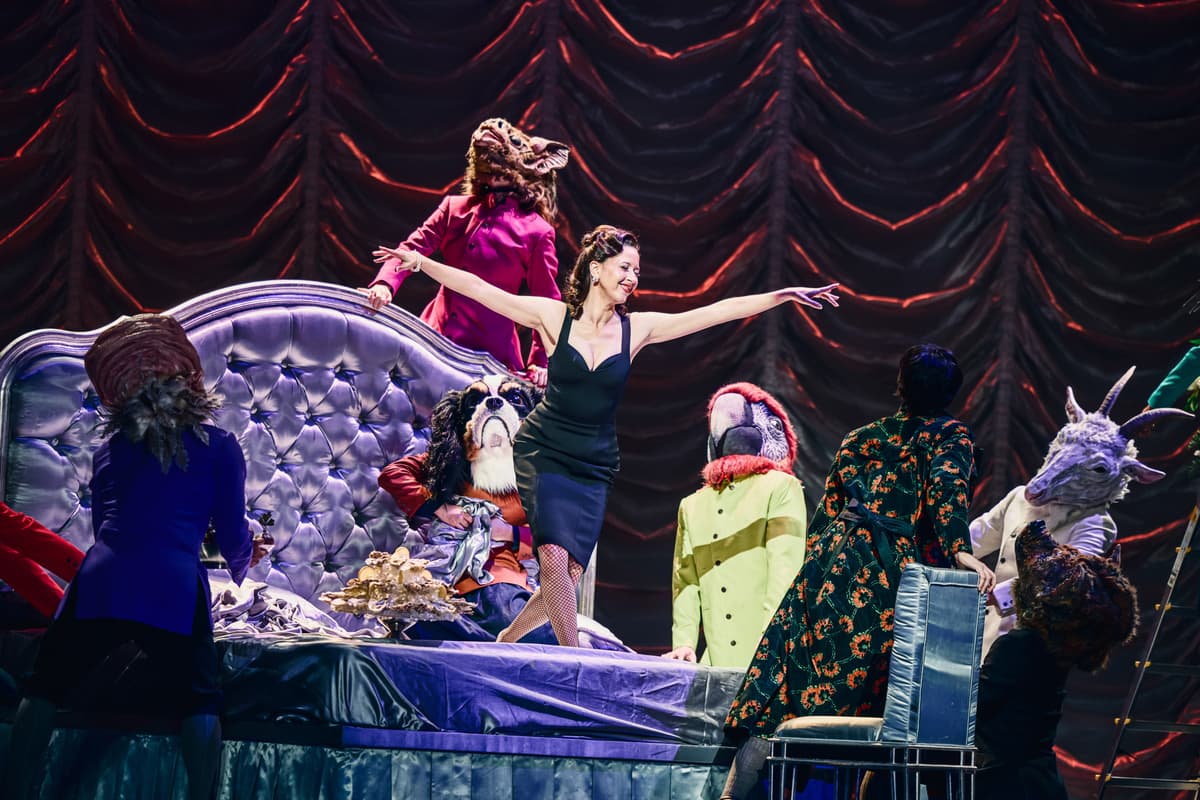
The appearance of the band of Puritans who feature at the beginning and end of Richard Jones’s production of Handel’s Alcina, revived at Covent Garden by Sarah Fahie, is at first sight puzzling. But they date approximately from the age of Handel’s primary source, Ariosto’s Orlando Furioso, and are key to Jones’s ingenious twist on the story, turning out to be revellers in the realm of hedonism indulged in on Alcina’s enchanted island in which former lovers have been turned into wild beasts.While the Puritans’ values of mercy and kindness are urged on the more vengeful characters, they themselves, when returned to human form, reflect on what they have experienced and reject their black, leather-bound Geneva Bibles in favour of The Joy of Sex. In between Jones unfolds a delectable fable full of imaginative touches, often comic, often affecting, with Handel’s glorious score offering an endless sequence of arias each more ravishing than the last. The cast is nearly the same as in 2022, with Lisette Oropesa dazzling in the title role, despite the announced heavy cold. Emily D’Angelo again impressed as Ruggiero, her latest lover, delivering a deeply expressive account of Verdi Prati, instilling the simple melody of the character’s yearning farewell to the island with a wealth of emotion. Crucial here was the contribution of conductor David Bates, in charge of a Baroque-sized ensemble selected from the ROH orchestra, drawing out the lines to maximum effect. And yet the peak of stylistic expressivity was reached by Mary Bevan as Morgana (Alcina’s sister) in her final aria of heartbreak, where she’s accompanied by just theorbos, harpsichord and a period cello played exquisitely by Hetty Snell. Ru Charlesworth has many beautiful lyric moments as Oronte, helplessly in love with Morgana. New to their roles are Edward Grint as a fine Atlante and Beth Taylor an equally admirable Bradamente. And I love the way the latter, Ruggiero’s wife disguised as her brother, and Ruggiero himself, a castrato role sung as usual by a mezzo-soprano, both turn up in kilts – adding an extra layer of intrigue to Handel’s gender-hopping scenario. As Oberto, searching for his father, turned here into a rather friendly lion, Thomas Mayes, head chorister of the Temple Church, is unfazed by the technical challenges thrown at him. If this revival took time – a good deal of the first act – to settle, it once again developed into an appropriately magical evening.
Alcina at Royal Opera: A magical evening
Full Article
Original Source
Read the full article at Standard →KhanList aggregates and links to publicly available news content. We do not host full articles from third-party sources. Always verify important information with original sources.