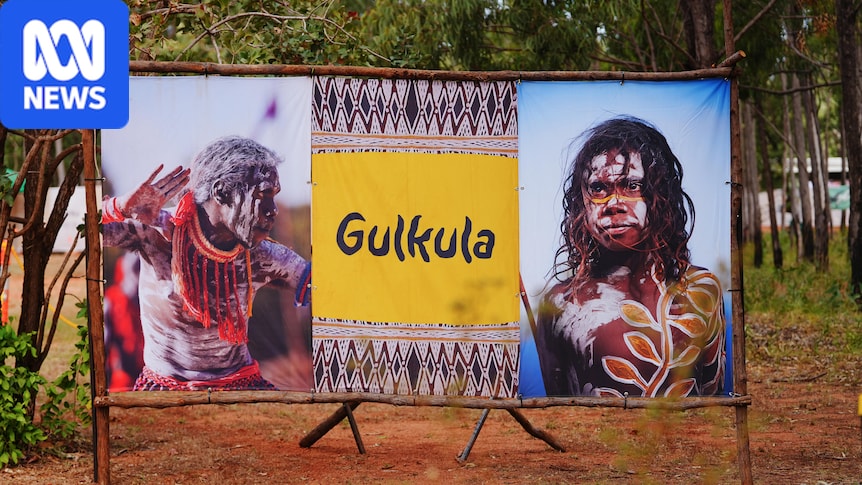
The ceremonial grounds of Gulkula on the peninsula of north-east Arnhem Land are steeped in history and heartbreak, leadership and loss and, above all, hope for the future.The story of this meeting place goes back thousands of years. The Yolŋu stories speak of Ganbulapula looking to the skies, forging a connection between the present and the future, the land and the sun.On the same peninsula, where the forest meets the sea in the red sand of the Gumatj clan, some of the country's best and brightest minds have gathered to chart a course on the problems facing Indigenous people and the solutions to our struggles.The theme of this year's Garma Festival is "bukmak"— a Yolŋu word meaning "everyone" — and is intended as an invitation to all to come, engage, and work with Indigenous Australia.The ceremonial grounds of Gulkula on the peninsula of north-east Arnhem Land are steeped in history and heartbreak, in leadership and loss, and above all, hope for the future. (ABC News: Billy Cooper)Albanese's notable absenceWith the Indigenous affairs agenda largely stalled domestically, some are looking to international partners to play a bigger role in shaping the future.In recent years Garma has hosted delegates from Australia's key strategic partners, including representatives from Fiji, Kiribati, Paula, Tuvalu, and Papua New Guinea. This year Timor-Leste Prime Minister Kay Rala Xanana Gusmão will attend.But a notable absence looms over the Garma Festival — a year after he swore to attend every year for as long as he was prime minister, Anthony Albanese declined his annual invitation.Broken promises are taboo in politics, but they happen when the risk is worth the pay-off.It boils down to the question of whether the benefits of being labelled as a promise-breaker outweigh the risks of being pilloried by the public.But it appears that equation shifts when a promise is made to 3 per cent of the population.Anthony Albanese meets chairman of the Yothu Yindi foundation Djawa Yunupingu at the Garma Festival 2025. (ABC News: Che Chorley)Garma showcases the dance, songs and art of the world's oldest continuing culture, but it also puts Indigenous affairs into focus for politicians and the public.Last year, Yothu Yindi chief executive Denise Bowden told the politicians present not to be "fooled" by the beauty of Garma."Your presence here is a powerful signal to the bush that you are prepared to go the distance with us, that you are not going to sit in Canberra and attend endless meetings with endless talk and run around in circles," she told the forum."Action is needed now. Don't leave Garma and put things on endless repeat. Don't be fooled into thinking your attendance here is enough."In short, coming here only means something if it results in action, and it could be argued that Albanese's presence has not resulted in much.The prime minister's decision not to attend also means fewer eyeballs on the event and less accountability for policymakers.At a time when Indigenous affairs have once again become the low-hanging fruit for culture wars, the prime minister failing to front up to the festival is yet another disappointment First Nations people have had to deal with."I think it's disappointing that the prime minister's not continuing that tradition of going to Garma and speaking with Aboriginal leaders there," Thomas Mayo said. (ABC News: Michael Franchi)'Only wants to listen when he has something he wants to stay'On the steps of the Labor faithful's own ceremonial meeting, its triannual conference last week, maritime union official and Indigenous rights campaigner Thomas Mayo called out what he saw as the prime minister's lack of ambition."I think it's disappointing that the prime minister's not continuing that tradition of going to Garma and speaking with Aboriginal leaders there," Mayo said.His comments echo the feelings of many Aboriginal leaders, speaking privately, who lament the prime minister's apparent crab-walk away from First Nations people and communities.Some believe he is not attending because he has nothing new to announce. Others believe it is a signal of where Indigenous affairs sits as a government priority."Albanese only wants to listen when he has something he wants to say," one elder told me in the weeks leading up to the event.Another broken promiseIndigenous leaders say it's obvious political will has wilted in the wake of the Voice referendum, and many believe the federal government's agenda is unambitious. Jobs and economic development at the centre, rights reforms left to gather dust.They acknowledge that the political landscape is challenging. The government has already failed to achieve its centrepiece policy with the Voice to Parliament, and ever since the referendum, the rise of the populist right and Pauline Hanson's One Nation party has only deepened the culture wars that Indigenous policy so often falls victim to.But outside the Canberra bubble, the PM's absence comes at a time when Indigenous Australians are increasingly under threat, following an alleged terror attack in Perth, a neo-Nazi attack in Melbourne, and reported rising levels of racism and abuse, and communities are looking for leadership.Instead, they are left with another broken promise, and no real consequences to speak of.In the lead-up to the festival this year, Indigenous leaders are keen to focus on the positives of Garma, keeping the focus on what they can control, rather than the PM's decision.There's no doubt his failure to attend could dampen what the Yothu Yindi Foundation has built up over the last quarter of a century, but it would be a disservice to the decades of Yolgnu leadership to say one man could make or break what they've made.Political disappointment is nothing new in these parts — the genesis of Garma came from the broken promise Bob Hawke made to deliver treaty.In years past, when politicians fail to come through, Indigenous people will turn their focus to what remains in their control: their voices, advocacy, ideas and ambition for our people.Sue-Anne Hunter says politics and politicians are only a small part of what makes Garma an important event. (ABC News: Billy Cooper)As National Commissioner for Aboriginal and Torres Strait Islander Children and Young People Sue-Anne Hunter put it, politics and politicians are only a small part of what makes Garma an important event."I think it's disappointing to consistently see commitments fall through … however, we need to remember the importance of the festival and the focus. So for me it's paying attention to those around us rather than who may or may not attend," she said."We have an incredible opportunity to involve and focus on children and young people and celebrations of culture and I think that's for me what's important. And those of us who do show up must remember that."A bruising referendumThe winds are once again shifting among Indigenous people.The referendum was bruising. It reignited old lies, and if the hearings of the parliamentary inquiry into racism are anything to go by, it resulted in a huge spike in abuse and violence against Aboriginal and Torres Strait Islander people.It's taken time for that wound to scab over, but now there are some trying to start a new conversation, one with truth at its centre.Slowly, momentum is once again building for a national truth-telling process, something the government had already committed to before the referendum was lost.From the backbench, former cabinet minister Ed Husic voiced his support for truth-telling at the Labor conference last week."Truth-telling is a really important part of that process. So, I mean, I certainly do support, in terms of resources for Makarrata, for the broader truth-telling process," Husic said."The biggest thing that could have potentially helped [with the referendum] is for us to have that conversation as a country about what's going on, why First Nations people feel the way they do … we'd be able to bring people together in a great sense of national unity."From the backbench, former cabinet minister Ed Husic voiced his support for truth-telling at the Labor conference last week. (ABC News: Matt Roberts)Whether his voice can be heard by his former cabinet colleagues remains to be seen, but Husic's sentiments are shared by many Indigenous leaders, including Kerrupmara and Gunditjmara man Travis Lovett, who completed the marathon Walk for Truth from Melbourne to Canberra in May.When Lovett reached the nation's capital, the prime minister walked out onto the forecourt to meet with those carrying a message calling for truth-telling, burned into a kangaroo skin and signed by thousands.At the time, the prime minister acknowledged the long journey Indigenous and non-Indigenous Australians have been on."It is unfinished business, the business of reconciliation," Albanese said."There are bumps in the road. It's not a straight journey, as progress never is."In time, it's hoped he once again could lead the country, to meet Indigenous people where they are, and to champion them once more.
Albanese's absence looms large over Garma
Full Article
Original Source
Read the full article at Abc →KhanList aggregates and links to publicly available news content. We do not host full articles from third-party sources. Always verify important information with original sources.