
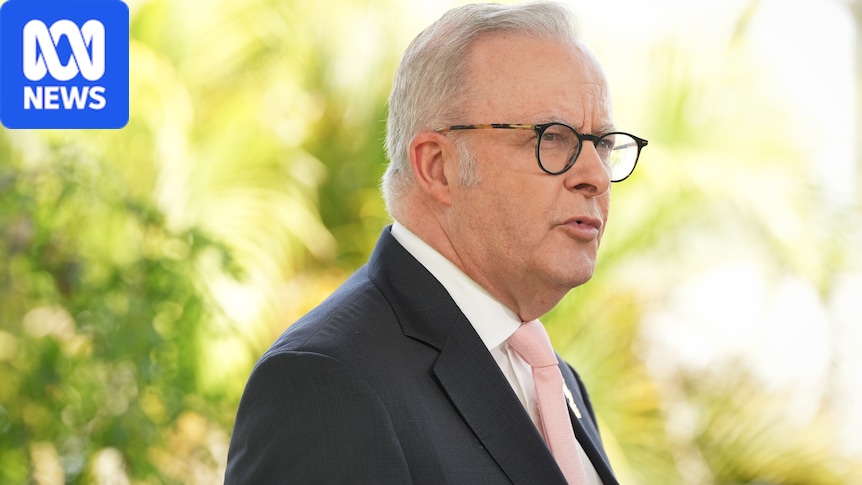
Anthony Albanese says the Iran war and the tariffs that continue to hurt Australia's economy were "major factors" in the Republican Party's drubbing in the US midterms, but he won't change how he deals with the White House.Back from the Commonwealth Heads of Government Meeting (CHOGM) in the Carribean, Mr Albanese said the election results were "very significant" and a key topic of discussion among leaders at the summit."Whether it be inflation in the global economy or the need to have free trade settings … every nation [at CHOGM] wants to see the war end and for the Strait of Hormuz to reopen," Mr Albanese said.Linking the war in Iran to Australia's cost-of-living crisis, Mr Albanese said he would continue to make representations to Washington for "de-escalation".But he argued he does not need to adopt a more forceful style in his dealings with Donald Trump."I have said it publicly and directly [to Mr Trump] that it's time for there to be a de-escalation," Mr Albanese said."[Australians] can expect me to continue to work diplomatically in Australia's national interests."The prime minister, back in Australia after a week at CHOGM, said he and Mr Trump came "from very different perspectives"."But I will work constructively with President Trump. That is what my job is," Mr Albanese said.Anthony Albanese says leaders at CHOGM discussed the midterm results. (ABC News: Matt Roberts)Mr Trump has admitted the Iran war was "probably" to blame for the Republican's midterm rout.Vice-President JD Vance was much more forceful, stating the war was "the reason we lost" in what has been seen as an attempt to distance himself from the president.Mr Albanese has been careful not to provoke a politically wounded and potentially volatile Mr Trump, but other Labor ministers have been more direct."The result in the US election was clear — that American consumers don't like tariffs and Australians don't like them either," Trade Minister Don Farrell said.Treasurer Jim Chalmers has described Australians as "the cost-of-living casualties of decisions made in DC and Tehran".Fifth rate hike won't change 'savings package'Those critiques come amid surging domestic inflation and fierce political debate about the extent to which public spending is driving it.Returning to Australia to face the fallout from the Reserve Bank's latest rate hike, Mr Albanese said the cash rate, now at an 18-year high, would not change the government's approach to its mid-year budget update."We'll be consistent. We've looked for savings in each and every economic statement, and we'll do so again in MYEFO," he said.Labor has committed to a "savings package" in the upcoming budget update, but not necessarily net savings.When he was asked what measures were on the table, Mr Albanese waved a pile of paperwork in the air."We're working on all of this," he said.Mr Albanese did not rule out means-testing home battery or electric vehicle subsidies, which the Business Council of Australia has called for.Opposition Leader Angus Taylor has accused the prime minister and his treasurer of being "in denial" about the economy."We do need to lower government spending," Mr Taylor said."This [inflation challenge] is homegrown. This is specific to Australia because of this government's failures."CHOGM 'worthwhile', but no take-home outcomesFacing criticism from the Coalition about his decision to travel to the Caribbean amid cost-of-living pressures at home, the prime minister defended the trip as "worthwhile" despite returning with no announceable outcomes."I see the relationship between [Canadian Prime Minister] Mark Carney, [UK Prime Minister] Andry Burnham and myself as being very important," he said in references to talks held with those leaders.Mr Albanese said the trio of middle powers used CHOGM, without the presence of the US or China, to discuss a push for global AI regulation ahead of the ASEAN, APEC and G20 summits."If there wasn't a forum that didn't feature the strategic competition between US and China, and didn't have authoritarian regimes like Russia involved, you might have to make it up, but there is — it's called the Commonwealth," he said.WA premier prompts backpacker talksTalks with Mr Burnham to reinstate regional work conditions for British backpackers were "constructive", according to the prime minister, though neither side has provided any detail about where negotiations landed.After previously ruling out any changes to the UK free-trade agreement, Mr Albanese said "representations" from the hospitality, agriculture sectors and the WA premier led him to change his mind."The removal of [regional work] obligations means you can have 77,000 UK backpackers sitting in Sydney or Melbourne … so this was raised by WA Premier Roger Cook directly, because they need people to get to Broome and Karratha. Those places rely upon working holiday makers," Mr Albanese said.It is understood talks with the UK government will continue over coming months, and that the proposal has been endorsed by Immigration Minister Tony Burke.Mr Albanese has a few days at home before departing for a lengthy stint abroad for the COP31 in Türkiye, ASEAN in the Philippines and APEC in China.
Albanese weighs in on 'very significant' US midterm results
Full Article
Original Source
Read the full article at Abc →KhanList aggregates and links to publicly available news content. We do not host full articles from third-party sources. Always verify important information with original sources.