
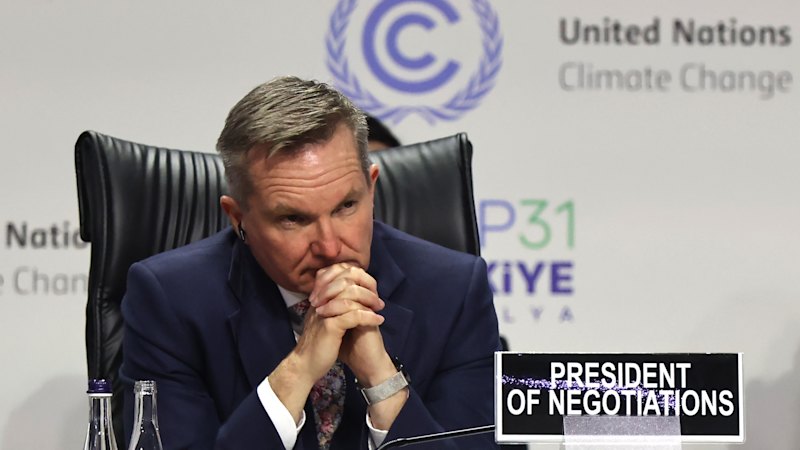
November 23, 2026 — 7:45pmPrime Minister Anthony Albanese has maintained it was in Australia’s national interest for Energy Minister Chris Bowen to co-host this year’s COP31 in Turkey, despite the summit’s negotiations collapsing without any agreed outcomes.The Coalition hammered Labor over Bowen’s role on Monday as the energy minister travelled home from Antalya, where the climate talks reached a stalemate on Sunday night for only the third time in the conference’s 32-year history.Climate Change and Energy Minister Chris Bowen.Getty ImagesThe central sticking point was whether the final document should specify phasing out fossil fuels – oil-producing nations led by Saudi Arabia wanted to scrub those references, while nations seeking more ambitious action, including Europe and the Pacific, said they must be included.The deadlock has cast a shadow over both the future of the UN’s climate summit and the role of Bowen, who campaigned for his role as president of negotiations when Australia lost its bid to host the talks in Adelaide.The Coalition on Monday called for Bowen to resign, with opposition energy minister Dan Tehan telling question time the minister had wasted “$150 million of our money on his big COP flop, including $30 million on a pre-COP [event in the Pacific that] no-one went to.”Opposition MP Dan Tehan has led the argument against Bowen’s joint COP presidency.Dominic LorrimerAlbanese defended Australia’s involvement, saying climate change was making weather events more extreme while the countries least responsible stood to lose the most, including Pacific neighbours.“The government believes that we have responsibility to this and future generations to act. [Critics argue that] one country acting alone won’t make a difference. We agree with that. We need to bring other nations with us on the journey,” Albanese said, to jeers from opposition MPs who asked how that was going.The prime minister also said there were links between environmental security and national security, referencing the interests of the Pacific. “I don’t think [the prime ministers of Fiji, Tuvalu, Samoa, Tonga and the Solomon Islands] thank the member opposite for the nature of that question, in which he said no-one was there at the pre-COP meeting held in the Pacific,” he said.Tehan, however, argued Bowen had embarrassed Australia on the world stage. “The [COP] model as it currently stands is completely and utterly broken,” he said.“Chris Bowen should have known that, and then he would have spared Australians the expense of $150 million for an exercise, which became a vanity project for him.”There was jeering in Monday’s question time as Albanese stood by Australia’s investment in this year’s COP.Dominic LorrimerConsensus approach the ‘root of the problem’: BowenIn the aftermath of the calamitous result, summit delegates are debating whether the joint co-hosting arrangement between Turkey and Australia, proposed by Bowen, backfired by muddying authority and slowing discussion in the conference’s final days.Some critics questioned Bowen’s strategy of insisting all 198 parties agree to a final cover decision.The cover text, which captures the COP’s headline aims, is negotiated throughout the summit to achieve consensus, and sinks if any country objects. The death knell this year came when Irish climate minister Darragh O’Brien, on behalf of the European Union, rejected the text on Sunday night because it “does not even mention fossil fuels”. Photo: Matt GoldingBowen said he tried to strike a balance: instead of using explicit language, the draft text referred to previous agreements on fossil fuels. “It was good faith attempt. It wasn’t enough,” he said.The Australian Greens were scathing of Bowen’s approach. “At the end of COP 31, we have the Albanese Labor government choosing to side with Saudi Arabia and Trump, and not mention fossil fuels, rather than back in Europe and our Pacific neighbours,” said leader David Shoebridge.“This is worse than disappointing.”Others argue that the requirement for consensus is a problem. The United Nations’ climate chief, Simon Stiell, said he was asking for advice on reforming the system on Sunday night.Bowen said the consensus rule was “the fundamental root of the problem”, not the joint presidency.Chris Bowen, president of COP31 negotiations, during the closing session at the climate summit in Antalya, Turkey.AP Photo/Khalil Hamra“When positions are so strong, that’s a very big challenge for any presidency – joint or individuals – to come to the global context,” he said in Turkey after the talks finished.“Australia left nothing on the field, trying to find solutions to reach what I now see as unbridgeable red lines. The situation coming into this COP was the most complicated and fraught geopolitical environment in living memory.“Unfortunately, we’re unable to reach agreement on a cover decision, and that’s disappointing ... I take my share of responsibility. Ultimately, you know, people can judge what could have been done or couldn’t have been done. Ultimately, it’s a party-driven process.”Bowen pointed to positive outcomes, such as more than 90 countries signing an electrification pledge. “People of goodwill worked very hard. I haven’t slept in the last three nights. We’ve been negotiating all the way through,” he said.Fiji’s environment minister, Lynda Tabuya, said the failure to agree on a cover text was not Bowen’s. “It is a collective responsibility that rests with all parties. Consensus requires compromise, courage, and political will from all of us,” she said.Failed COP talks create hope for better forumsThe stakes were raised at this year’s conference given the United Nations’ environment program had warned just weeks before that the world would overshoot the Paris Agreement of limiting global warming to 1.5 degrees.Former president of Ireland, Mary Robinson, said that should have shaken leaders into action, but “instead COP31 saw a shameful lack of urgency and leadership from the co-presidencies Turkey and Australia”.Former United States vice-president Al Gore, however, blamed the failure on a “handful of petro-states [who] have veto power over any mention of fossil fuels”.Other climate change advocates praised the EU and its allies for choosing to play hardball, including former UN climate change executive secretary Christiana Figueres, who said COP31 showed progress could be achieved without consensus.“Let’s be clear about what happened in Antalya: more than 130 countries refused to sign a deal that would have belied the true state of our crisis,” she said.Matthew McDonald, a professor of international relations at the University of Queensland, said the longer-term legacy of this year’s talks could be a “recognition of the limits of this consensus-driven approach to climate negotiations, and the development of alternative sites for climate action.”Tuvalu’s climate change minister, Maina Talia, said the island nation would next year co-host with Ireland the second conference on transitioning away from fossil fuels, alongside “a growing coalition of doers”.“Tuvalu cannot accept this as the final scenario. So we are putting our resolve where we can make an impact,” he said.“It is moving beyond debating whether fossil fuels are simply mentioned in a text, to creating detailed plans for a global transformation.”From our partners
Albanese stands by Bowen after failed COP amid global recriminations
Full Article
Original Source
Read the full article at Smh →KhanList aggregates and links to publicly available news content. We do not host full articles from third-party sources. Always verify important information with original sources.