
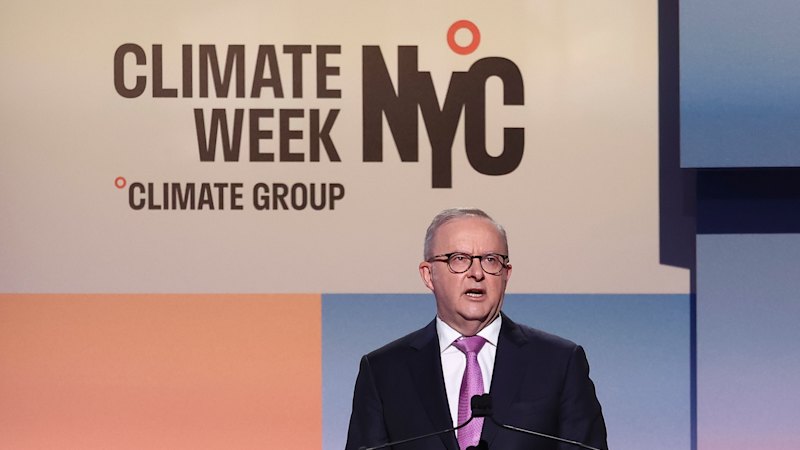
Anthony Albanese opens Climate Week in New York with a clarion call about climate action. “We need to meet the problem head on” and “unfortunately, without strong action” climate disasters will get worse (“Albanese takes climate warning to New York, but fossil fuel experts test credibility”, September 22). Yet his actions at home are anything but strong. Australia, the world’s third-largest fossil fuel exporter, is still approving new fossil fuel projects, has a Clayton’s carbon offset system, has a 43 per cent target for emissions reduction that is not enforceable, and gives billions to fossil fuel companies through diesel rebates and direct project funding. Like his gambling advertising reforms and government transparency, he talks the big talk, but his actions speak otherwise. Rowan Godwin, RozellePrime Minister Anthony Albanese at the opening of New York Climate Week.Dominic LorrimerPM Albanese must surely have developed a thick skin after 30 years in politics. How else could a leader proclaim the need for greater measures to curb global warming in front of an international audience, despite having approved 37 fossil fuel projects since assuming office? Admittedly, Australia’s dependence on fossil fuels is trending downwards, but any reduction is offset by an increase in our coal exports. No doubt this is facilitated by more than $1 million in donations from the fossil fuel industry before to the 2025 election. Roger Epps, ArmidaleI welcome Prime Minister Albanese standing up on the world stage and acknowledging that our climate is warming and that we need to meet the problem head on. But since coming to office, the government has approved multiple new, expanded or extended coal, oil and gas developments. If Australia is going to call on the rest of the world to confront climate change, we need to confront it at home, too. That means stopping the approval of new or expanded fossil fuel projects. Our actions need to match our words. Suzy Bessell, CremorneHerald readers have been treated to compelling opinion pieces from Richard Flanagan on AI (“Albanese is selling out Australia to AI colonists as artists face ruin”, September 18) and Tim Winton on gas and climate disasters (“Big gas drillers give us so little and take so much”, September 19). If Geraldine Brooks were to write about Albanese’s failure to permanently protect native forests we’d have a trifecta of Australia’s literary heavyweights highlighting three major policy blind spots. Amy Hiller, Kew (Vic)Unholy allianceSnake oil just doesn’t cover it. Exclusive Brethren leader Bruce Hales, who says he is “so close to the Lord Jesus that he can feel his heartbeat”, advocates – like Gina Rinehart and “the redhead” – digging up God’s “limitless resources” (“More power to the redheads: Brethren leader backs Hanson”, September 22). On what planet are resources limitless? In what universe is our planet not burning up? As for using our uranium to “build a few bombs”, that surely is a window into the man’s soul. Bearing arms is against Brethren doctrine, but by all means pray for it and advocate for it, via God, in the political sphere. Hales’ support for Hanson is now on the record. One Nation national director James Ashby will not comment. The Coalition continues to defend the Brethren. Will the “intense scrutiny” now being applied to examine their activities, including ties with neo-Nazis, curtail their actions at polling booths next time around? Fiona Colin, Malvern East (Vic)Poisoned by greedGovernments are finally noticing the rot they’ve allowed to creep into our universities (“Vice chancellors may have to justify their pay packets”, September 22). I graduated with my PhD in 2015. Well before that, the rot in my university was evident: managerialism had taken over. One of the major eight universities, it got rid of its school of philosophy within the faculty of arts and social sciences. What respectable university does not have a school of philosophy? Philosophy is at the core of the intellectual rigour that should be embodied in higher education. One of my supervisors was offered redundancy because the claim was that no one was enrolling in his courses. But people did not enrol because the managers did not advertise them. Decades ago, our governments were seduced by the education export dollars and lost all interest in the role of education in building the intellectual capital of a nation. They are obsessed with the neoliberal managerialism that has poisoned our once-great universities. Peter Thompson, GrenfellThe ridiculously inflated salaries for some senior university staff has undermined academics’ trust in their own educational institutions. A simple formula of linking VCs’ pay to professorial salaries might stop the rot. Even the most senior academic staff (including VCs) should not be paid more than double a full professor’s salary. And accountants’ and managers’ pay should be capped at the salary level of an associate professor. This would ensure that the more highly qualified academics remain the most highly rewarded members of the academy. After all, universities are educational and research institutions, not businesses competing to accumulate wealth by underpaying the very academics who embody their profession’s principal and principled raison d’etre. Philip Bell, BronteUniversities have become too focused on chasing the dollar.Louie DouvisThe university sector is in quite a mess, with overpriced humanities degrees, vice chancellors and executives in trouble for alleged misbehaviour and an unhealthy over-reliance on fees from overseas students. In addition, vice chancellors are happy to accept inflated salaries of over $1 million, plus other perks. The VCs’ argument is that they are ultimately managing billion-dollar budgets and have staff that number in the thousands, like a large corporation. However, unlike corporate bosses, they do not answer to shareholders. A better comparison might be to compare them to the CEOs of our local health districts, which have similar numbers of staff and budgets to manage, not to mention life-and-death decisions – and their salaries are between $350,000 and $600,000. The vice chancellor should be, foremost, the first among equals (the professoriate) and not a CEO, just as the prime minister is the first among equals with parliamentary colleagues. The salaries of the executive leaders of publicly funded tertiary institutions such as universities should be capped at the same level that the prime minister is paid. How can they argue that their job is more demanding or challenging than that of leading the nation? Dale Bailey, St LeonardsIt is not just the pay that a vice chancellor pulls in that erodes public trust. Universities have created a perception that as public funding is limited, they must operate like a corporation. When revenue is down, then costs have to be cut to maintain the business. Well, if that is governance 101, then surely senior management should be held accountable, like any director of a corporation. Threatening to remove them for maladministration doesn’t go far enough; make them personally liable, make them pay back bonuses and out them through the courts if necessary. Anything less will merely be swept under the plush carpet in their offices. Michael Blissenden, Castle HillNot only NassifAfter almost 40 years in the field of residential building litigation, I found that claims against building contractors nearly always involved defective or incomplete work and overcharging. Though he may ultimately prove to be the worst, Jean Nassif was not alone (“Jean Nassif told ICAC there were ‘minor defects’. Owners are spending $10 million to fix them”, September 22). Some developers I came across weren’t even licensed. Others, if they ever attended TAFE, dropped out early. Honesty and pride in their work were foreign concepts; in fact, they gave honest contractors a bad name. The introduction of private certifiers opened the floodgates. The head contractors rarely actually did the work and did not, or could not, sign the trade certifications private certifiers relied upon to issue occupation certificates. My heart goes out to the Riviera apartment owners in their plight and the many others left high and dry by our lame bankruptcy and insolvency laws. I wonder how far they explored their legal options against the private certifiers and the licensed subcontractors, who actually laid the foundations, installed the damp-proof courses (or didn’t), installed the wiring, glazing, balconies, plumbing, cladding, pest barriers etc. Howard Charles, GlebeNeeds addressedWith increasing community concern over youth being drawn into organised crime, Riley Walter’s report on the principles underlying the United Muslims of Australia’s youth programs should be noted by all parents and educators (“‘We have the brotherhood to offer you’: Inside the push to keep boys away from crime,” September 22). The organisation shows awareness of the importance of two key human needs identified by psychologist Abraham Maslow – belongingness and esteem. These are what gangs have to offer, but with bad outcomes. Parents, schools, sports clubs and church groups need to understand this and work to satisfy these needs in ways that are productive for individuals and society. Paul Casey, Callala BayProductivity pipe dreamJames Massola, like many fellow journalists and economists, questions the government’s forecast on productivity (“Chalmers can try to predict 40 years into the future, but he’s really talking 2028″, September 22). A figure of 1.2 per cent sure looks ambitious when we’ve averaged 0.3 per cent for the past 10 years. We have no national plan to build rail lines, ports, roads, power and other infrastructure we will need. We have made no serious attempt to make our taxation system more efficient. We do little to encourage our brightest minds to stay and innovate here. We sit on gazillions of superannuation dollars and don’t require funds to invest here in productivity-boosting ventures. Our schools produce increasingly less educated children and we have no plan to transition people displaced by AI to productive activities. Let’s not fool ourselves or indulge in back patting for what we have achieved. Let’s roll up our collective sleeves and build a future we will be proud to hand to our kids. Brian Barrett, PadstowTreasurer Jim Chalmers speaks before the release of the 2026 Intergenerational Report at the Australian National University in Canberra on Monday.AAPSorry to spoil Pauline Hanson’s pity party, but it seems one of the main takeaways from the government’s latest intergenerational report is that immigration has saved us from the declining birth rates experienced by most other countries in recent years, and will go a long way to saving us in the future (“Australia faces rapid ageing as birth rates plummet”, September 22). Anyone under the age of 40 should really pay close attention to the repercussions of One Nation’s anti-immigrant race to the bottom. Phil Bradshaw, NaremburnThe intergenerational report will have its 24 hours in the sun then be consigned to a shelf to gather dust. The key issue of lifting productivity is one that successive governments, including the current one, have avoided for the past two decades. To do so involves hard, politically unpalatable decisions. It’s ironic that the current report has AI at the centre of any increase in productivity, yet the PM is currently overseas advocating for limitations on its use. As James Massola states, Albanese, along with the Treasurer, will be long gone from politics when the effects are truly being felt. Mike Kenneally, ManlyBoycott HansonIn view of One Nation’s exclusion of the ABC, the Guardian and Herald from its media events, I suggest Australian news outlets follow the example of American broadcasters ABC, CBS, NBC and Fox News (“Trump launches ‘Trump TV’ channel after networks boycott him”, September 22). They have stood in solidarity with CNN in not covering the exploits of Donald Trump after CNN reporters were barred from the White House. If our media groups refused to cover Pauline Hanson and company it would do much to protect Australians’ access to balanced reporting, surely a given in a real democracy. Janie Page, RozelleUS citizens watch in outrage or glee as their democracy is being rapidly dismantled, and we watch in horror, hoping the same could not happen here. Yet we seem to be sleepwalking into a similar future, where ignorance, nastiness, blame and complaint substitute for a reasoned approach to addressing our complex problems. Where is solidarity? When a minority politician excludes major media from press conferences, why do other media send reporters? Those journalists should be ashamed. This is not America. Surely in Australia it’s “one in, all in”. Hanson should be left to talk to herself unless she is willing to talk to all of us and address our concerns. Jennifer Katauskas, Turramurra How pleasing to read that major press organisations in the USA, including Fox, are boycotting Trump’s press conferences while he selectively bans news outlets that he considers unfairly critical. It would be even more pleasing if Australia’s media organisations did the same to politicians and political parties that ban certain news outlets they consider overly critical. This attempted censorship needs to be confronted at the outset before it becomes the new normal. Christopher Gow, AustinmerWest’s best and worstVivienne Parsons’ contribution to the discussion over the Coalition’s proposed education reforms makes me wonder if some of the criticism levelled against teachers by some parents and politicians isn’t partially justified (Letters, September 22). I don’t think anyone is suggesting that we “deny our Western cultural traditions”, but “our role in upholding them” has sometimes had a very dark side, and that needs to be acknowledged and taught. Alynn Pratt, GrenfellPutin’s sure thingDeath and taxes are known as the two certainties in life. Add to these Vladimir Putin winning Russia’s latest elections. I wonder whether any betting agencies offered odds on this happening (“Surprise! Putin just won the Russian elections”, September 22). Peng Ee, Castle CoveTo submit a letter to the Sydney Morning Herald, email letters@smh.com.au. Click here for tips on how to submit letters.The Opinion newsletter is a weekly wrap of views that will challenge, champion and inform. Sign up here.
Albanese is all talk, no action on climate
Full Article
Original Source
Read the full article at Smh →KhanList aggregates and links to publicly available news content. We do not host full articles from third-party sources. Always verify important information with original sources.