
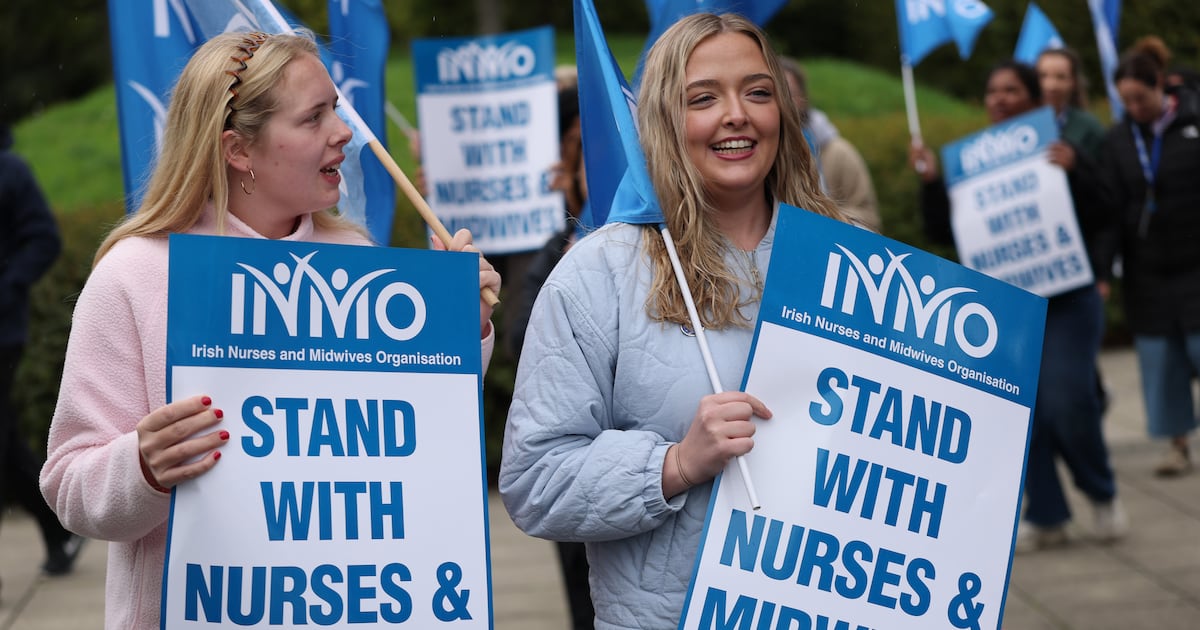
On Wednesday, unless there is a last-minute breakthrough in the public sector pay dispute, thousands of workers like me will be standing on a picket line outside our workplaces. This will be a new and unwelcome experience for most of us, and an unfamiliar sight for the majority of the Irish public. Strikes are very rare in Ireland: we routinely record single-digit days not worked due to industrial action per thousand workers annually, when the EU average is more than 30 days. Even during the depths of the financial crisis, the European Commission reported itself pleasantly surprised by how quiescently Irish workers, both public and private, swallowed the privations of austerity, pay cuts, lay-offs and hiring freezes. Negotiations around the Croke Park (2010) and Haddington Road (2013) agreements were traumatising for a trade union movement which had become complacent during social partnership in the 1990s and 2000s, having allowed its capacity to organise and mobilise workers on the ground to wither away. As the economy roared back into life over the past 10 years, wages increased dramatically – but so did inflation, particularly for essentials such as housing and utilities. Workers feel like hamsters on a wheel, running to stand still. Since the Lansdowne Road agreement of 2016, successive governments recognised that providing the level of public services that the Irish people, in the context of a growing population and economy, rightly demand requires more public sector workers; and that stability in the delivery of public services creates the certainty for private sector (especially multinational) investment. Those workers often need high levels of education and training to deliver complex services and infrastructure, and the State is competing for workers with the private sector and internationally. Remember, this benefits private sector workers, too, when their employers in turn have to compete with public sector conditions. READ MOREFor the past decade, pay has broadly gone up in line with inflation – until this year, when negotiations on a new agreement broke down. The bottom line is that if you don’t pay people enough, they won’t work for you. The disruption of a strike is simply compressing into a single day, week or month the long-term process of attrition, staff shortages, deskilling and lost expertise that arises when workers move jobs, or choose a career path outside the public sector in the first place. Private sector employers fully understand the problems of attracting and retaining skilled workers; they just don’t usually have to face up to the stark reality of compressed labour shortages in the form of a strike, because only 14 per cent of private sector workers are organised into trade unions. In the public sector, the majority of workers are union members. That gives us bargaining power to resist the prospect of losing money for doing our jobs, as inflation devours our wages.There has been minimal industrial unrest in this country for a very long time (the last big public sector strike was 2009). Most people in Ireland have no real experience of prolonged industrial action. I was on strike during the UK’s mini-winter of discontent in 2022-23, when the country was roiled by strikes in transport and public services. Workers spent weeks on picket lines, on and off, watching public sympathy ebb and flow. Strictly speaking, a strike is not a popularity contest: it’s about how long the employer can keep its operations going without the striking workers’ labour, and whether that is longer than the workers can last without their wages. It’s a cold, hard economic calculation. But the lower trade union membership is, or the less well-organised the workers are, the more they rely on public sympathy to exert pressure on the employer. So part of what both sides in this current industrial dispute are looking for is a read on the public mood.On Monday afternoon, Minister for Public Expenditure Jack Chambers invited unions to negotiate with the Government at the Workplace Relations Commission, but if the strike does go ahead tomorrow, as seems almost inevitable, schools will close, the Dáil will not sit and non-urgent healthcare services will be cancelled. A second strike is planned for October 21st.[ Winter of discontent looms as public sector workers prepare for stoppageOpens in new window ]The question being asked right now in both Liberty Hall and Government Buildings is, who will bear the blame for disruption caused by these strikes, should they go ahead? Actual trade union membership in Ireland is low (25 per cent), but sentiment is relatively favourable: stripping out undecideds, 55 per cent of non-union members would support a union in their workplace. Crucial to the resolution of this dispute will be the “Liveline effect”: whose story will cut through to the public – the nurse who can’t make rent in Dublin and plans to emigrate, or the parent who has to take a day off work because schools are closed, or the elderly patient whose hospital appointment is cancelled? And will the narrative shift depending on how long the strikes go on for? One unexpected factor in the UK strikes was the emergence of charismatic trade union leaders such as Mick Lynch and Pat Cullen (now a Sinn Féin MP). Will trade union leaders become household names in Ireland again, like they were during social partnership? And what about the significant energy Irish trade unions devote towards campaigning on other issues, from housing to Gaza to breast cancer awareness? These are worthy causes voted for by their members but will they help in attracting broader solidarity, or distract from pay demands and confuse the message? Strikes tend to increase union membership, as workers see the value in an active organisation on the ground. Trade unions have an opportunity now to make the case, not just for their position in this dispute, but for their value generally, to an Irish public broadly unfamiliar with how unions and collective bargaining work. Closing schools and hospitals will be both a learning experience and a health check for Irish workers.Dr Alan Eustace is an assistant professor at the School of Law, Trinity College Dublin. He is a trade union member but writes here in a personal capacity
Alan Eustace: The ‘Liveline effect’ will be crucial to the resolution of the public sector strikes
Full Article
Original Source
Read the full article at Irishtimes →KhanList aggregates and links to publicly available news content. We do not host full articles from third-party sources. Always verify important information with original sources.