
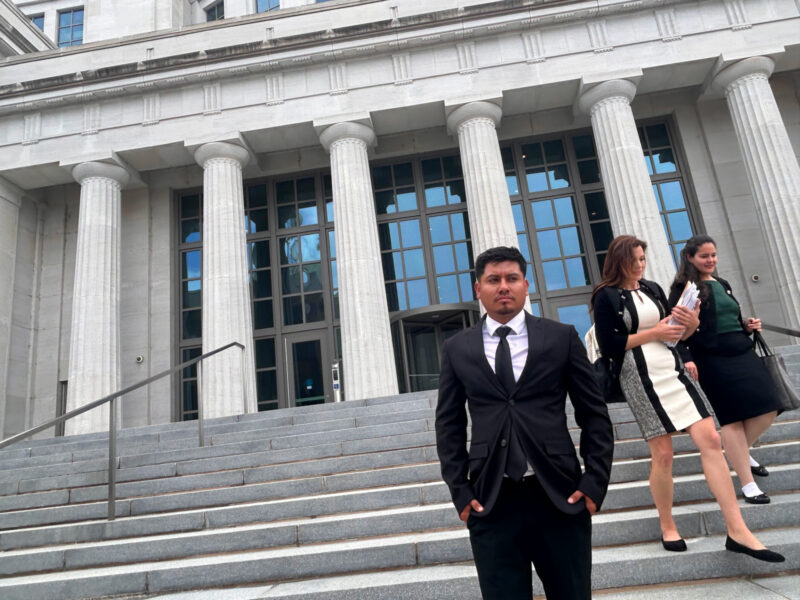
A Mobile federal judge temporarily stopped agents from entering private job sites without a warrant, doing roundups without suspicion and detaining people who show proof they're in the country legally.MOBILE, Ala. (CN) — A federal judge in Mobile Monday temporarily blocked immigration enforcement tactics used on Alabama construction sites, saying Department of Homeland Security agents likely violated the Fourth Amendment when they tackled a U.S. citizen, called his REAL ID fake and held him anyway.Chief U.S. District Judge Jeffrey U. Beaverstock stayed what Leonardo Garcia Venegas calls a warrantless entry policy, a preemptive detention policy and a continued detention policy. The order, issued under the Administrative Procedure Act, is narrower than the preliminary injunction Venegas sought, with Beaverstock calling a full injunction “a drastic and extraordinary remedy.” He said pausing the challenged practices was enough to protect Venegas while the case proceeds.Venegas, a Florida-born concrete worker who lives along the Alabama coast, says masked officers jumped a fence at a site on May 21, 2025, bypassed non-Latino workers, tackled his brother and then him as he recorded and yelled that he was a citizen. He says they pulled his Alabama STAR ID from his pocket, rejected it and held him for more than an hour.A few weeks later, according to Venegas, an officer walked into a nearly finished house, marched Venegas to an unmarked car with other Latino workers and again rejected his ID. He was released both times after his citizenship was confirmed and was never charged.“They can suddenly show up and detain you without having done anything,” Venegas testified in a May 2026 hearing. “Now I don’t feel free to drive, to go to work or go to the store.”Beaverstock had already found the three policies exist and that Venegas has standing. On the merits, he rejected the government’s claim that a construction site is always an “open field” officers may enter at will.“The court is not persuaded by the government’s position that it never needs a warrant to enter a construction site,” he wrote, noting the June encounter happened inside a structure. Beaverstock was appointed by President Donald Trump.He was equally blunt on the detentions. Video does not show Venegas interfering with another arrest and non-Latino workers on the same site were left alone.“The government offers no factual support whatsoever as to why officers reasonably believed Venegas ‘may be an alien.’” On the June stop, where the government had no records, Beaverstock added: “The court is simply not inclined to take the government’s word for it.”Alabama issues the STAR ID only to citizens and lawfully present residents. Once Venegas produced his ID, Beaverstock wrote, officers should have treated him as lawfully present. Continuing to hold him “is likely to run afoul of the Fourth Amendment.”The government, represented by Assistant U.S. Attorney Sam Ladd Jr., has denied the policies exist. It argued brief stops were reasonable and that Venegas had no privacy interest in job sites he does not own.Beaverstock noted the contradiction: If the policies do not exist, staying them cannot “curtail” lawful enforcement.“Neither the government nor the public has any legitimate interest” in enforcing an unlawful policy, he wrote.Homeland Security Investigations supervisor Phillip Lavoie testified agents are trained to need reasonable suspicion and to end encounters once citizenship is verified.Venegas is represented by the Institute for Justice. The stay applies to the three described practices pending further proceedings. Class certification and other claims remain unresolved.“This decision is a huge blow to DHS’s lawless enforcement practices,” said Jared McClain, Institute of Justice senior attorney, in an emailed statement Monday. “The government stood up in court and argued that they don’t need warrants to enter private construction sites and round up all the workers, and that they can’t trust government-issued IDs. By setting aside those unconstitutional policies, the court has restored the rule of law. Construction workers like Leo can finally go to work in peace again.”Subscribe to our free newslettersOur weekly newsletter Closing Arguments offers the latest about ongoing trials, major litigation and rulings in courthouses around the U.S. and the world, while the monthly Under the Lights dishes the legal dirt from Hollywood, sports, Big Tech and the arts.Additional Reads
Alabama judge freezes ICE construction site tactics after US citizen targeted
Full Article
Original Source
Read the full article at Courthousenews →KhanList aggregates and links to publicly available news content. We do not host full articles from third-party sources. Always verify important information with original sources.