
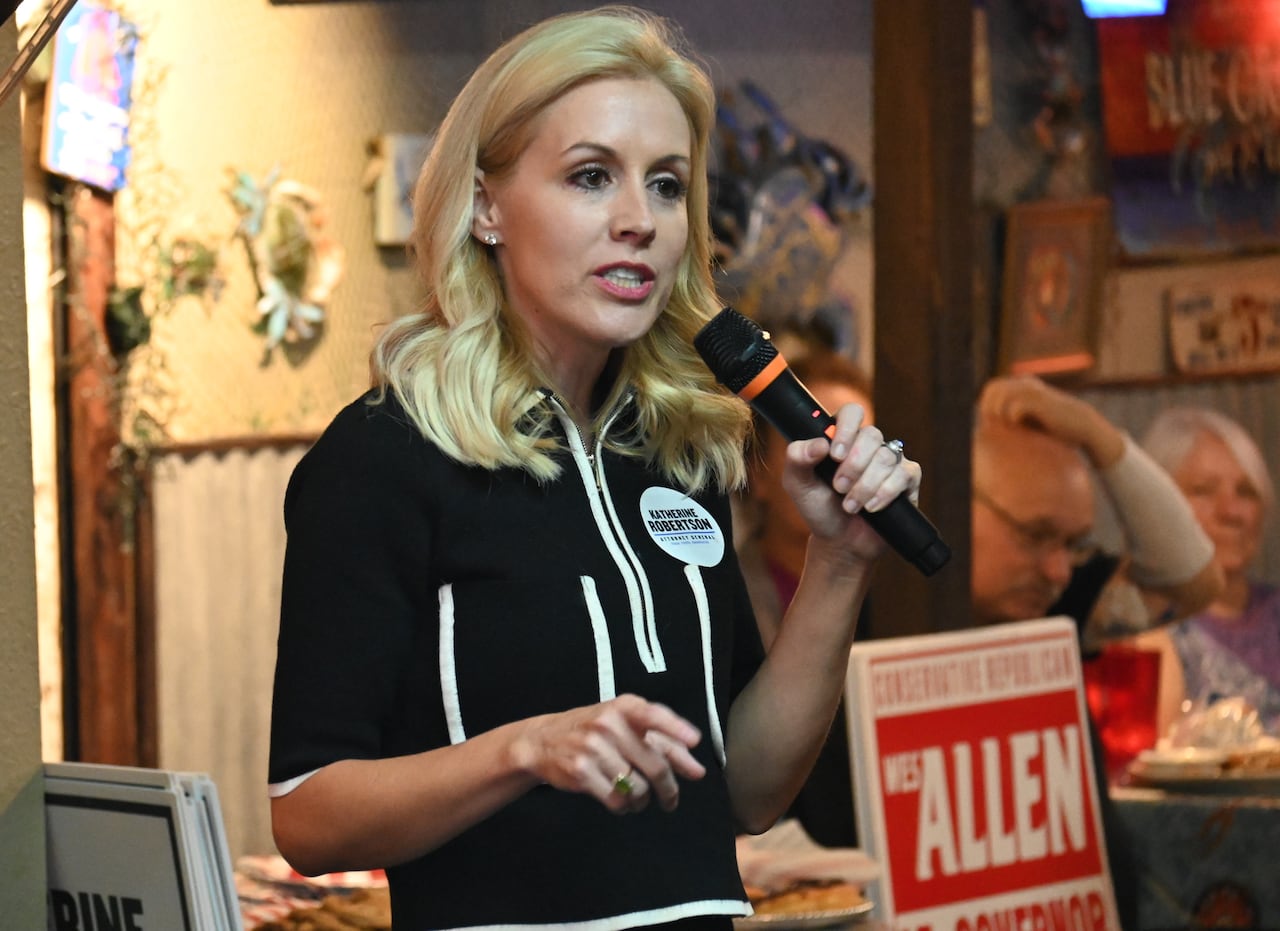
PoliticsKatherine RobertsonJohn SharpBy Cliff McCollum | cmcollum@al.comAlabama Republican attorney general nominee Katherine Robertson says the state needs uniform rules governing police use of Flock cameras, adding another prominent voice to a growing debate over privacy and law enforcement surveillance.“We’re going to probably be very engaged on the Flock camera debate, probably to my political detriment,” Robertson said Friday on Alabama Public Television’s “Capitol Journal.”“But I think that a big conversation needs to be had about the pros and cons to make sure that we are protecting privacy while also giving law enforcement an important tool,” she said. “I really want Alabama to lead the nation in that conversation.”Huey “Hoss” Mack, executive director of the Alabama Sheriffs Association, told AL.com earlier this month that most sheriffs support the camera systems and would resist legislation they consider too restrictive.“Right now, there is a lot of talk about some proposed legislation, but I’ve not seen any drafts,” Mack said. “About 95 percent of the Sheriffs support the Flock camera system and will oppose any unreasonable legislation.”Mack said sheriffs agree some safeguards may be needed but do not believe the Legislature should write them into law.“We do agree there probably should be some safeguards, but we believe the safeguard should be placed internally among the systems themselves and among the individual sheriffs’ offices and not by legislative act,” he said.Flock cameras are automated license plate readers that photograph vehicles and record identifying information that police can search during investigations.More than 2,800 automated license plate readers are operating across Alabama, according to previous AL.com reporting.Law enforcement agencies say the cameras help locate suspects, stolen vehicles and missing people.Privacy advocates and some lawmakers have raised concerns about how the data can be used, stored and shared.Robertson said relying on different policies from agency to agency is not enough.“I think the goal would be to have some safeguards written into law so that every Alabamian understands when a police department in Huntsville is using it or a police department in the Wiregrass is using these cameras, that everybody’s got the same set of rules,” Robertson said. “And right now, there’s not really one set of rules.”Alabama does have administrative regulations governing license plate reader systems. They require agencies to adopt written policies, keep access logs and limit use and sharing to criminal justice public safety purposes.Current rules allow license plate reader data to be stored for as long as five years, longer in some active investigations or pending cases, but Alabama has no state law written specifically to establish broader limits on the technology.That could change next year, as State Sen. Arthur Orr (R - Decatur) has said he plans to introduce legislation during the 2027 session imposing stronger statewide limits.Orr has discussed shorter data retention periods, audits, possible warrant requirements and penalties for misuse.Robertson said the competing interests between residents and law enforcement are exactly why she wants the attorney general’s office involved.“I think that people are right to have policy concerns, but at the same time, we’ve always worked through the balance of privacy versus law enforcement,” she said.Robertson said she believes law enforcement agencies understand the privacy concerns, but added that someone needs to help settle the broader policy fight.“I think our law enforcement here are just as sensitive to privacy issues as they would be anywhere,” Robertson said. “I think there needs to be somebody kind of mediating this conversation, and I’m willing to step up and do it.”
Alabama AG nominee pushes for statewide Flock camera rules
Full Article
Original Source
Read the full article at Al →KhanList aggregates and links to publicly available news content. We do not host full articles from third-party sources. Always verify important information with original sources.