
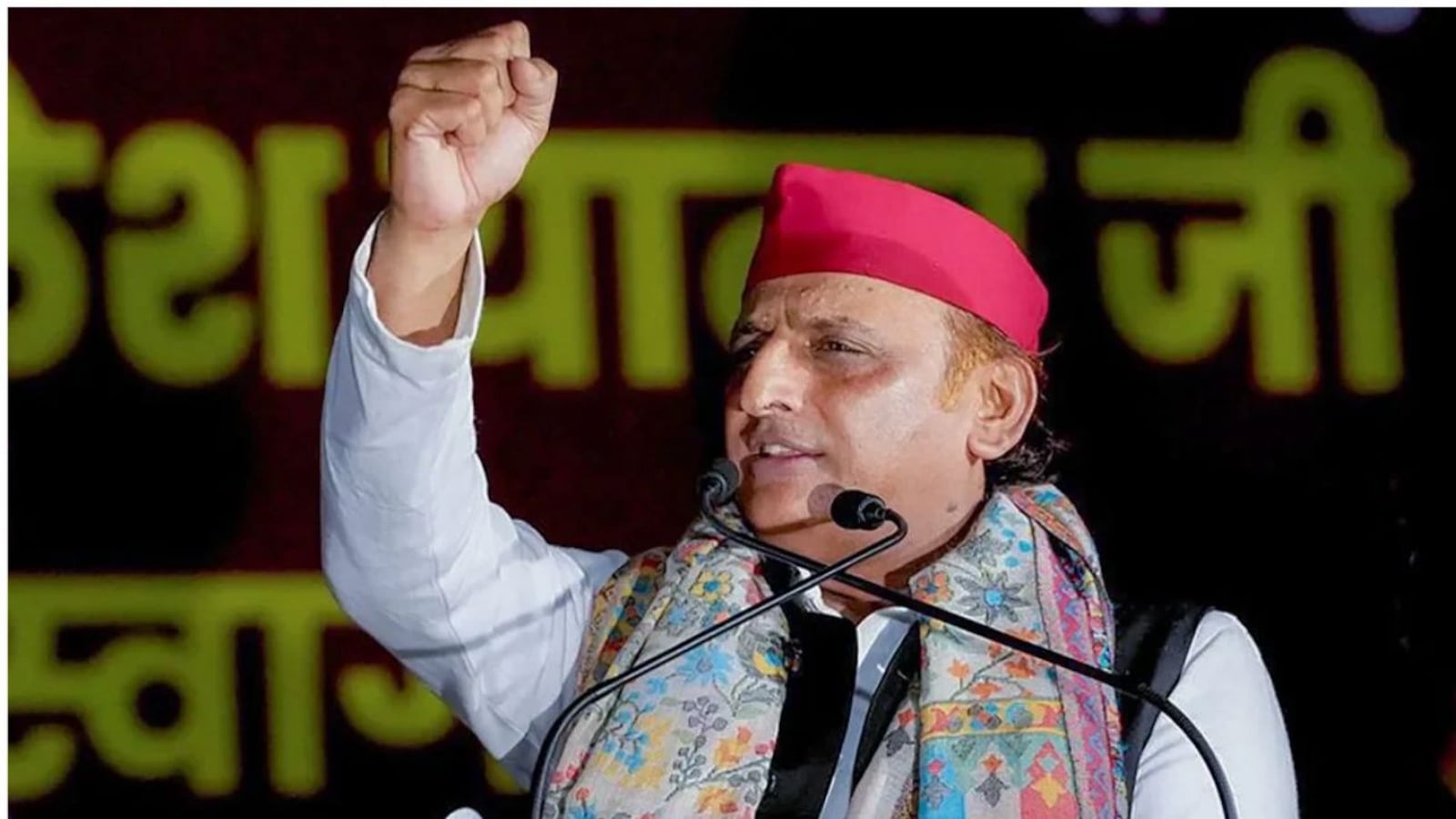
New Delhi: With the 2027 Uttar Pradesh assembly elections approaching, politics over the Dalit vote bank and the majority vote has started to intensify. While Samajwadi Party (SP) chief Akhilesh Yadav has announced his intention to visit the Ayodhya Ram temple, much of the action is also focused on the Dalit vote. Besides the SP, BSP chief Mayawati and Azad Samaj Party leader Chandrashekhar Azad, who has joined hands with Asaduddin Owaisi and is the chief ministerial candidate of the alliance, are all focused on the Dalit vote.On Sunday, Akhilesh Yadav held a Dalit conference in Agra, where he targeted the BJP and Owaisi. The AIMIM chief, addressing a rally in Meerut near Agra, had hit out first over Akhilesh Yadav's proposed visit to Ayodhya."Akhilesh is going to the place where we prayed for 400 years," Owaisi had said, recalling that Muslims had offered prayers for centuries at the Babri Masjid, which stood at the site before it was demolished in 1992.In response, speaking at a conference held at the Government Inter College grounds in Agra on Sunday, Akhilesh Yadav hit back at Owaisi's remarks on the 'PDA' alliance. 'PDA' stands for Pichda, Dalit, Alpsankhyak, or Backward, Dalit, Minority.Akhilesh Yadav said on Sunday that some people have arrived as "political tourists", but their "OTP" lies with someone else. He added that these individuals were just acting as loudspeakers for someone else's microphone. The comments were widely seen as a reference to the BJP. Owaisi's AIMIM has long been described by the Opposition as the "B Team" of the BJP, since it is seen to divide the Muslim vote.Offering a new political interpretation of 'PDA', Akhilesh Yadav defined the 'D' as standing for "Damdar Dalit" (empowered Dalit). His message was clear: the Samajwadi Party intends to prioritise the participation of Dalits within its 'PDA' equation.Why AgraThe choice of Agra for this Dalit conference is significant. It reflects not just the staging of an event but also the district's broader social and electoral importance.According to the 2011 census, the total population of Agra district was approximately 44.18 lakh, with a Scheduled Caste population of 9,91,325, or roughly 22.4 per cent.As a result, Agra is considered a key hub for Dalit politics in western Uttar Pradesh. The district also shares a deep connection with Dr Bhimrao Ambedkar and has been linked to the Ambedkarite movement and its ideology. The city, best known as the home of the Taj Mahal, has therefore grown in political significance ahead of the election.Mayawati, Akhilesh, Chandrashekhar: 3 Faces Of Dalit PoliticsDalit politics in Uttar Pradesh is no longer confined to a contest between the BSP and other parties.Mayawati retains the BSP's traditional political base and an established identity within Dalit politics. Through the 'PDA' framework, Akhilesh Yadav is attempting to bring these groups onto a common political platform. Chandrashekhar Azad, for his part, is working to solidify his own standing as an independent political alternative for Dalits through his Azad Samaj Party.Each of the three leaders uses a different political strategy. The BSP seeks to connect with Dalits by leveraging its long-standing social and political legacy. The Samajwadi Party champions the Constitution, social justice and the 'PDA' agenda. Chandrashekhar Azad presents a distinct voice focused on Dalit rights and political participation.What Numbers SayBefore the delimitation exercise for the 2007 assembly elections, there were six assembly constituencies in Agra district, five of which were won by the BSP. After delimitation, the number of constituencies rose to nine.In 2012, even as a 'Samajwadi Party wave', led by Akhilesh Yadav, swept across Uttar Pradesh and enabled the party to form a government with an absolute majority, the BSP managed to keep a strong position in Agra.The BSP won six of the district's nine seats, while the BJP secured two and the Samajwadi Party won only one.The situation changed completely in 2017, when the BJP won all nine assembly constituencies in Agra. It repeated this in the 2022 assembly elections, securing all nine seats once again.Data from the Lok Sabha elections also reflects the shifting political dynamics in the district. The Agra Lok Sabha constituency is reserved for the Scheduled Castes.In the 2019 Lok Sabha elections, the BJP received 56.48 per cent of the votes, compared with 38.01 per cent for the BSP. In 2024, the BJP retained the seat with 53.34 per cent of the vote. Samajwadi Party candidate Suresh Chand Kardam received 29.20 per cent, while BSP candidate Pooja Amrohi received 15.70 per cent.These figures indicate a decline in the BSP's vote share and an increase in the Samajwadi Party's vote share in 2024 compared with 2019.Given this, it is not just political alliances that will matter in the coming elections. Issues such as education, employment, reservation, social security and constitutional rights could also play a crucial role in shaping the direction of Dalit politics.
Akhilesh Yadav's Dalit Pitch, Ayodhya Plan Stir UP Vote Bank Cauldron
Full Article
Original Source
Read the full article at Ndtv →KhanList aggregates and links to publicly available news content. We do not host full articles from third-party sources. Always verify important information with original sources.