
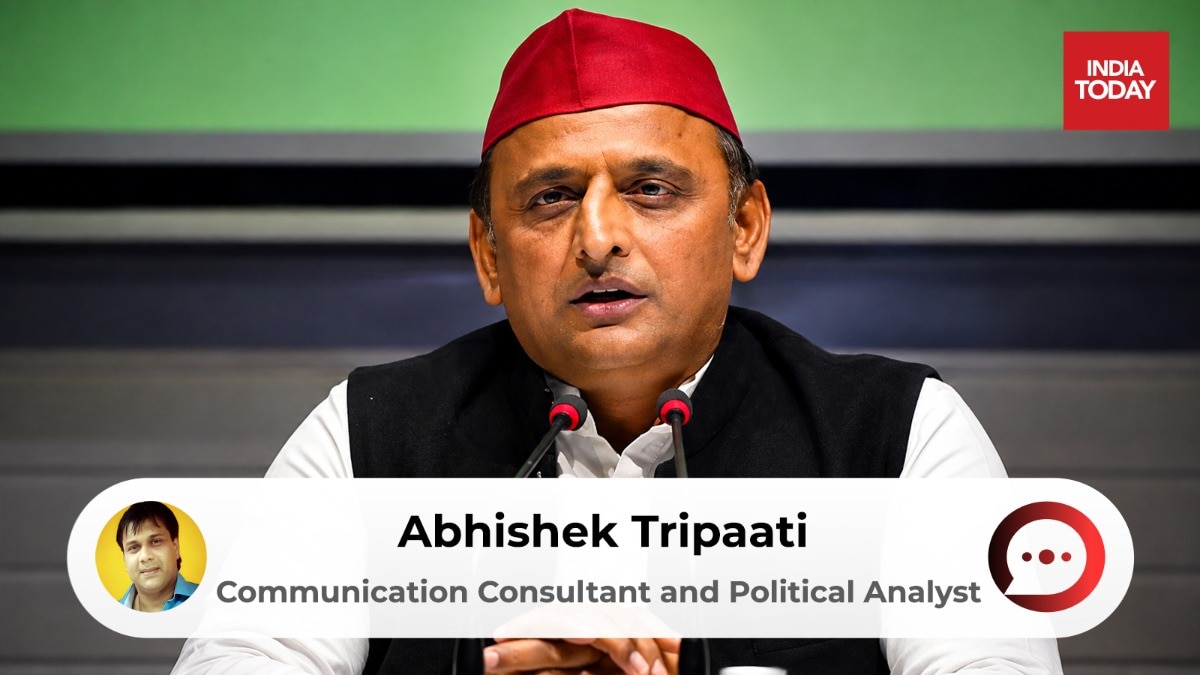
There is something noticeably different about Akhilesh Yadav and the Samajwadi Party right now.It is not simply the confidence that followed the 2024 Lok Sabha election. It is not merely the expansion of the party's political vocabulary. And it is certainly not just another attempt to build an electoral caste equation.The bigger change is in the way Akhilesh Yadav is positioning the Samajwadi Party.The SP that emerged from the 2022 Uttar Pradesh Assembly election was still largely seen through the familiar lens of its traditional social base. The SP of today is trying to communicate something broader. The most visible example came earlier this month when Akhilesh Yadav gave a new meaning to the party's PDA formulation, saying that the "P" also stands for Pandit.That was not a casual remark. It was a political communication statement.And it tells us a great deal about where Akhilesh Yadav believes the SP needs to stand in Uttar Pradesh today.THE MOMENT THAT CHANGED THE SPThe numbers are important because political confidence often begins with numbers.In the 2022 Assembly election, the BJP won 255 of Uttar Pradesh's 403 seats, while the SP won 111. The BJP secured approximately 41.3% of the vote and the SP around 32.1%.Two years later, the psychological equation changed.In the 2024 Lok Sabha election, the SP became the single largest party in Uttar Pradesh, winning 37 of the state's 80 seats. The BJP won 33 and the Congress six.The SP's vote share also rose to approximately 33.6%.The significance of 2024 for the SP was therefore larger than the seat tally.It gave the party something every political organisation needs: the belief that it can win.That changes the behaviour of cadres, candidates and supporters.A party that believes it is capable of winning attracts greater political energy. Leaders speak with greater confidence. Potential candidates become more ambitious. Supporters become more willing to publicly identify with the party.That psychological shift is visible in the SP's political communication today.THE BIGGEST CHANGE: COMMUNICATIONAkhilesh Yadav's evolution as a political communicator is perhaps the most interesting part of the SP's current story.His politics is no longer being communicated only through the traditional language of socialist politics or through opposition to the BJP.PDA has become the central architecture of his political communication.Originally presented as Pichhda, Dalit, Alpsankhyak, the formulation was an attempt to build a social coalition beyond the SP's conventional Muslim-Yadav identity.Now Akhilesh is explicitly bringing Pandit into that vocabulary.The message is significant because it tells a Brahmin voter something very different from the old image of the SP.The party is saying: you are not outside our political conversation.This is particularly notable because the BJP has historically enjoyed substantial support among upper-caste voters in Uttar Pradesh.Akhilesh's recent outreach therefore represents more than a change in terminology. It represents an attempt to make the SP's political identity broader.And importantly, he is doing it without abandoning PDA.That balancing act is the real story.BRAHMIN OUTREACH: NOTHING SUBTLE ABOUT ITAkhilesh's recent Brahmin outreach has been unusually direct.At the Prabuddh Sammelan in Lucknow, organised around the birth anniversary of socialist leader Janeshwar Mishra, he explicitly said that the "P" in PDA also stands for Pandit. I want to add on to it, P in today’s political scenario also stands for Peedit, in English its victim, oppressed or afflicted.The symbolism of the event was equally deliberate.Akhilesh shared the platform with senior party figures, community representatives and religious figures. The event was part of a larger attempt by the SP to reach communities that have historically been more comfortable with other political formations.India Today's recent reporting described the move as the clearest indication yet of the SP's effort to broaden its social base beyond its traditional Muslim-Yadav support.But the interesting point is not whether every Brahmin voter will suddenly move towards the SP.That is too simplistic.The important question is whether the SP can change the perception that it is a party meant primarily for a particular social bloc.Political parties are brands.And brands change when their communication changes consistently.FROM PDA TO A BROADER POLITICAL IDENTITYThis may be Akhilesh's most important political communication exercise.For years, the BJP's political communication in Uttar Pradesh has successfully projected itself as a broad social and ideological coalition.The SP, meanwhile, has had to deal with the perception that its political support is concentrated among particular communities.PDA was Akhilesh's answer to that problem.The inclusion of Pandit in the formulation represents another stage in that exercise.It is an attempt to move the conversation from: "Who traditionally votes for the SP?"To: "Who can see themselves represented by the SP?"That is a much more ambitious political proposition.And it explains why the SP's current communication feels different from the post-2022 period.THE SP IS ALSO LEARNING TO CONTROL ITS MESSAGEAnother sign of political maturity is message discipline.Akhilesh has recently warned SP leaders against making statements that could create unnecessary controversy or help the BJP politically.That may appear like a small organisational instruction.It isn't.For an opposition party, communication discipline is crucial.One controversial statement by an individual leader can become the national narrative for the entire organisation.Akhilesh appears increasingly conscious of this.The objective is simple: keep the political conversation centred on the issues and social coalition the SP wants to talk about.That is a significant change from the politics of reactive messaging.A LESS DEFENSIVE SPThere is another subtle change.Akhilesh Yadav increasingly appears comfortable defining the SP on his own terms rather than merely defining himself as the alternative to the BJP.That distinction matters.Opposition politics can be built around criticism.But a political party attempting to expand its support base has to communicate an identity of its own.PDA provides that identity.The Brahmin outreach provides another layer.The emphasis on representation provides another.And the confidence that came from the 2024 Lok Sabha result gives the entire exercise credibility.The SP is therefore not communicating only: "Vote against the BJP."It is increasingly trying to communicate: "This is the social and political coalition that the SP represents."That is a much stronger proposition.BJP IS THE BENCHMARK, BUTOf course, the BJP remains a formidable political organisation with a deeply established electoral and organisational network.But the significance of the current moment is that Akhilesh does not appear to be trying to defeat that organisation simply by attacking it.He is trying to alter the political space around it.That is a different strategy.Instead of asking voters to abandon an existing political identity, the SP is attempting to tell additional communities that they can find political representation within its framework.That is why the Brahmin outreach matters.That is why PDA matters.And that is why the 2024 result matters.AND THEN THERE IS MAYAWATIMayawati and the BSP remain relevant to any understanding of Uttar Pradesh politics, particularly because the BSP's vote base cannot simply be assumed to disappear.But the more interesting development today is what the SP is doing with the political space that has opened up around it.Akhilesh appears to be concentrating on expanding his own coalition rather than allowing the political conversation to remain a simple BJP-versus-SP binary.That makes the SP's present positioning more interesting than its old electoral stereotype.Perhaps the easiest mistake is to look at Akhilesh Yadav only through the prism of the 2022 Assembly election.That Akhilesh and this Akhilesh are not communicating from the same political position.The 2022 election produced a clear BJP advantage.The 2024 Lok Sabha election gave the SP something different: political confidence.And in 2026, Akhilesh is using that confidence to experiment with the identity of his party.PDA.Pandit.Representation.Social expansion.Message discipline.A more assertive political personality.These are not isolated developments. Together, they point towards a Samajwadi Party that is trying to look less like a party of inherited support and more like a party capable of building a wider social coalition.Akhilesh Yadav has changed the conversation around the Samajwadi Party. And in politics changing the conversation is a good, new starting point.- EndsPublished By: Aprameya RaoPublished On: Aug 24, 2026 22:41 IST
Akhilesh Yadav is changing how the Samajwadi Party talks to Uttar Pradesh
Full Article
Original Source
Read the full article at Indiatoday →KhanList aggregates and links to publicly available news content. We do not host full articles from third-party sources. Always verify important information with original sources.