
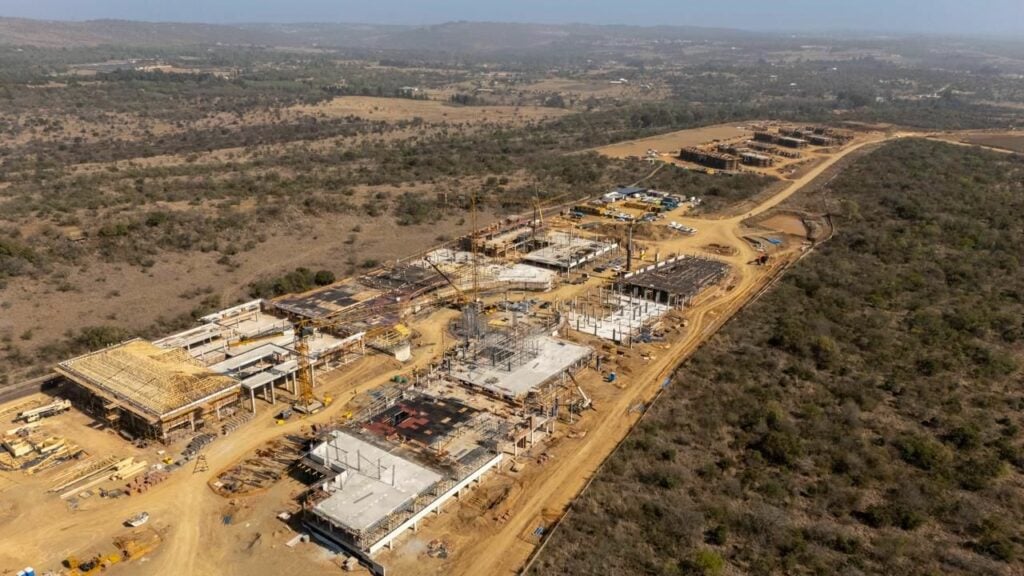
But experts warn that the market is overheated. The new Akademia campus currently under construction east of Pretoria at a cost of R3.2 billion is providing a major boost to the surrounding property market, according to several experts. Akademia is an Afrikaans higher education institution of the Solidarity movement that has been functioning for several years from different sites in Centurion. The new purpose-built campus will provide one home for the institution. Although it is expected to increase the value of surrounding properties, sellers currently have unrealistic expectations, says Joop Coetzee, an estate agent with RainMaker Agri who has been operating in the eastern parts of Pretoria for 25 years. “People are now asking R1 million per hectare for vacant land, whereas a 4.2 hectare smallholding with two houses until recently would have fetched between R3.5 million and R4 million,” says Coetzee. He receives calls daily from people looking for land on which to build student accommodation, but they do not realise that Akademia itself is building residences and that property development requires substantial capital, takes a long time, and is far from easy. He also warns that properties rezoned for high-density developments by the former Kungwini local municipality (which was dissolved and absorbed into the City of Tshwane metro in 2011), but not yet proclaimed, could lose those development rights next year. The City of Tshwane has decided that all Kungwini rezoning approvals that have not been proclaimed by the end of March 2027 will revert to agricultural land. The new campus Henk Schalekamp, managing director of Kanton Beleggings, the Solidarity movement’s property company developing the Akademia campus, says the first phase, costing R1.8 billion, is expected to be completed by October 2027 and open to students in January 2028. It will include, among others: Four residences – two for women and two for men 750 beds in total Sports facilities (netball, rugby and athletics) Parking for 7 500 cars Four lecture blocks A student centre with a cafeteria, and An administration block. A second phase, due to be completed by 2030, will include another two residences, an additional lecture block, an auditorium, and a chapel. There will be several coffee shops on campus, operated by Akademia itself under its ‘Sowel As’ brand, but no other retail space. Attraction to developers Schalekamp says there are numerous local and international examples of densification taking place around campuses such as Akademia’s. Locally, Potchefstroom and Stellenbosch are examples. Such a development creates economies of scale that render other developments viable. He says there are already signs in the rural area surrounding the new Akademia campus, which consists largely of smallholdings, and that the campus entrance is near the Boschkop police station. It is about 7km from the intersection of Solomon Mahlangu Drive and Lynnwood Road, close to Kitty Hawk airport and the upmarket Waterlake residential estate. For example, says Schalekamp, a developer has bought land at the entrance to the campus and is developing a residential project, while other private student accommodation projects are being planned. However, he believes the market in the area is currently overheated. “There is enormous interest. A four-hectare smallholding, for example, is currently on the market for R12 million.” Schalekamp stresses that student accommodation is not the only opportunity. There will also be about 400 staff members working on the campus. ‘Major impact on surrounding area’ expected Ben Espach, director of valuations at Rates Watch, says such a development will undoubtedly have a major impact on the surrounding area. “Just look at a student’s shopping list,” he says, “and you get an idea of the demand that will be created – everything from bread and milk to entertainment.” Although staff are generally more mobile than students, he says they will probably also look for accommodation close to the campus. “It will create a mix of opportunities,” he says. “It brings a concentration of people who were not previously there, which will benefit existing businesses and create opportunities for new ones.” Property economist Erwin Rode, chair of Rode & Associates, agrees. “Ten years from now, there will be very little left of the agricultural smallholdings,” he predicts. He refers to the Equestria area, also in eastern Pretoria. It was initially developed on agricultural smallholdings and is now fully developed, with various residential options and retail facilities. Rode hopes private developers will pursue integrated development that also makes provision for affordable housing, because “not everyone is academic; there will also be cleaners and so on”. Another opportunity he expects to emerge over time is for a hotel, as campuses typically attract large numbers of visitors. “The only thing you would not expect is industrial development.” ‘People smell blood’ Rode says markets are often overheated when a major development that can act as a catalyst for further development becomes a reality. “People smell blood.” It often happens that a developer wants to buy more than one smallholding for a development. Once the first transaction has been concluded, the neighbours think they can increase their prices because the buyer is desperate. Developers, however, often use a third party to quietly acquire the land on their behalf. Estate agent Coetzee says Kanton has been preparing for the campus for seven years, and when it broke ground, the market immediately responded. “Now everyone wants to build student accommodation. They don’t realise that Akademia is building its own student accommodation. If everyone does it now, there will be an oversupply. And nobody is thinking about the staff!” He believes expectations are currently far too high. As far as retail is concerned, there is already land zoned for this purpose at the intersection of Graham Road and Boschkop Road, but the market is not yet large enough. “Large developers have already looked at it,” he says, “but nobody has committed themselves to it yet.” Warnings for would-be developers Coetzee warns that time has run out for owners of land that has been zoned for high-density development but has not yet been proclaimed. It is too late now to complete the process to the point of proclamation before March next year, when the rights expire. The process will then have to start from scratch, which could take three years. Developers prepared to undertake this process usually buy land subject to a suspensive condition that the development applications are approved, with the seller only receiving payment once that milestone has been reached. Many owners are now illegally constructing units for student accommodation on their smallholdings. Coetzee warns that this could prove costly. If the metropolitan municipality acts against them, they could be forced to demolish the structures. Opening The first phase of the campus is expected to be completed by October 2027 and ready to welcome its first students in January 2028. This article was republished from Moneyweb. Read the original here.
Akademia campus to boost Pretoria East property development
Full Article
Original Source
Read the full article at Citizen →KhanList aggregates and links to publicly available news content. We do not host full articles from third-party sources. Always verify important information with original sources.