
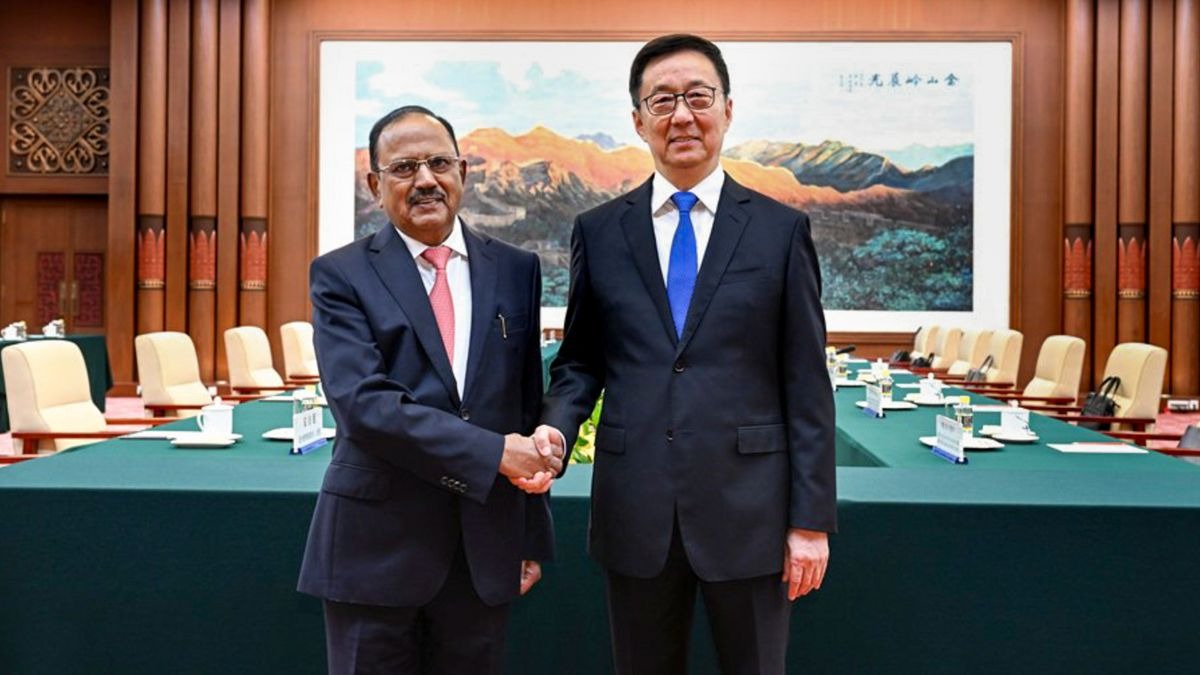
Doval's meeting with Chinese foreign minister Wang Yi for the 25th round of Special Representatives' talks seeks to steady ties burdened by border crisis and mistrustThe geopolitical chessboard is shifting fast. As Bangladesh signals interest in the emerging Saudi Arabia-Trkiye-Pakistan axis (Mecca Joint Defence Agreement), India is simultaneously deepening engagement with Russia and China amidst war and instability continuing to convulse the Middle East.Against this turbulent backdrop, India-China ties face another crucial diplomatic test. National security advisor Ajit Doval is meeting Chinese foreign minister Wang Yi in Beijing for the 25th round of Special Representatives’ talks on the boundary question. The dialogue comes as both sides seek to steady a relationship still burdened by the legacy of border crisis, strategic mistrust and competing ambitions across Asia.The meeting comes just weeks before India hosts the BRICS Summit in New Delhi on September 12-13, where Chinese president Xi Jinping is widely expected to make his first visit to India in seven years. His presence could provide a crucial opening for renewed high-level engagement and a broader reset in New Delhi-Beijing relations.Chinese vice-president Han Zheng met Doval before the 25th round of Special Representatives’ talks. In a statement issued by Beijing, Han Zheng stated that over the past two years, Chinese President Xi Jinping and Indian Prime Minister Narendra Modi had met twice and reached important consensus on the development of China-India relations and guiding the bilateral relationship onto a track of recovery. As neighbours and key emerging economies, China and India should handle their relationship from a strategic and long-term perspective, enhance mutual trust, strengthen multilateral coordination and manage differences, the statement read. For New Delhi, the Special Representatives’ talks are important not simply because they reopen high-level dialogue but because they test whether India and China can move beyond the cycle of border tensions, military deployments and crisis management. The unresolved past of the 2020 Galwan Valley clash, competing territorial claims and continuing military infrastructure build-up along the Himalayan frontier remain major obstacles to a durable improvement in relations.The India-China boundary dispute is among Asia’s most difficult geopolitical challenges. The disputed frontier stretches roughly 3,488 km, from Ladakh in the west to Arunachal Pradesh in the east. The Special Representatives mechanism, established in 2003, was intended to work towards a political settlement of the issue.More than two decades later, however, a final boundary agreement remains out of reach. The mechanism has nevertheless played an important role by keeping communication channels open and helping prevent disputes from escalating into larger crises. From the Indian perspective, though, dialogue cannot become an alternative to resolving the underlying security problem. Without a permanent settlement, negotiations risk becoming primarily a mechanism for managing tensions rather than removing their causes.The June 2020 Galwan Valley clash was a turning point. It was the most serious military confrontation between India and China in decades and fundamentally altered the assumptions that had shaped bilateral relations. Before Galwan, economic engagement had provided some space for managing political differences even as the boundary remained unresolved. After the clash between soldiers, New Delhi adopted a significantly more security-focused approach. India accelerated border infrastructure development, strengthened military preparedness along the Line of Actual Control (LAC), expanded surveillance and rapid-response capabilities, and deepened strategic partnerships in the Indo-Pacific.At the same time, China’s expansion of roads, rail links, airfields and military facilities in Tibet has heightened India’s concerns about the long-term security environment along the Himalayan frontier. For New Delhi, the central lesson is straightforward: normalisation of wider relations cannot be separated from peace and stability along the border.The Doval-Wang engagement brings together two senior officials dealing with perhaps the most sensitive issue in the bilateral relationship. India’s priorities are centred on maintaining peace along the LAC, preventing another military confrontation, ensuring compliance with existing border agreements and opposing unilateral attempts to alter the status quo. New Delhi also has an interest in building practical confidence-building measures. But India’s approach is unlikely to be based on trust alone. Confidence has to be backed by verifiable actions, transparency and respect for existing arrangements.China watchers claim this is where the fundamental difference in approach becomes apparent. India sees durable stability as dependent on mutual trust, transparency and adherence to established commitments. Beijing, meanwhile, has generally sought to manage the dispute while maintaining its existing territorial claims.Arunachal Pradesh will remain central to India’s security concerns. China claims the Indian state as “South Tibet”, while India firmly maintains that Arunachal Pradesh is an integral and inseparable part of the country. New Delhi has repeatedly rejected Beijing’s practice of assigning Chinese names to locations in the state. India’s position is that changing place names cannot change sovereignty, historical realities or the situation on the ground. For India, this is not merely a question of cartography or diplomatic language; it is directly linked to territorial integrity.The strategic importance of Arunachal Pradesh extends beyond the boundary dispute. Its location near Tibet makes it crucial to India’s northeastern security architecture and the wider Himalayan strategic balance. Any serious escalation in the region could therefore have consequences well beyond the immediate India-China relationship.Despite political and military tensions, India and China remain major economic partners, with bilateral trade worth around $150 billion (Rs 14.3 lakh crore). Yet the relationship is complicated by a substantial trade imbalance and increasing strategic competition. The stakes extend beyond bilateral commerce. India-China relations influence Indo-Pacific security, global supply chains, regional stability, economic cooperation and the wider balance of power in Asia. As the US-China strategic competition intensifies, India’s importance in the global strategic landscape has grown. Beijing has an interest in stable relations with New Delhi for economic and diplomatic reasons while India seeks engagement that protects its strategic autonomy and national security interests.Military analysts believe the Special Representatives’ talks could lead to three broad outcomes. The most positive would be gradual stabilisation, with both sides implementing confidence-building measures, reducing military tensions and improving communication. Such progress could eventually create space for broader cooperation. A more realistic near-term possibility is managed competition: continued diplomatic engagement without a final boundary settlement, with both countries working to prevent tensions from becoming open conflict.The third possibility is renewed crisis. Increased military activity or sharper disputes over Arunachal Pradesh and other sensitive areas could trigger another confrontation, with consequences for regional stability.For India, therefore, the objective is not dialogue for dialogue’s sake. New Delhi has consistently sought engagement while making clear that sovereignty, territorial integrity and national security are non-negotiable. The Doval-Wang talks can help reduce tensions, but they cannot by themselves resolve the boundary dispute. The real test will come through concrete actions on the Himalayan frontier. If Beijing and New Delhi can translate diplomatic engagement into restraint, transparency and confidence-building, the relationship could gradually move towards managed stability.The Himalayan frontier is no longer simply a bilateral boundary problem. It has become a defining factor in the strategic balance of 21st century Asia. For India, lasting peace must be accompanied by respect for sovereignty, territorial integrity and commitments already made.Subscribe to India Today Magazine- EndsPublished By: Akshita JollyPublished On: Aug 25, 2026 17:48 IST
Ajit Doval in China: Why border peace rests on Beijing's commitment to territorial integrity
Full Article
Original Source
Read the full article at Indiatoday →KhanList aggregates and links to publicly available news content. We do not host full articles from third-party sources. Always verify important information with original sources.