
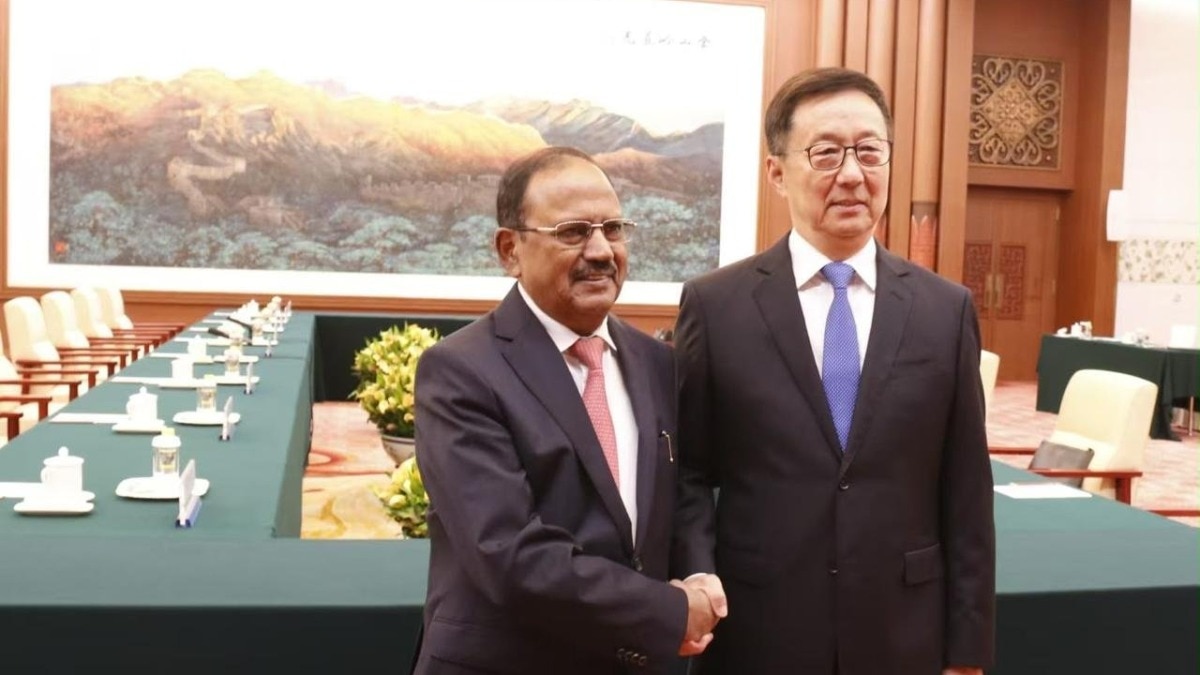
National Security Adviser Ajit Doval and Chinese Foreign Minister Wang Yi on Tuesday held the 25th round of Special Representatives’ talks on the India-China boundary question in Beijing. The meeting came at a critical juncture for bilateral ties amid renewed concerns over Chinese activity along the Arunachal Pradesh frontier.The talks focused on the boundary question, bilateral relations and regional and international developments, as New Delhi and Beijing seek to consolidate a cautious stabilisation in ties following the prolonged military stand-off in eastern Ladakh triggered by the 2020 Galwan Valley clash.Doval, India’s designated Special Representative for the boundary talks, is on a two-day visit to China at the invitation of Wang, his Chinese counterpart in the mechanism.The NSA also met Chinese Vice President Han Zheng, with the two leaders discussing ways to maintain peace and tranquillity along the border and further strengthen bilateral ties across economic, political and multilateral platforms, in line with the consensus reached by the leaders of the two countries. Doval's meetings assume added significance ahead of the BRICS summit in New Delhi on September 12 and 13, where Chinese President Xi Jinping is expected to participate, although Beijing has not yet officially confirmed his visit. A potential meeting between Prime Minister Narendra Modi and Xi on the sidelines of the summit could provide political momentum to efforts to improve bilateral relations.PM Modi and Xi last met in August 2025 on the sidelines of the Shanghai Cooperation Organisation summit in Tianjin.THE ARUNACHAL CONCERN While the disengagement process in eastern Ladakh has helped ease some of the immediate military tensions along the Line of Actual Control (LAC), the broader boundary dispute remains unresolved. Arunachal Pradesh continues to be one of the most sensitive components of the dispute.China claims the entire Indian state, which it refers to as "Zangnan"or southern Tibet. India has consistently rejected the claim, maintaining that Arunachal Pradesh is an integral and inalienable part of the country.The eastern sector has recently gained renewed attention following reports of increased Chinese military activity and aggressive posturing in Arunachal Pradesh’s Upper Subansiri region. The developments have added another layer of complexity to efforts by New Delhi and Beijing to improve bilateral relations.India has repeatedly maintained that peace and tranquillity along the border are fundamental to the wider relationship. External Affairs Minister S Jaishankar reiterated that position ahead of the Doval-Wang meeting.Speaking at the Economic Times World Leaders Forum in New Delhi on Saturday, Jaishankar said the deterioration in ties after 2020 was primarily linked to the situation along the border."I think we went through a particularly bad patch between the summer of 2020 and the autumn of 2024, and that was primarily an outcome of the situation in the border areas," he said, reiterating that peace and tranquillity in the border areas were a prerequisite for stable relations between the two countries.The External Affairs Ministry has also described developments along the border as a matter of the "most serious" concern. The MEA spokesperson, Randhir Jaiswal, also said recently that maintaining peace and tranquillity along the LAC was of "utmost importance", stressing that the situation on the frontier would determine the overall trajectory of India-China relations.Beijing, however, has sought to play down recent reports of heightened activity. Chinese Foreign Ministry spokesperson Guo Jiakun said on August 12 that the situation along the China-India border was "generally stable at the moment", with the two sides maintaining communication through diplomatic and military channels.China has been releasing its own lists of names for locations in the Arunachal since 2017. India has repeatedly dismissed the move as an attempt to reinforce Beijing’s territorial claims through administrative and cartographic measures. The government asserted that assigning alternative names to locations in Indian territory cannot alter their legal or territorial status.New Delhi had recently rejected Beijing's criticism of India's decision to formally identify 27 places and geographical features in Arunachal Pradesh by their standard Indian names.WHAT SPECIAL REPRESENTATIVES MECHANISM MEANSEstablished in 2003, the Special Representatives mechanism is the principal political framework for addressing the India-China boundary question. It was created to explore the broader political parameters of a settlement rather than limit discussions to military or diplomatic channels dealing with immediate friction.The India-China boundary extends approximately 3,488 km and remains disputed across three broad sectors, with significant differences between the two sides over their respective perceptions of the LAC.The mechanism has not produced a final settlement. It has, however, provided a structured channel for senior-level political communication, particularly during periods when tensions along the frontier have threatened to spill over into the wider relationship.Ahead of the meeting, Chinese Foreign Ministry spokesperson Lin Jian described the SR talks as the "main channel" for negotiations between China and India on the boundary question and an important platform for communication on issues of mutual interest. Lin had said Doval and Wang would have an "in-depth discussion" on the boundary question and exchange views on bilateral, regional and international issues.FROM GALWAN TO CAUTIOUS STABILISATIONThe significance of Tuesday’s meeting is rooted in the sharp deterioration in India-China relations following the Galwan Valley clash in eastern Ladakh in June 2020.The clash resulted in fatalities on both sides and triggered one of the most serious military confrontations between India and China in decades. Thousands of troops were subsequently deployed along the LAC, while both countries accelerated infrastructure development and forward military deployments.The stand-off continued for several years and affected virtually every aspect of bilateral relations, including political engagement, trade and people-to-people ties.Since then, New Delhi and Beijing have used military and diplomatic channels to resolve friction points, reduce troop confrontations and prevent further escalation. The disengagement process has gradually created conditions for a limited stabilisation in ties.Tuesday’s talks mark the latest high-level diplomatic engagement as both sides seek to maintain that stabilisation while differences over the boundary remain unresolved.XI JINPING’S POSSIBLE INDIA VISITThe timing of Doval’s visit is also significant because of the possibility of Xi Jinping travelling to New Delhi for the BRICS summit next month.There has been no official confirmation from Beijing on Xi’s participation. Chinese Foreign Ministry spokesperson Lin Jian has also avoided giving a direct response when asked about the expected visit.If Xi attends the summit, it could provide an opportunity for PM Modi and Xi to hold another bilateral meeting and assess the progress made in stabilising relations since their previous summit-level interaction.The Doval-Wang talks could help provide a diplomatic backdrop for such high-level engagement by addressing sensitive areas of disagreement and reinforcing existing understandings on maintaining peace along the LAC.The talks will also test whether the political and diplomatic channels established over the past two decades can continue to contain differences even as strategic competition between the two Asian powers persists.- EndsPublished On: Aug 25, 2026 09:09 IST
Ajit Doval, Chinese Foreign Minister hold key border talks amid Arunachal tensions
Full Article
Original Source
Read the full article at Indiatoday →KhanList aggregates and links to publicly available news content. We do not host full articles from third-party sources. Always verify important information with original sources.