
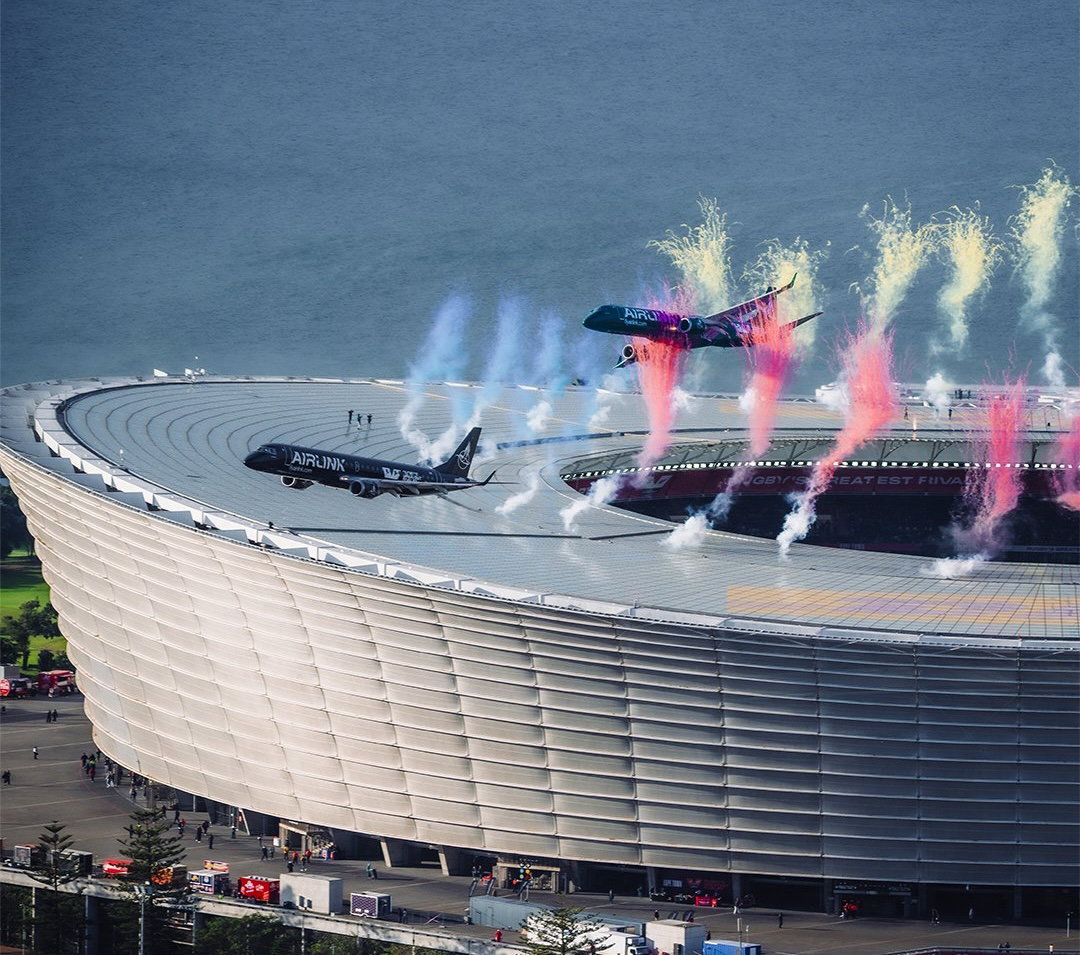
It’s not uncommon to see flyovers at major sporting events, and they can be pretty spectacular to watch. However, a flyover that happened in South Africa yesterday was maybe a little too impressive, to the point that it potentially put a lot of lives at risk. I’m curious what an investigation reveals into who authorized this, and if the plan was actually followed. Airlink Embraer jets overfly Cape Town rugby matchAirlink claims this flyover was authorized and safe… really?!Bottom line Airlink Embraer jets overfly Cape Town rugby match On Saturday, August 29, 2026, there was a rugby match at DHL Stadium in Cape Town, with the South African Springboks playing against the New Zealand All Blacks. Just prior to the start of the game, two Embraer jets belonging to South African carrier Airlink performed a low flyover of the stadium, which was accompanied by fireworks. You might think that official footage is just an optical illusion, but no matter which angle you look at it from, it’s absolutely wild. Flight tracking software suggests that the plane got to an altitude as low as 50 feet, which doesn’t sound quite right, since the stadium has a height of 164 feet. But the plane certainly got to somewhere around 200 feet. Countries have regulators that set the rules that aircraft operators have to follow. In the case of South Africa, the rules are pretty clear. Civil Aviation Regulation 91.06.32(1)(a) states that “an aircraft may not be flown over congested areas or an obvious open-air assembly of persons at a height less than 1,000 feet above the highest obstacle, within a radius of 2,000 feet from the aircraft.” The airline claims this was all carefully rehearsed, and that it received regulatory approval for this. At the same time, that’s a real head scratcher. If true, why would regulators approve something like this, which clearly violates the rules? I’m not trying to be an alarmist here, but no matter how much you practice for something, you need a safety margin. Even the smallest downdraft, or an engine failure due to ingesting a flock of birds, could’ve sent this plane into the stadium. Obviously pilots performing these flyovers assume some level of risk in agreeing to do this, but the thousands of people in the stadium didn’t consent to this. Over the years, we’ve seen a countless number of planes crash during airshows, flyovers, etc. And while we’d like to think that safety margins in the aviation industry have improved, it does seem like some people are really pushing their luck. Just weeks ago we saw a soon to be delivered Qatar Airways Cargo Boeing 777 perform a dangerously low flyover of a Texas airport, and that was also extremely risky. Que raso!Um 777-200LR(F) que está em processo de preparação para entrega para a Qatar foi visto dando esse rasante espetacular sobre o Horseshoe Bay Resort Jet Center, no Texas!Esse foi baixo! pic.twitter.com/btzClzKiU5— Eric Breno ✈️🇧🇷 (@EBaviation) June 25, 2026 Thank goodness this ended okay, but this definitely isn’t a situation you’d want to find yourself in. Bottom line Two Airlink Embraer aircraft performed a low flyover of DHL Stadium in Cape Town, just ahead of the kickoff of a Rugby game. While this is one of the most spectacular flyovers I’ve ever seen, that’s not really a good thing, because this really cut into safety margins. It’s strange, the airline claims it had all the necessary approvals for the flyover. At the same time, the plane traveled well below the minimums that regulators require, and those exist for a reason. No matter how well you plan something, you can never be sure you won’t lose 10-20 feet of altitude, and that could’ve had catastrophic implications here. What do you make of this Airlink flyover in Cape Town?
Airlink’s Dangerously Low Flyover Of DHL Stadium Raises Serious Safety Questions
Full Article
Original Source
Read the full article at Onemileatatime →KhanList aggregates and links to publicly available news content. We do not host full articles from third-party sources. Always verify important information with original sources.