
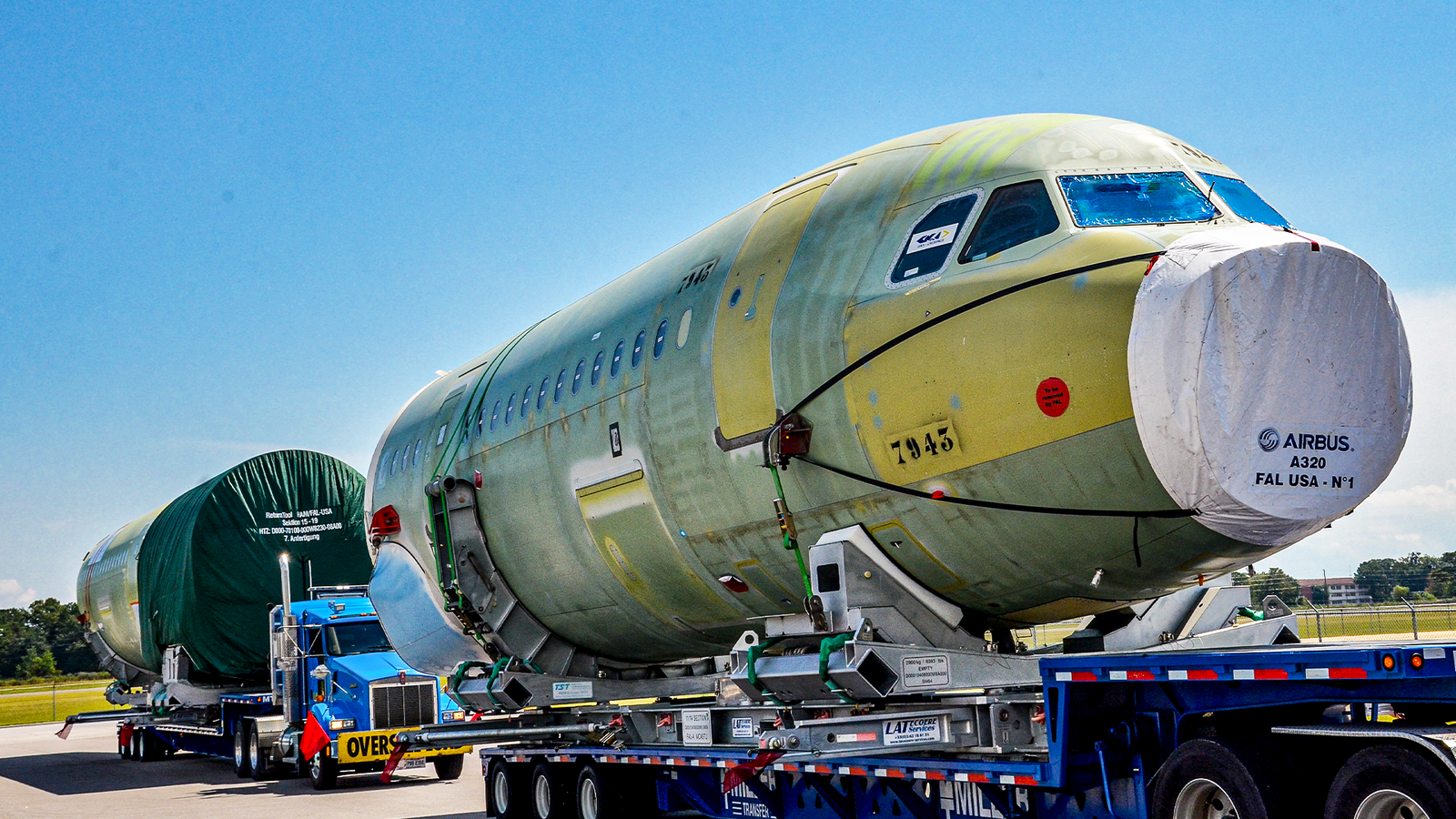
At its manufacturing campus in Mobile, Alabama, Airbus now operates three final assembly lines, two dedicated to the A320 Family and only one building the A220, following the October 13, 2025 inauguration of its second A320 final assembly line. That two-to-one split is a key point of note in the growth of Airbus' Gulf Coast operations, but it also makes many wonder about how the manufacturer balances high-volume single-aisle demand against regional to small narrowbody production on US soil. Why allocate two final assembly lines in Alabama to the A320 Family and keep just one line on the A220? This article looks at how the Mobile site has evolved alongside trade dynamics, global production targets, and American airline orders, demonstrating how Airbus is positioning domestic assembly to serve a massive US backlog and keep tariff and supply-chain risks in check. The Growth Of Airbus In Alabama Credit: Airbus Airbus' manufacturing campus at Mobile Aeroplex at Brookley in Alabama began commercial aircraft assembly in 2015 with a single A320 final assembly line, establishing its first commercial production foothold in the United States. Four years later, in 2019, Airbus added a dedicated A220 final assembly line alongside the existing A320 operation, and the first Mobile-built A220 was delivered to Delta Air Lines in October 2020. That phased buildout expanded the site into a multi-line narrowbody hub before reaching a new milestone on October 13, 2025, when Airbus inaugurated its second A320 final assembly line, bringing the campus to three final assembly lines in total, with two building the A320 Family and one building the A220. The October 2025 expansion added about 350,000 square feet (3,251 square meters) of manufacturing, office, and logistics space along with roughly 1,000 additional jobs, as noted by Made In Alabama. Across the campus, the buildout incorporated more than a million square feet (more than 92,000 square meters) of A320 double-bay hangars and quad-bay hangars dedicated to the A220. With the new A320 line up and ready, the Mobile facility now spans more than 2.5 million square feet (232,257 square meters) and supports a workforce of more than 2,000 employees. Taken together, a decade of additions took that single-line Alabama plant to a large-scale industrial complex capable of housing three distinct final assembly lines under one roof. Having double-bay and quad-bay hangars alongside 2.5 million square feet (232,257 square meters) of operational space gives the site the scale needed to run parallel single-aisle production flows without crowding earlier assembly bays. How The A220 Came To Be Credit: Airbus The existence of an A220 final assembly line in Mobile traces directly back to the 2017 trade dispute in which Boeing filed a complaint against Bombardier over the C Series program, triggering steep proposed US import tariffs on Canadian-built aircraft, as reported by Business Insider. Rather than letting tariff threats shut US customers out of the program, Airbus stepped in to take control of the C Series, later rebranded as the A220, and brought final assembly onto American soil in Alabama. Building A220 airframes domestically gave US carriers a pathway to take delivery without running into cross-border trade barriers. Assembling A220s in Alabama also gave Airbus an industrial hedge alongside its main A220 final assembly line in Mirabel, Quebec, making Mobile and Mirabel the only two final assembly sites for the aircraft type. Even after trade duties were ultimately overturned, locating domestic final assembly in the United States supported the program within a core commercial market and gave a shield to US deliveries from future trade friction. For Airbus, having both Canadian production in Mirabel and an Alabama assembly line quickly became a permanent strategic asset. The existence of US-built A220 capability lets Airbus serve American-based airlines from inside the tariff wall while keeping the program closely integrated across North America. Why Pick The A320 Over The A220? Credit: Airbus Bringing a second A320 final assembly line online in Mobile tilts the site's narrowbody production mix decisively toward the A320 Family, giving Airbus two dedicated A320 lines against a single line for the A220. Ultimately, the A320 Family sits at the core of narrowbody airline fleet plans, so adding a second domestic assembly line expands how many single-aisle aircraft Airbus can finish in the United States and not have to rely solely on overseas final assembly plants. For domestic customers, doubling A320 final assembly capacity in Alabama shortens the logistical path between factory completion and airline entry into service. In a different scenario, airlines would be competing exclusively for overseas build slots or shipping finished narrowbodies across the Atlantic, whereas with this added capacity, customers gain more domestic throughput on a proven aircraft family that is focused on main cabin and short to medium-haul networks. At the same time, running two A320 lines alongside one A220 line reflects clear operational specialization rather than placing equal volume across every aircraft type. Now concentrating twin final assembly lines on the A320 Family in Mobile while keeping A220 final assembly at a single line there, Airbus matches its layout to the much larger commercial scale of A320 Family demand that has been lying overhead. Ramping Up Production Rates Credit: Airbus Globally, Airbus has set its sights on reaching a production rate of 75 A320 Family aircraft per month in 2027, while targeting 14 A220 aircraft per month across its Mobile and Mirabel final assembly network in 2026. Pairing two A320 final assembly lines with a single A220 line in Mobile mirrors how sharply production scale diverges between the two programs. On one hand, the A320 Family carries massive global volume requirements, whereas the A220 ramps up across a smaller single-aisle tier. Pacing a single A220 final assembly line alongside two A320 lines also highlights how industrial delays govern real-world delivery speed. Even when final assembly bays are in the right place, hitting monthly targets depends on keeping major components, such as engines, cabin interiors, and aerostructures, flowing smoothly from global suppliers into each assembly station. Any lag in component deliveries or line-side tooling can slow how quickly a single line or a dual-line setup turns out completed jets. For Airbus' wider manufacturing network, keeping the A220 on one Mobile line while scaling A320 Family output toward rate 75 is an exercise in calibrated pacing. Over-allocating floor space to lower-volume builds would slow down the overall production rate, so instead Airbus paces each program according to its production curve and supply-chain readiness, meaning global delivery commitments stay aligned with factory capacity. Made In The USA Credit: Airbus With more than 850 Airbus aircraft on order for US customers, as per Airbus data, domestic airline demand provides the commercial helping hand behind expanding final assembly capacity in Alabama. American carriers rely heavily on single-aisle jets to refresh aging fleets, grow regional and mainline networks, and support long-term fleet modernization across both major network airlines and low-cost operators. Having deep domestic order books gives Airbus strong visibility into steady US delivery pull over the coming years. Against that backdrop, Airbus' bigger ambition is for US carriers' narrowbodies to eventually come from Mobile and not still be reliant on imported airframes. Aligning Alabama final assembly with American airline demand brings production closer to the end customer, helping streamline handovers, acceptance flights, and customer support across the United States. Even with only one line dedicated to the A220 alongside two A320 Family lines, domestic assembly positions Mobile as the centerpiece of Airbus' US narrowbody delivery strategy. Turning that long-term goal into everyday reality still depends on matching build mix and slot availability to what US airlines actually need next. Because carrier order books span multiple single-aisle sizes and delivery windows, Mobile's configuration plays a central role in how quickly Airbus can turn US backlog commitments into active aircraft on American flight lines. From Humble Beginnings To True Ambition Mobile was once just a single-line narrowbody operation, and now, it has evolved into a deliberate two-to-one industrial split. Two A320 Family final assembly lines alongside one A220 line are designed to balance high-volume single-aisle scale with tariff-resilient domestic flexibility. Now committing its A220 production in Alabama after the 2017 trade dispute and expanding A320 assembly capacity in October 2025, Airbus has positioned its Gulf Coast campus to serve United States airline demand closer to home while keeping supply-chain pacing and cabin brand expectations aligned. Looking ahead, the clearest benchmark for this strategy is how Mobile and the wider manufacturing network work together through the end of 2027, when Airbus aims to reach a monthly production rate of 70 to 75 A320 Family aircraft and stabilize at a rate of 75 alongside its ongoing A220 ramp-up and domestic backlog deliveries. Hitting those volume milestones and not straining supplier flow or sacrificing cabin consistency will show whether a two-line A320 and one-line A220 footprint in Alabama becomes the status quo going forward for Airbus' next decade in the United States.
Airbus Now Has 3 Final Assembly Lines In Alabama & Only One Of Them Builds A220s
Full Article
Original Source
Read the full article at Simpleflying →KhanList aggregates and links to publicly available news content. We do not host full articles from third-party sources. Always verify important information with original sources.