
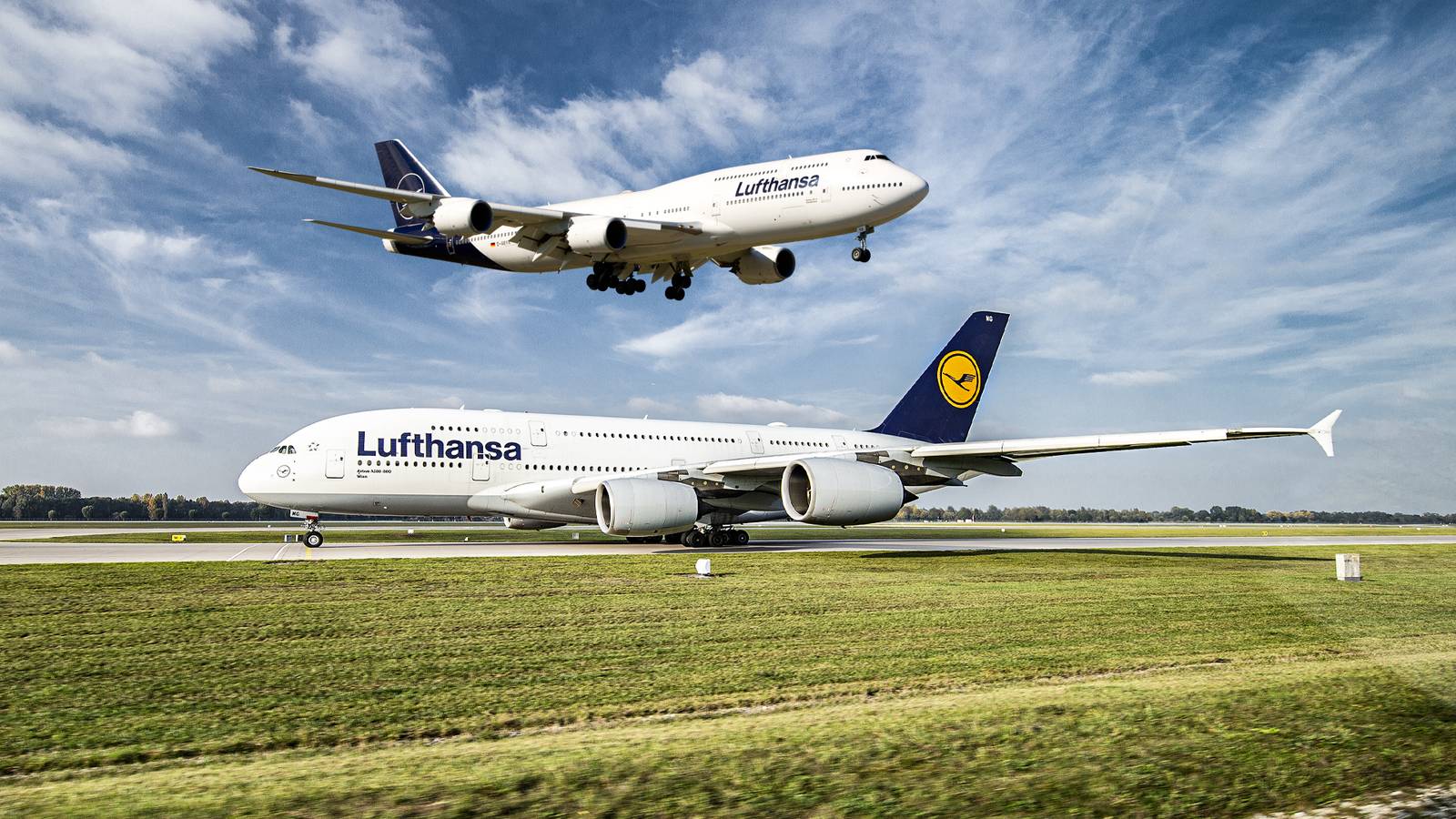
Published Oct 8, 2026, 12:42 PM EDT Writer - Patricia joins Simple Flying with over 20 years of experience in aviation. She has served as cabin crew on flights from economy-class through to first-class and on private jets as well as being head of cabin crew and cabin safety focal point. Patricia has a master's level postgraduate diploma in Human Factors in Aviation and has written about aviation since 2010. Based in Dubai/Cyprus. Both the Airbus A380 and the Boeing 747-8 are huge commercial airliners that require a large team of cabin crew in order to operate safely and provide service. Although both have a lower and upper deck, the 747's upper deck is much smaller and more compact than the A380's full upper deck. Which aircraft legally demands more flight attendants? The number of flight attendants on commercial aircraft is determined by a number of factors. These include aircraft certification, capacity, the number of emergency exits, and rules set by agencies like the Federal Aviation Administration (FAA) and the European Union Aviation Safety Agency (EASA). A common rule is one flight attendant for every 50 seats. In addition, each floor-level emergency exit must have a crew member assigned to it. The A380 Has More Flight Attendants Credit: Valentina Kornilova | Shutterstock The Airbus A380 requires more flight attendants than the Boeing 747-8, both at the legal minimum and in terms of the airline's service. The main factors are the A380's larger cabin and having more emergency exits than the 747-8. It has 16 floor-level emergency exits: eight on each side of the aircraft. Ten exits are on the main deck (five on each side), and there are six on the upper deck (three on each side). All 16 exits are large, floor-level Type-A emergency doors equipped with dual inflatable escape slides. Airbus says that this is because safety regulations require at least one flight attendant per floor-level exit; the 16 doors establish a baseline minimum crew requirement for the aircraft. An Airbus A380 typically carries between 20 and 26 flight attendants on a standard commercial flight. Because of its immense size and double-deck design, it requires a larger crew than any other airliner in the world. The exact number depends on the airline, the flight duration, and the class configuration. For airlines operating at maximum capacity, high-density layouts (up to 853 passengers) require regulators to mandate at least 18 flight attendants to ensure the entire aircraft can be evacuated in under 90 seconds. Two crew members, although not responsible for an exit, are stationed by the stairwell in case of evacuation. Crew Complement For The 747-8 Credit: Ceri Breeze | Shutterstock In comparison, the Boeing 747-8 has ten full-size emergency exit doors on the main deck and two doors on the upper deck. The main exit doors are Type A doors, and the upper-deck exits are certified as Type I doors that operate differently from the other doors. The legal minimum number of flight attendants required to operate a passenger Boeing 747-8 is 10 to 13, depending on the configuration, but in actual airline operations, more crew are carried. The exact number of flight attendants carried depends strictly on safety regulations, the airline's specific seating configuration, and the length of the flight route. Under EASA and international standards, the exact minimum number is established during the aircraft's emergency evacuation demonstration and type certification process for each operator's unique layout. While short-range or lower-density configurations can sometimes operate with a baseline minimum of ten crew, higher-density layouts or long-haul configurations requiring relief crews or augmented crew to cover crew rest often scale up to 13, 15, or more flight attendants. Aviation safety regulations (such as the FAA rule of one flight attendant per 50 passenger seats) require at least nine or ten flight attendants on a standard 747 configuration, but standard practice is to carry 13 or 14 flight attendants. Rules And Regulations Credit: Sergey Kohl | Shutterstock Aviation authorities such as the FAA and EASA calculate the required number of flight attendants using the following rules. Under FAA (14 CFR Part 121.391) and EASA regulations, airlines must staff at least one flight attendant for every 50 installed passenger seats (regardless of how many passengers are actually on board). For wide-body aircraft, regulations require at least one flight attendant to be positioned per emergency exit. Both Australia and Canada have lower crew-to-seat ratios: 36 seats and 40 seats, respectively. Because the 747-8 features 12 emergency exit doors, a baseline safety crew of 12 is required just to cover evacuation points. If an older variant does not have a hard number specified in its type certificate, EASA defaults to one flight attendant for every 50 (or fraction of 50) passenger seats installed on the same deck. So if a Boeing 747-8 has 467 passenger seats, ten flight attendants are required as a minimum, but more are typically carried. EASA regulations say the Airbus A380's maximum load is 853 passengers and requires a minimum of 18 flight attendants. EASA (based on a full economy configuration) states that there should be a minimum of eleven flight attendants on the main deck and seven on the upper deck. On average, the A380 has between 20 and 25 flight attendants. A Comparison Credit: M101Studio | Shutterstock In theory, a Boeing 747 would have a minimum of ten crew, while an A380 would have a minimum of 16 crew, although legal minimum complements are set during initial aircraft certification and then approved or modified by the national aviation authority. In general, airlines staff well above the minimum on long-haul routes, as this also has to cover augmented crew to cover rest periods and still have enough crew to evacuate the aircraft safely or deal with any emergency. Emirates usually operates the A380 with 24 flight attendants and two cabin assistants. The latter are not trained flight attendants and cannot perform safety duties but look after the onboard shower spas. Qantas operates its A380 with 21 cabin crew, more than double an average-sized jet. British Airways operates the A380 with 20 flight attendants. Singapore Airlines operates the aircraft with between 22 to 26 flight attendants depending on the configuration. Lufthansa is the one airline that operates both types of aircraft, and it is reducing its A380 crew from 21 to 20 flight attendants. Its 747-8 is a much smaller operation, with up to 364 seats across four travel classes. Staffing on the older jumbo has historically run in the high teens: on Cathay Pacific's 747-400, crews flew with 17 or 18 flight attendants on a 398-seat aircraft. Larger Aircraft Out Of Favor Credit: Parkdolly | Shutterstock The A380 was popular with passengers and crew alike because it was the only true double-decker aircraft. However, post-pandemic, as the airline industry struggled to recover, the aircraft became less popular with airlines. Air France, China Southern and Malaysia Airlines all phased out their A380 fleets due to high operating costs. Emirates, British Airways, Singapore Airlines, and Lufthansa still operate the A380. The iconic 747, known as the "Queen of the Skies," was very popular and is sadly missed by many. Almost all commercial airlines retired their 747 fleets post-pandemic, replacing the aircraft with more fuel-efficient twinjets. The last 747 produced went to cargo operator Atlas Air. Lufthansa, Air China, Korean Air and Rossiya Airlines continue to operate the Boeing 747. It seems that, post-pandemic, these larger aircraft types fell out of favor, and both ceased production. Airbus ceased production of the A380 in December 2021, and Boeing ceased production of the 747-8 in early 2023. Airlines dropped them for the newer Airbus A350 and the Boeing 777X (although the 777X still faces production delays), which are more fuel-efficient and less expensive to maintain. Key Takeaways Credit: ODEN Daniel | Shutterstock Both the Boeing 747-8 and the Airbus A380 were the largest commercial aircraft of their time and required a large team of flight attendants to operate them. To work out the number of flight attendants onboard, many regulators use the rule of one flight attendant per emergency exit. Another rule is the ratio of one flight attendant per 50 passenger seats and does not apply to the actual number of passengers onboard. Some regulators use aircraft type certification and evacuation tests to determine how many crew members are carried. All aircraft must undergo evacuation certification tests to prove they can be evacuated in under 90 seconds, with half of the evacuation routes unavailable. Manufacturers are required to prove that all passengers can exit in a simulated emergency with smoke, dimmed lighting, and obstacles such as baggage. When the Airbus A380 was tested, 853 'passengers', 18 flight attendants, and two pilots evacuated in 78 seconds using eight exits, therefore meeting the 90-second requirement. Most airlines have retired their 747 and A380 fleets because of operating costs and the shift to newer, more fuel-efficient aircraft. Just a handful of airlines still operate these iconic aircraft. The A380 usually carries between 20 and 24 flight attendants, whereas the 747 has 12 to 14 flight attendants on average, around half of that of the A380. Usually, more crew are carried than the minimum required to ensure fast evacuation if needed, but also for efficient service as well as to cover crew rest periods.
Airbus A380 Or Boeing 747-8: Which Aircraft Legally Demands More Flight Attendants?
Full Article
Original Source
Read the full article at Simpleflying →KhanList aggregates and links to publicly available news content. We do not host full articles from third-party sources. Always verify important information with original sources.