
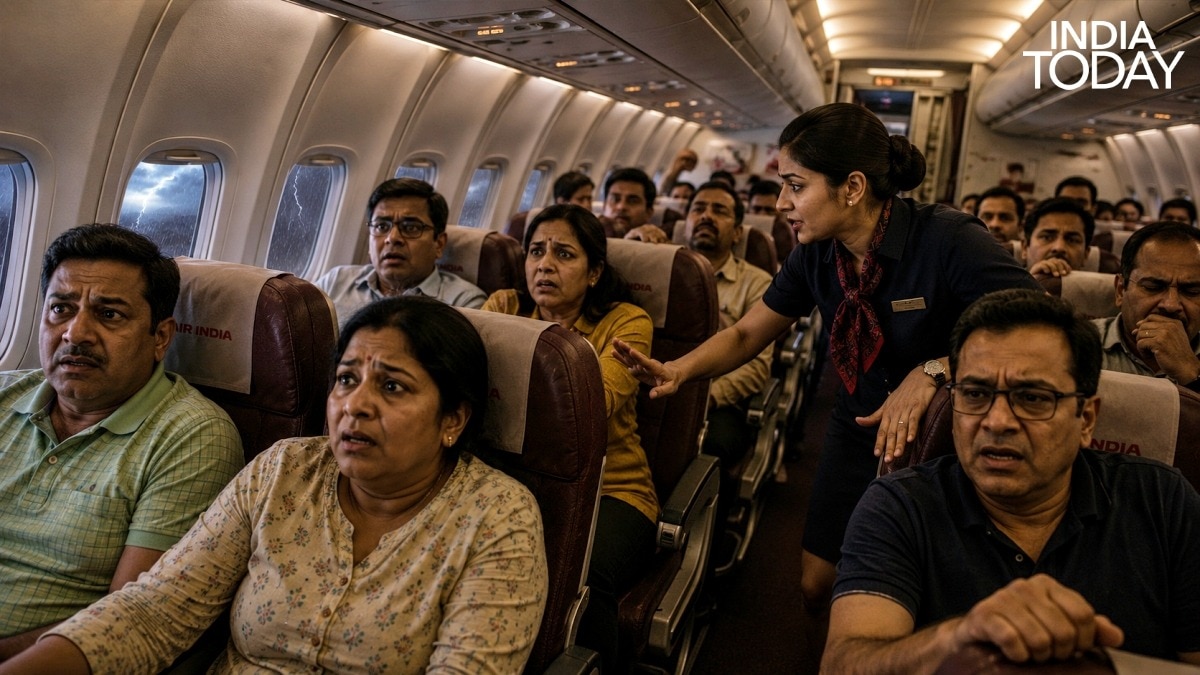
An Air India flight from Phuket to Delhi dropped around 300 feet in severe turbulence, injuring at least 14 people. The incident has renewed focus on research linking climate change to more frequent and intense turbulence.Turbulence is the irregular movement of air that causes an aircraft to shake, jolt, or suddenly change altitude. (Photo: Generative AI by India Today)An Air India flight from Phuket to Delhi encountered severe turbulence on Tuesday, suddenly dropping around 300 feet mid-flight and leaving at least 14 passengers and cabin crew members injured.While the injuries were not believed to be life-threatening, the incident has once again drawn attention to a growing concern in aviation: the increasing frequency and intensity of turbulence in a warming world.We first need to understand what turbulence is.WHAT IS AIR TURBULENCE?Turbulence is the irregular movement of air that causes an aircraft to shake, jolt, or suddenly change altitude during flight. It occurs when planes pass through unstable air created by factors such as thunderstorms, strong winds, jet streams, mountain ranges, or rapid changes in air temperature and pressure. Modern aircraft are engineered to withstand even severe turbulence. Turbulence ranges from light bumps to severe jolts that can briefly affect an aircraft's altitude and injure unrestrained passengers. One of the most dangerous forms is clear-air turbulence, which occurs in cloudless skies and is difficult to detect with weather radar, making it especially challenging for pilots to avoid.Most encounters are mild, but severe turbulence can result in abrupt altitude changes, causing injuries to passengers and crew who are not securely fastened in their seats.WHAT IS CLEAR AIR TURBULENCE?Among the most dangerous forms is clear-air turbulence (CAT), which occurs above 15,000 feet in cloudless skies.Air India: Phuket - Delhi, 04.08.2026.The worst two hours of my life. Please, please, please always wear your seatbelt on a plane, even when the seatbelt sign is off.I saw people being thrown into the air, hitting their heads, and getting injured. For a while, I genuinely pic.twitter.com/3bVjcZZ18g— Minchen (@minchen_t) August 4, 2026Unlike turbulence associated with storms, CAT is virtually invisible and cannot be detected by conventional weather radar or seen by pilots, making it particularly hazardous.The sudden nature of CAT means airlines often have little warning before an aircraft is jolted.HOW IS CLIMATE CHANGE MAKING FLIGHTS BUMPIER?Scientists say climate change is making this invisible threat worse.A landmark 2023 study by researchers from the University of Reading and the UK Met Office found that severe clear-air turbulence over the North Atlantic increased by more than 55 per cent between 1979 and 2020.Another study in 2025 confirmed that the atmosphere will become more turbulent in future decades as climate change makes the air less stable."Pilots may need to keep seatbelt signs on longer and suspend cabin service more often during flights, but airlines will also need new technology to spot turbulence before it hits, protecting passengers as skies become more chaotic," Professor Paul Williams, co-author of the paper published in the Journal of the Atmospheric Sciences, noted.The researchers attributed the rise to global warming, which is strengthening jet streams, the fast-moving air currents that play a major role in generating turbulence.The study concluded that severe turbulence is increasing faster than light or moderate turbulence and is likely to become even more common as the climate continues to warm.Another study by researchers at Seoul National University found that climate change is not only intensifying clear-air turbulence but also mountain-wave and near-cloud turbulence, suggesting that aircraft could face bumpier skies across a wider range of conditions in the future.ARE AIRCRAFT READY TO HANDLE INCREASING TURBULENCE?Modern aircraft are engineered to withstand even severe turbulence, and advances in weather forecasting, atmospheric modelling, and pilot training continue to improve aviation safety.However, regulators and airlines stress that the simplest protection for passengers remains keeping seatbelts fastened throughout the flight, even when the seatbelt sign is off.Following previous turbulence-related incidents, several airlines have revised cabin procedures, including suspending meal service during turbulence and ensuring cabin crew remain seated whenever possible.- EndsPublished By: Sibu Kumar TripathiPublished On: Aug 7, 2026 11:42 IST
Air India incident: Why mid-air turbulence is becoming frequent and violent
Full Article
Original Source
Read the full article at Indiatoday →KhanList aggregates and links to publicly available news content. We do not host full articles from third-party sources. Always verify important information with original sources.