
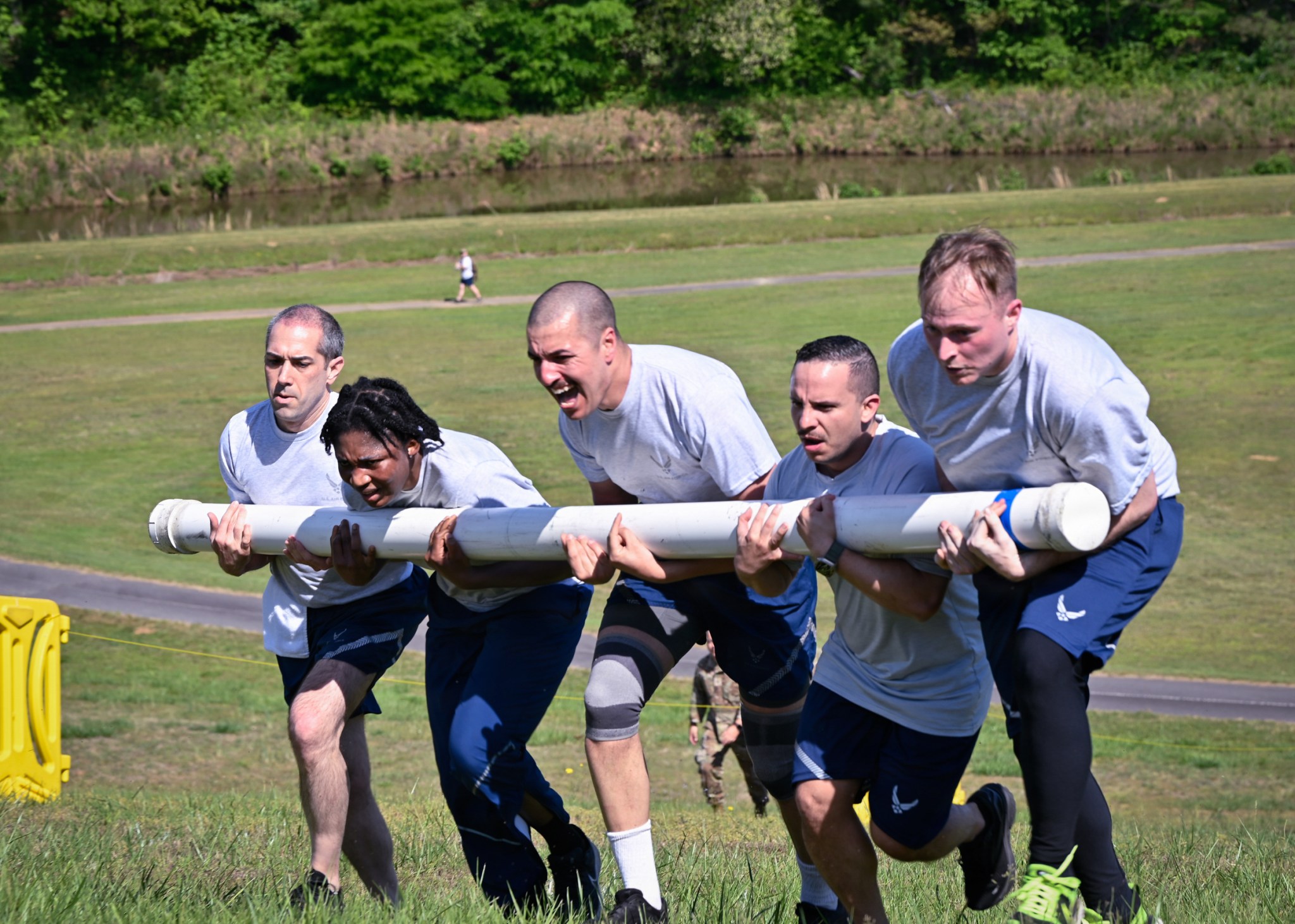
The three-star general overseeing training for the Air Force and Space Force said Monday that he’s serious about getting newly trained airmen to emulate the culture of another service: the Marine Corps. In a wide-ranging discussion hosted by The Mitchell Institute for Aerospace Studies, Lt. Gen. Clark Quinn called an identity shift his top command priority. “If you find a Marine, where they’re active-duty, retired, doesn’t matter, and you ask them, ‘Hey, what do you do?’ Their answer is, ‘I’m a Marine,’” Quinn said. If you ask the same of an airman, he added, you’re more likely to hear him or her identify by their specific career field. “Part of what we are trying to do in forging airmen is to get that fundamental underpinning that is, what does it mean to be an airman,” he said. “I don’t know that by the end of my time here, an airman is going to go, ‘I’m an airman,’ but that’s the mentality that we’re trying to drive into it.” The Air Force has been emphasizing its cultural identity – what service members sometimes call “airmindedness” – in other ways. A Basic Military Training overhaul currently underway gives the most junior trainees the opportunity, for example, to load and rearm an F-16 Fighting Falcon, emphasizing every airman’s role in providing airpower to the joint force. In a September interview, officers leading that effort told Military Times that the added intensity and hands-on learning was making trainees more curious about combat scenarios and prompting them to think critically and independently about their training. While it’s not a further effort to emulate the Marines, Quinn also said he’s looking for ways to make airmen more physically and mentally fit so they can better handle the chaos of being in a cockpit, or simply supporting combat operations in any role. He said he wants to build a holistic human performance curriculum called Comprehensive Readiness for Aircrew Flying Training, or CRAFT, into training pipelines for all airmen. Used at most flight training locations, CRAFT includes up to 103 hours of human performance instruction and helps students solve complex problems and manage stress, while also preventing future injuries. “What I really like about it is, it’s not just fitness; it is using your whole brain while being fit,” Quinn said. “If you have a very simple fuel calculation: I’m going to fly for 10 minutes; I’m going to do 100 pounds of fuel. Just sitting here, you or I or a lieutenant could answer that really quickly. If I ask you that same question after you do 10 burpees, or after a fire alarm is going off in the background, and still expect you to get that answer correct, the likelihood of you getting it correct is a lot lower.” Quinn called building CRAFT curriculum into existing training pipelines “relatively easy,” though he didn’t provide a timeline for making the change. The move contrasts in some ways with another training adaptation he said he wanted to make: accounting for the Gen-Z airmen trainees who’ve had access to smartphones their entire lives and making their educational resources smarter and more intuitive. “Some of this is pretty minor, but we’re not issuing you stacks of books anymore; we’re issuing an iPad that has those stacks of books on it,” Quinn said. “What I like to think about is, what goes onto that iPad and how can we make you smarter.” AI integrations, he said, could ask airmen questions as they read material and recognize deficiencies based on their responses. Then, he said, it could propose other readings to augment their learning and help them to make up any knowledge deficiencies before guiding them back to their assignment. “That’s something that can be done without an instructor watching you; that’s just the system making you smarter,” he said. “It doesn’t detract from the importance of the instructor. That did not replace an instructor. It just allows the instructor to teach and instruct at a different level, assuming that [students are] coming in having read and understood things.”
Air Force training chief’s No. 1 priority: be more like the Marines
Full Article
Original Source
Read the full article at Militarytimes →KhanList aggregates and links to publicly available news content. We do not host full articles from third-party sources. Always verify important information with original sources.